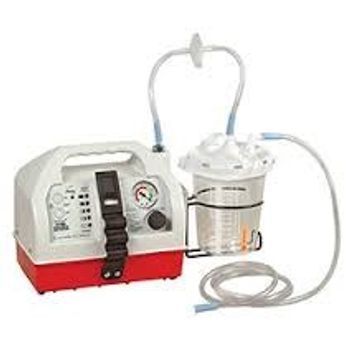
Allied Healthcare Products OptiVac AC/DC Portable Suction Unit
 Allied Healthcare Products · Model OptiVac AC/DC Portable Suction Unit
3 hours run time at maximum vacuum on a fully-charged battery. 1 hour run time after just 2 hours of charging. AC or DC operation … ready when you are, 24/7. 25-550 mm Hg vacuum range, coupled with greater than 30 lpm flow at open flow, provides powerful suction for faster aspiration. Fully chargeable in 8 hours. Will run at full performance on AC power even with a depleted battery. Battery maintenance system keeps the battery fully charged but not over-charged. Long-life internal rechargeable battery eliminates the need for frequent replacement. Sealed water-resistant unit is easy to clean, and minimizes potential contamination or damage to the compressor and battery. Angled control panel for easy viewing. Impact-resistant and durable. 3-year warranty on the unit, 1 year on the battery.
Key tips
- ·Always leak-test under load - a regulator that reads correctly at rest can still leak and fail in real use.
- ·Canister and tubing changes are an infection-control issue as much as a mechanical one.
Typical Failure Modes
Compiled for this model from its own documentation and established engineering knowledge for this equipment class - not from a verified service record. Confirm against the manufacturer's service manual.
Low or no suction
HighSymptoms: Weak or no vacuum at the patient port, slow to pull down, will not reach rated vacuum.
Root cause: Worn pump diaphragm / vanes, an air leak in the lid / tubing / overflow float, or a blocked filter.
Overflow / hydrophobic-filter blockage
MediumSymptoms: Suction drops suddenly, fluid near the pump, filter wet.
Root cause: Overflow shut-off triggered or a saturated / clogged bacteria filter.
Motor / pump fault
MediumSymptoms: Pump noisy, hot, runs slow, or trips its thermal cut-out.
Root cause: Worn motor bearings or pump head.
Battery will not hold charge (portable)
MediumSymptoms: Short run time, will not power on off mains.
Root cause: Aged battery.
Vacuum gauge / regulator fault
LowSymptoms: Gauge inaccurate or vacuum will not regulate.
Root cause: Gauge or regulator wear.
Serviceable Parts & Consumables
Serviceable items for this model, compiled from its documentation and engineering knowledge for this equipment class. Service class and relative cost are estimates, not manufacturer figures; no part numbers are given. Confirm intervals and pricing against the manufacturer.
Pump diaphragm / vane kit
Class Periodic replacementRel. cost $$R&R Moderate
Hydrophobic / bacteria filter
Class ConsumableRel. cost $R&R Easy
Collection-jar lid seals & float
Class Frequent wear itemRel. cost $R&R Easy
Motor / pump head
Class Major service partRel. cost $$$R&R Difficult
Battery (portable)
Class Periodic replacementRel. cost $$R&R Fairly easy
| Part | Service class | Relative cost | R&R difficulty |
|---|---|---|---|
| Pump diaphragm / vane kit | Periodic replacement | $$ | Moderate |
| Hydrophobic / bacteria filter | Consumable | $ | Easy |
| Collection-jar lid seals & float | Frequent wear item | $ | Easy |
| Motor / pump head | Major service part | $$$ | Difficult |
| Battery (portable) | Periodic replacement | $$ | Fairly easy |
Relative cost: $ lowest · $$$$ highest service-part cost for this equipment class. Not a price.
PM Checklist
Preventive-maintenance tasks typical of this equipment class. Perform to the manufacturer's procedure and your facility's policy - this is general reference, not a schedule for this specific unit.
- ·Regulator calibration and leak check
- ·Canister / tubing replacement
- ·Annual full PM
Troubleshooting Approach
A starting sequence for this model, compiled from its documentation and engineering knowledge for this equipment class. Follow the manufacturer's service documentation for the actual procedure.
Symptom: Low or no suction
- Fit a fresh bacteria / hydrophobic filter and confirm the collection-jar lid and seals are intact and seated.
- Cap the patient port and measure the vacuum the pump can pull against a gauge.
- Check the tubing and the overflow float for leaks or a stuck shut-off.
- Rebuild the pump with the diaphragm / vane kit.
- Re-verify the rated vacuum and flow.
Symptom: Suction drops suddenly / fluid near the pump
- Check the overflow shut-off has not triggered and the float is free.
- Replace a saturated hydrophobic / bacteria filter.
- Inspect the jar and lid for a crack.
- Dry out any fluid that reached the pump and check the diaphragm.
- Confirm the overflow protection works before returning to service.
Symptom: Pump noisy / hot / trips its thermal cut-out
- Inspect the pump head and motor for wear.
- Confirm the cooling path is clear.
- Rebuild or replace the pump head.
- Check the regulator and gauge.
- Verify vacuum, flow and noise level after repair.
Symptom: Vacuum will not regulate / gauge inaccurate
- Compare the gauge to a calibrated reference at several set points.
- Rebuild the regulator with the diaphragm / valve kit.
- Check the DISS / wall connector seals.
- Replace a damaged gauge.
- Re-verify regulation across the range.
Technical Specs
- Height
- 9.4 in
- Length
- 7.5 in
- Weight
- 11.4 lbs
- Width
- 16.8 in
Typical Location
Where this class of equipment is typically deployed - general reference, not this unit's own placement record.
- Operating Room
- Emergency Department
- Patient floors (wall suction regulators)
- Central vacuum plant
Documents & Manuals
Troubleshoot this device with Bio
Describe a symptom or error code. Bio answers from this device's own documented error codes, failure modes, parts, and guides.
Ask Bio