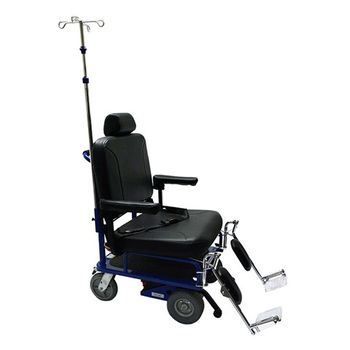
Alco Attendant-Driven Powerchair 700
 Alco · Model Attendant-Driven Powerchair 700
Folding & removable armrests & swing-out footrests provide easy side or front loading of patient Rear locking anti-tip casters & front holding brake prevent movement of chair during loading Small footprint allows tight turning radius to easily navigate hallways & into elevators User friendly controls. Programmable upper speed limit & infinite forward/reverse speed control Dual hand controls with “Automatic Neutral” & variable speed throttle Seat belt or optional shoulder harness configurations Standard I.V. pole & optional articulating-arm I.V. pump/pole arm to increase safety & eliminate need for second caregiver during transfer Warning horn 1.8 cubic feet of cargo space for belongings or medical gear Belly bump stop for attendant safety Sealed maintenance-free batteries with advanced solid state charging system Non-marking, maintenance-free tires Direct drive, regenerative PWM control, provides smooth & quiet operation Totally enclosed, maintenance-free transaxle drive 200+ trained service technicians across North America should service ever be required.
Key tips
- ·Casters and the wheel-lock brake take the most day-to-day wear - check both every PM, not just on complaint.
- ·A cracked weld or loose frame joint is a safety-critical finding - pull the unit from service until it's repaired.
Typical Failure Modes
Compiled for this model from its own documentation and established engineering knowledge for this equipment class - not from a verified service record. Confirm against the manufacturer's service manual.
Will not drive / drives weakly or cuts out
HighSymptoms: No movement, jerky drive, cuts out on inclines, drive-fault flash code.
Root cause: Discharged or aged batteries, a motor / brake fault, a joystick fault, or a controller fault.
Battery will not hold charge
HighSymptoms: Short range, will not reach full charge, sudden shutdown.
Root cause: Aged battery pack or a charger fault.
Joystick / control-module fault
MediumSymptoms: Drifts, no response, error code, will not power on.
Root cause: Worn joystick gimbal or a control-module fault.
Motor / gearbox / brake fault
MediumSymptoms: One side weak, grinding, freewheel lever ineffective, park brake will not hold.
Root cause: Worn motor brushes / gearbox or an electromagnetic-brake fault.
Powered seat-function fault (tilt / recline / elevate)
LowSymptoms: A seat actuator will not move or hold.
Root cause: Linear actuator or its switch / control.
Serviceable Parts & Consumables
Serviceable items for this model, compiled from its documentation and engineering knowledge for this equipment class. Service class and relative cost are estimates, not manufacturer figures; no part numbers are given. Confirm intervals and pricing against the manufacturer.
Battery pack
Class Frequent wear itemRel. cost $$R&R Fairly easy
Joystick / control module
Class Periodic replacementRel. cost $$$R&R Moderate
Drive motor / gearbox
Class Major service partRel. cost $$$R&R Difficult
Electromagnetic brake
Class Major service partRel. cost $$R&R Moderate
Seat actuator (tilt / recline)
Class Major service partRel. cost $$R&R Moderate
| Part | Service class | Relative cost | R&R difficulty |
|---|---|---|---|
| Battery pack | Frequent wear item | $$ | Fairly easy |
| Joystick / control module | Periodic replacement | $$$ | Moderate |
| Drive motor / gearbox | Major service part | $$$ | Difficult |
| Electromagnetic brake | Major service part | $$ | Moderate |
| Seat actuator (tilt / recline) | Major service part | $$ | Moderate |
Relative cost: $ lowest · $$$$ highest service-part cost for this equipment class. Not a price.
PM Checklist
Preventive-maintenance tasks typical of this equipment class. Perform to the manufacturer's procedure and your facility's policy - this is general reference, not a schedule for this specific unit.
- ·Caster / wheel and brake function check
- ·Frame, weld, and mounting-hardware inspection
- ·Upholstery / surface condition check
- ·Annual full PM
Troubleshooting Approach
A starting sequence for this model, compiled from its documentation and engineering knowledge for this equipment class. Follow the manufacturer's service documentation for the actual procedure.
Symptom: Will not drive or cuts out
- Confirm the batteries are charged and the freewheel levers are engaged for drive.
- Read the controller flash / fault code.
- Check the joystick centres and the motor connectors.
- Load-test or replace the batteries.
- Replace the joystick or controller as the code / testing indicates.
Symptom: Short range / poor battery
- Charge fully and check the charger output.
- Load-test the battery pack.
- Inspect for corroded terminals or a chafed loom.
- Replace the battery pack (both batteries together).
- Confirm range and hill-climb after replacement.
Technical Specs
- Height
- 23 inches back support hight
- Length
- 47.2 inches overall with footrests
- Weight
- 226 lbs shipping weight
- Patient Weight Capacity
- 750 lbs
- Width
- 34 inches overall with armrests
Typical Location
Where this class of equipment is typically deployed - general reference, not this unit's own placement record.
- Ambulance / transport vehicles
- Emergency Department
- Inter-facility transport teams
Documents & Manuals
Troubleshoot this device with Bio
Describe a symptom or error code. Bio answers from this device's own documented error codes, failure modes, parts, and guides.
Ask Bio