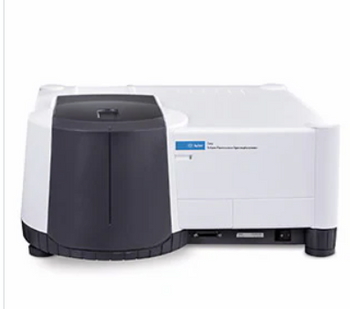
Agilent Technologies Cary Eclipse Fluorescence
 Agilent Technologies · Model Cary Eclipse Fluorescence
Flexible fluorescence spectrometer with multiple data collection modes including fluorescence, phosphorescence, chemiluminescence, bioluminescence, and time resolved phosphorescence. Robust and reliable performance, backed up by a 10-year lamp life guarantee (for new Cary Eclipse fluorescence spectrometer systems purchased from Agilent or participating partners). Low cost-of-ownership due to the guaranteed long lifetime of the Cary Eclipse fluorometer lamp. This also eliminates the need for lamp replacements, a time-consuming and hazardous waste-producing technical operation. Easy-to-use Cary WinFLR software suitable for novice and expert users alike. Easily switch between measurement modes without touching the hardware, and quickly get reliable, accurate results. Room light immunity provided by the unique design of the Cary Eclipse fluorescence spectrometer allows the instrument to operate with the front and top panels removed - for easy access to samples and fast installation of large accessories, expanding analytical capabilities. Performance and sensitivity that you need right across the fluorescence spectrum due to high-sensitivity optics and detectors. High throughput laboratories and fast kinetics applications are well suited to the Cary Eclipse fluorometer, as its xenon flash lamp allows the instrument to capture a data point every 12.5 ms, and scan at 24,000 nm/min without peak shifts. Sampling flexibility enables a wide range of fluorescence applications, with accessories available for every sample type - liquids, solids, and powders. Polarizers and temperature control are also available. Inherent protection from photodegradation, as the Cary Eclipse fluorometer only illuminates the sample when data is actually being acquired. This protects your valuable samples so you can measure them repeatedly and get the same, reliable results.
Typical Failure Modes
Compiled for this model from its own documentation and established engineering knowledge for this equipment class - not from a verified service record. Confirm against the manufacturer's service manual.
Low signal / high noise
HighSymptoms: Weak fluorescence signal, noisy spectra, poor signal-to-noise.
Root cause: Xenon flash lamp at end of life, dirty sample-compartment optics, or a PMT / detector fault.
Baseline / lamp-flash instability
MediumSymptoms: Baseline drift or ripple, inconsistent replicate scans.
Root cause: Aging xenon flash lamp or its power supply.
Wavelength (excitation / emission) accuracy off
MediumSymptoms: Known standard peaks shifted.
Root cause: Monochromator drive calibration on the excitation or emission side.
PC communication fault
LowSymptoms: Cary Eclipse software will not connect or control the instrument.
Root cause: Interface cable, port, or driver.
Serviceable Parts & Consumables
Serviceable items for this model, compiled from its documentation and engineering knowledge for this equipment class. Service class and relative cost are estimates, not manufacturer figures; no part numbers are given. Confirm intervals and pricing against the manufacturer.
Xenon flash lamp
Class Periodic replacementRel. cost $$$R&R Moderate
Sample-compartment optics / cell holder
Class Major service partRel. cost $$R&R Moderate
PMT / detector module
Class Major service partRel. cost $$$$R&R Difficult
Communication cable
Class Periodic replacementRel. cost $R&R Easy
| Part | Service class | Relative cost | R&R difficulty |
|---|---|---|---|
| Xenon flash lamp | Periodic replacement | $$$ | Moderate |
| Sample-compartment optics / cell holder | Major service part | $$ | Moderate |
| PMT / detector module | Major service part | $$$$ | Difficult |
| Communication cable | Periodic replacement | $ | Easy |
Relative cost: $ lowest · $$$$ highest service-part cost for this equipment class. Not a price.
Troubleshooting Approach
A starting sequence for this model, compiled from its documentation and engineering knowledge for this equipment class. Follow the manufacturer's service documentation for the actual procedure.
Symptom: Low signal / high noise
- Run the instrument performance test.
- Replace the xenon flash lamp if energy is low.
- Clean the sample-compartment optics and cell holder.
- Check the PMT voltage / gain settings for the method.
- Re-run a fluorescence standard.
Symptom: Wavelength check fails
- Scan a known emission standard (e.g. a rare-earth solution).
- Compare peak positions to reference values.
- Recalibrate the excitation and emission monochromators per the manual.
- Re-verify.
- Refer for service if calibration will not hold.
Documents & Manuals
No documents available for this device yet.
Related calculators
From BioLab, for work done with this kind of equipment.
Troubleshoot this device with Bio
Describe a symptom or error code. Bio answers from this device's own documented error codes, failure modes, parts, and guides.
Ask Bio