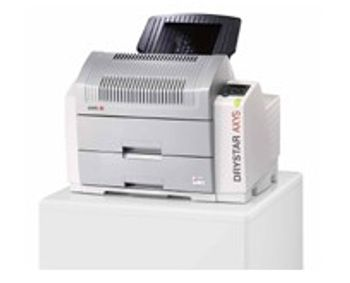
AGFA Drystar AXYS
 AGFA · Model Drystar AXYS
Small footprint, enormous potential Despite its compact size, DRYSTAR AXYS offers a great range of possibilities. It can be used in both centralized and dedicated workflows. It fits a full range of applications. And it features daylight handling for the two on-line media sizes, with five media sizes and three different media types available. The imager thus offers enhanced flexibility and convenience. Its ultra-short access time for the first four prints, as well as its efficient throughput, provide improved workflow and increased productivity for almost all radiology applications. Direct Digital Imaging: More reliability, for more availability As with all of Agfa's DRYSTAR family of imagers, DRYSTAR AXYS features Direct Digital Imaging (DDI). This solid-state technology avoids the use of complex optical components, for an imager that is more reliable and durable by design. In addition, DRYSTAR AXYS is ecological and user-friendly, requiring no wet processing, darkroom, complicated adjustments or cleaning procedures. High-quality mammography images from a table-top imager With DRYSTAR AXYS, the mammography department can enjoy all the convenience of a table-top, digital imager. Its high resolution of 508 dpi matches the 50 µm modality resolution, without interpolation. The result is the superior image quality required for diagnostic mammography images. Yet the DRYSTAR AXYS offers the same reliability, affordability and convenient size of all the Agfa DRYSTAR table-top imagers. Right for both centralized and dedicated environments DRYSTAR AXYS is the right solution for both smaller facilities with limited space and lower patient volume, and larger facilities with many departments. As a centralized imager, it supports a wide range of applications, including CT, MR, DSA and US, as well as CR/DR applications for GenRad, Mammography, Orthopaedics, Dentistry, etc. Equally, its compact design makes it the ideal dedicated departmental imager, for the digital mammography department, for example. Easy connectivity for maximum flexibility DRYSTAR AXYS is a DICOM-native imager, which makes network connectivity easy. For point-to-point connection with non-DICOM modalities, DRYSTAR AXYS can be used with Agfa's LINX™ Paxport™. A#Sharp: Enhancing imaging quality As part of our continual drive to provide you with excellent image quality, our award winning Direct Digital Imaging (DDI) technology has been enhanced to include A#Sharp technology. This technology intensifies imaging capability, enabling DDI to provide sharper image quality across all applications.
Key tips
- ·Never bypass a radiation interlock to "just get the image" - this is one of the few true zero-tolerance rules in BMET work.
- ·Trend image-quality phantom results over time - drift shows up before an outright failure does.
- ·Portable/mobile units take real physical abuse from transport - check wheel locks and cable strain reliefs more often than fixed units.
Typical Failure Modes
Compiled for this model from its own documentation and established engineering knowledge for this equipment class - not from a verified service record. Confirm against the manufacturer's service manual.
Poor print quality
HighSymptoms: Density too light / dark, banding, streaks, non-uniform image, blotches.
Root cause: Print head / laser optics contamination, film / cartridge issue, or density-calibration drift.
Film jam / transport fault
MediumSymptoms: Film jams in the pick-up or transport, mis-feeds, or multi-feeds.
Root cause: Worn pick-up rollers, a transport-roller fault, or a mis-loaded film cartridge.
Density / calibration fault
MediumSymptoms: Prints do not match the reference, calibration fails, densitometer error.
Root cause: Internal densitometer or the calibration routine.
DICOM / queue fault
MediumSymptoms: Jobs stuck in the queue, printer offline to modalities, association failures.
Root cause: Network / DICOM configuration or the controller board.
Thermal head / laser fault
MediumSymptoms: Whole-image defect, print-engine error.
Root cause: Thermal print head or the laser / optics module.
Serviceable Parts & Consumables
Serviceable items for this model, compiled from its documentation and engineering knowledge for this equipment class. Service class and relative cost are estimates, not manufacturer figures; no part numbers are given. Confirm intervals and pricing against the manufacturer.
Pick-up / transport rollers
Class Periodic replacementRel. cost $$R&R Moderate
Thermal print head / laser optics
Class Periodic replacementRel. cost $$$R&R Difficult
Internal densitometer
Class Major service partRel. cost $$R&R Moderate
Controller / network board
Class Major service partRel. cost $$R&R Moderate
Film (media)
Class ConsumableRel. cost $$R&R Easy
| Part | Service class | Relative cost | R&R difficulty |
|---|---|---|---|
| Pick-up / transport rollers | Periodic replacement | $$ | Moderate |
| Thermal print head / laser optics | Periodic replacement | $$$ | Difficult |
| Internal densitometer | Major service part | $$ | Moderate |
| Controller / network board | Major service part | $$ | Moderate |
| Film (media) | Consumable | $$ | Easy |
Relative cost: $ lowest · $$$$ highest service-part cost for this equipment class. Not a price.
PM Checklist
Preventive-maintenance tasks typical of this equipment class. Perform to the manufacturer's procedure and your facility's policy - this is general reference, not a schedule for this specific unit.
- ·Daily QC per modality: image-quality phantom test
- ·Tube and detector inspection
- ·Annual state-required radiation safety survey
- ·Vendor-scheduled preventive maintenance
Troubleshooting Approach
A starting sequence for this model, compiled from its documentation and engineering knowledge for this equipment class. Follow the manufacturer's service documentation for the actual procedure.
Symptom: Poor print quality
- Print the built-in test / SMPTE pattern.
- Run the density calibration.
- Clean the print head / laser optics per the manual.
- Confirm the film type / cartridge matches the printer setting.
- Replace the print head or optics module if a whole-image defect persists.
Symptom: Film jam or jobs stuck
- Clear the jam and note the location.
- Inspect and clean the pick-up and transport rollers.
- For queue problems, check the DICOM association and network.
- Restart the print controller.
- Send a test job from a modality to confirm.
Technical Specs
- Height
- 53.6 in
- Throughput
- 75 films/hour 14 x 17 inch
- Length
- 28.1 in
- Power Requirements
- 100-240 VAC
- Weight
- 198 lbs
- Time to First Film
- 65 sec
- Width
- 28.7 in
Typical Location
Where this class of equipment is typically deployed - general reference, not this unit's own placement record.
- Radiology / Imaging department
- Emergency Department (portable units)
- Operating Room (C-arms)
- Cath lab
- Bedside ICU (portable X-ray)
Documents & Manuals
Safety & Recalls
Synced live from the FDA openFDA API.
- RECALL
The "Film Calibration" setting on the printers was set to the default "OFF" position instead of "ON".
Troubleshoot this device with Bio
Describe a symptom or error code. Bio answers from this device's own documented error codes, failure modes, parts, and guides.
Ask Bio