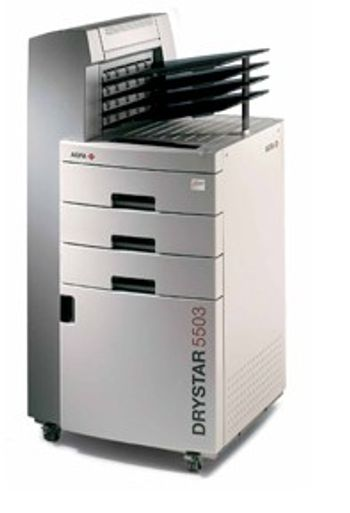
AGFA DRYSTAR 5503
 AGFA · Model DRYSTAR 5503
[i]Drystar 5503 is a versatile partner capable of handling a diversity of printing tasks from different sources with speed and reliability. Below you can find other key benefits of this innovative imager.[/i] Improved workflow across departments Drystar 5503 offers high throughput of up to 100 14 x 17" sheets/hour, a unique multi-format architecture and sorting by modality function, to enhance workflow across departments. Every pixel tells a story The Direct Digital Imaging technology employed by Drystar 5503 is not only clean, fast and environmentally friendly, it is also one of the best ways of translating the high-resolution capability of 508 ppi at a spot size of 50 µm to a final image. Direct Digital Imaging ensures that every pixel in the image is fully software controlled for virtually flawless and consistent image quality. A significant reduction in wear and tear is due to an equally significant reduction in moving parts as a result of using Direct Digital Imaging technology. Multi-format and 3 media sizes on-line Although Drystar 5503 features multiple-format handling, the three most popular media sizes and types are permanently on-line. This means that the imager is capable of delivering CT, MRI, DSA, digital R&F, CR, DR and mammo images at high speed onto different Drystar DT2 media, making the final image versatility of this stand-alone, small footprint unit remarkable. Sorting it out To increase efficiency and user-friendliness, Drystar 5503 has a unique sorter function. This ensures that whichever modality is being served, whichever print command is currently being handled, all tasks will be carried out and sorted, according to modality of patient record, if available. With Drystar 5503, high traffic density input no longer means bottlenecks and slow-speed output at the imager, virtually eliminating log jams. Increasing performance for mammo As an option, Drystar 5503 can also print mammography images. Using our dedicated DT2 Mammo film ensures you the highest image quality, in accordance with mammography standards. With its 508 dpi resolution and the A# Sharp technology, Drystar 5503 produces the sharpest images, ideally suited for digital mammography.
Key tips
- ·Never bypass a radiation interlock to "just get the image" - this is one of the few true zero-tolerance rules in BMET work.
- ·Trend image-quality phantom results over time - drift shows up before an outright failure does.
- ·Portable/mobile units take real physical abuse from transport - check wheel locks and cable strain reliefs more often than fixed units.
Typical Failure Modes
Compiled for this model from its own documentation and established engineering knowledge for this equipment class - not from a verified service record. Confirm against the manufacturer's service manual.
Poor print quality
HighSymptoms: Density too light / dark, banding, streaks, non-uniform image, blotches.
Root cause: Print head / laser optics contamination, film / cartridge issue, or density-calibration drift.
Film jam / transport fault
MediumSymptoms: Film jams in the pick-up or transport, mis-feeds, or multi-feeds.
Root cause: Worn pick-up rollers, a transport-roller fault, or a mis-loaded film cartridge.
Density / calibration fault
MediumSymptoms: Prints do not match the reference, calibration fails, densitometer error.
Root cause: Internal densitometer or the calibration routine.
DICOM / queue fault
MediumSymptoms: Jobs stuck in the queue, printer offline to modalities, association failures.
Root cause: Network / DICOM configuration or the controller board.
Thermal head / laser fault
MediumSymptoms: Whole-image defect, print-engine error.
Root cause: Thermal print head or the laser / optics module.
Serviceable Parts & Consumables
Serviceable items for this model, compiled from its documentation and engineering knowledge for this equipment class. Service class and relative cost are estimates, not manufacturer figures; no part numbers are given. Confirm intervals and pricing against the manufacturer.
Pick-up / transport rollers
Class Periodic replacementRel. cost $$R&R Moderate
Thermal print head / laser optics
Class Periodic replacementRel. cost $$$R&R Difficult
Internal densitometer
Class Major service partRel. cost $$R&R Moderate
Controller / network board
Class Major service partRel. cost $$R&R Moderate
Film (media)
Class ConsumableRel. cost $$R&R Easy
| Part | Service class | Relative cost | R&R difficulty |
|---|---|---|---|
| Pick-up / transport rollers | Periodic replacement | $$ | Moderate |
| Thermal print head / laser optics | Periodic replacement | $$$ | Difficult |
| Internal densitometer | Major service part | $$ | Moderate |
| Controller / network board | Major service part | $$ | Moderate |
| Film (media) | Consumable | $$ | Easy |
Relative cost: $ lowest · $$$$ highest service-part cost for this equipment class. Not a price.
PM Checklist
Preventive-maintenance tasks typical of this equipment class. Perform to the manufacturer's procedure and your facility's policy - this is general reference, not a schedule for this specific unit.
- ·Daily QC per modality: image-quality phantom test
- ·Tube and detector inspection
- ·Annual state-required radiation safety survey
- ·Vendor-scheduled preventive maintenance
Troubleshooting Approach
A starting sequence for this model, compiled from its documentation and engineering knowledge for this equipment class. Follow the manufacturer's service documentation for the actual procedure.
Symptom: Poor print quality
- Print the built-in test / SMPTE pattern.
- Run the density calibration.
- Clean the print head / laser optics per the manual.
- Confirm the film type / cartridge matches the printer setting.
- Replace the print head or optics module if a whole-image defect persists.
Symptom: Film jam or jobs stuck
- Clear the jam and note the location.
- Inspect and clean the pick-up and transport rollers.
- For queue problems, check the DICOM association and network.
- Restart the print controller.
- Send a test job from a modality to confirm.
Technical Specs
- Printing Resolustion
- 50 µm
- Height
- 55.5 in
- Throughput
- 160 films/hour 8 x 10 inch
- Length
- 28.1 in
- Film Drawers
- Up to 3
- Power Requirements
- 100-240 VAC
- Weight
- 425 lbs
- Time to First Film
- 57 sec (8 x 10 inch)
- Width
- 28.3 in
Typical Location
Where this class of equipment is typically deployed - general reference, not this unit's own placement record.
- Radiology / Imaging department
- Emergency Department (portable units)
- Operating Room (C-arms)
- Cath lab
- Bedside ICU (portable X-ray)
Documents & Manuals
Troubleshoot this device with Bio
Describe a symptom or error code. Bio answers from this device's own documented error codes, failure modes, parts, and guides.
Ask Bio