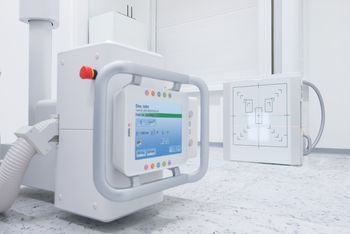
AGFA DR 600 Ceiling
 AGFA · Model DR 600 Ceiling
Excellent image quality provided by our most advanced generation MUSICA™ image processing software Single or multi-detector, high productivity and high-throughput digital X-ray room Full automation, auto-positioning and auto-tracking ZeroForce™ Technology, offering smooth operation with almost zero effort for manual movements Significant potential for dose reduction, with the Cesium Iodide detector Handles a broad range of general radiography and tomosynthesis exams DR Full Leg/Full Spine capability with EasyStitch™ technology for both standing and recumbent patients Predictive workflow assistance from Agfa’s SmartXR™ Assistant, supporting improved productivity and consistent outcomes: SmartAlign™, SmartPositioning™, SmartDose™ and SmartRotate™ LiveVision™ technology, enabling accurate radiation dose-free remote positioning.
Key tips
- ·Never bypass a radiation interlock to "just get the image" - this is one of the few true zero-tolerance rules in BMET work.
- ·Trend image-quality phantom results over time - drift shows up before an outright failure does.
- ·Portable/mobile units take real physical abuse from transport - check wheel locks and cable strain reliefs more often than fixed units.
Typical Failure Modes
Compiled for this model from its own documentation and established engineering knowledge for this equipment class - not from a verified service record. Confirm against the manufacturer's service manual.
Detector not connecting / dropped images
HighSymptoms: Panel not detected, images not received, wireless / tethered link drops mid-exam.
Root cause: Detector battery (wireless), Wi-Fi / tether cable, a docking / connector fault, or detector electronics.
Image quality / calibration fault
MediumSymptoms: Fixed-pattern artefacts, non-uniformity, dead pixels / lines, calibration overdue or failing.
Root cause: Detector gain / offset calibration, a bad pixel map, or physical detector (drop) damage.
Generator / exposure fault
HighSymptoms: Exposure inhibited, kV / mAs error, no exposure captured, AEC over/under.
Root cause: HV generator, tube, filament supply, or an AEC / interface fault.
Positioner / tube-stand / bucky fault
MediumSymptoms: Tube column, wall stand or table bucky will not track, detent, or auto-position.
Root cause: Drive motor, brake, encoder, or the auto-positioning interface.
Acquisition workstation / PACS fault
MediumSymptoms: Images will not display, process or send; worklist missing; slow processing.
Root cause: Workstation PC, software, or the DICOM / network configuration.
Serviceable Parts & Consumables
Serviceable items for this model, compiled from its documentation and engineering knowledge for this equipment class. Service class and relative cost are estimates, not manufacturer figures; no part numbers are given. Confirm intervals and pricing against the manufacturer.
Flat-panel detector (exchange)
Class Major service partRel. cost $$$$R&R Moderate
Detector battery (wireless)
Class Periodic replacementRel. cost $$R&R Easy
Tether cable / access point
Class Periodic replacementRel. cost $$R&R Fairly easy
Positioner drive / brake / encoder
Class Major service partRel. cost $$$R&R Difficult
Acquisition workstation PC
Class Major service partRel. cost $$$R&R Moderate
AEC ion chamber
Class Major service partRel. cost $$$R&R Difficult
| Part | Service class | Relative cost | R&R difficulty |
|---|---|---|---|
| Flat-panel detector (exchange) | Major service part | $$$$ | Moderate |
| Detector battery (wireless) | Periodic replacement | $$ | Easy |
| Tether cable / access point | Periodic replacement | $$ | Fairly easy |
| Positioner drive / brake / encoder | Major service part | $$$ | Difficult |
| Acquisition workstation PC | Major service part | $$$ | Moderate |
| AEC ion chamber | Major service part | $$$ | Difficult |
Relative cost: $ lowest · $$$$ highest service-part cost for this equipment class. Not a price.
PM Checklist
Preventive-maintenance tasks typical of this equipment class. Perform to the manufacturer's procedure and your facility's policy - this is general reference, not a schedule for this specific unit.
- ·Daily QC per modality: image-quality phantom test
- ·Tube and detector inspection
- ·Annual state-required radiation safety survey
- ·Vendor-scheduled preventive maintenance
Troubleshooting Approach
A starting sequence for this model, compiled from its documentation and engineering knowledge for this equipment class. Follow the manufacturer's service documentation for the actual procedure.
Symptom: Detector not connecting or images not arriving
- Check the detector battery (wireless) or reseat the tether.
- Confirm the Wi-Fi access point, channel and range.
- Reboot the detector and the acquisition workstation.
- Try a known-good detector if the site has one.
- Escalate a confirmed detector-electronics fault to the OEM.
Symptom: Fixed-pattern artefacts or failed calibration
- Run the detector gain / offset calibration and the dead-pixel map.
- Inspect the detector for drop / crush damage.
- Expose a uniform phantom and check uniformity.
- Confirm the generator and AEC are within spec with an analyser.
- Exchange the detector if calibration will not hold.
Typical Location
Where this class of equipment is typically deployed - general reference, not this unit's own placement record.
- Radiology / Imaging department
- Emergency Department (portable units)
- Operating Room (C-arms)
- Cath lab
- Bedside ICU (portable X-ray)
Documents & Manuals
No documents available for this device yet.
Safety & Recalls
Synced live from the FDA openFDA API.
- RECALL
After an upgrade of the software of the Overhead Tube Crane, there were isolated cases in which the Overhead Tube Crane movement does not stop when the movement button is released. Instead of stopping while the movement button is released, the Tube Head Crane moves to the intended position.
- RECALL
A supplier for the Agfa system noted a potential for the steel support cables of a similar device to break. This led to a mandatory review of all systems, changing the pulley and cables if any deterioration in the cables or irregular or excessive pulley wear. If the two cables that support the equipment to its roof anchor break, the equipment might fall and cause harm to the patient, or others.
- RECALL
Some customers reported that while using the DX-D600 in room or exam preparation, the Overhead Tube Crane (OTC) showed increased velocity and uncontrolled longitudinal movement.
- RECALL
The GS1 circuit board may fail resulting in smoke or fire.
Troubleshoot this device with Bio
Describe a symptom or error code. Bio answers from this device's own documented error codes, failure modes, parts, and guides.
Ask Bio