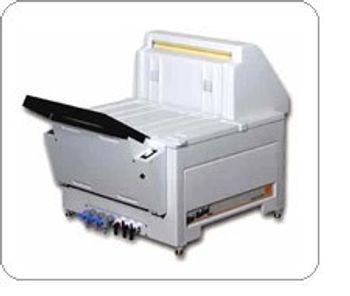
AFP Imaging Mini-Medical/90
 AFP Imaging · Model Mini-Medical/90
Built-in quality control - Audible and visual indicators add to operator convenience by signaling when the processor is ready to accept another film Developer level and temperature indicator - Two separate indicator lights let the operator know the developer solution is at the proper level and that it has reached the optimum temperature for film processing Constant readiness design - A special "jog" cycle keeps rollers wet while the machine is in standby, thus guaranteeing quality processing throughout the day Automatic chemical replenisher - An electronic activating system replenishes solutions automatically keeping all chemicals used in the Mini-Medical at peak operating efficiency Interlocking crossover - Films travel from tank to tank with minimum exposure to air. The tank's new molded plastic uni-body design and the interlocking design of each rack simplify removal Automatic wash water control - Minimizes the consumption of water by eliminating flow during standby mode. Approximately 1 pint of fresh water is added during each "jog" cycle to eliminate algae problems associated with standing water Infrared dryer - Energy efficient "I.R. heat lamps" dry each film quickly and quietly. "Pivot-back" dryer rack enables easy access to wash section Simple installation - The AFP Mini-Medical runs on standard electrical current (115 VAC, 15 A) and requires only a cold water line connection. The unit is UL approved Automatic standby - During periods of inactivity, the drive motor and pumps shut off automatically reducing energy consumption and mechanical wear. Temperatures are maintained electronically Light-proof covered feed tray - Reduces time in the dark Silver recovery connection - Fixer drainage hose fittings are compatible with most standard silver recovery units Solid state circuitry - Modular, state-of-the-art electronics are designed to assure reliable operation with minimal start-up and reset times. An audible tone alerts operator that processor is ready to accept another film.
Key tips
- ·Never bypass a radiation interlock to "just get the image" - this is one of the few true zero-tolerance rules in BMET work.
- ·Trend image-quality phantom results over time - drift shows up before an outright failure does.
- ·Portable/mobile units take real physical abuse from transport - check wheel locks and cable strain reliefs more often than fixed units.
Typical Failure Modes
Compiled for this model from its own documentation and established engineering knowledge for this equipment class - not from a verified service record. Confirm against the manufacturer's service manual.
Poor film quality (fog / streaks / light films)
HighSymptoms: Fogged, streaked, mottled or under-developed films; density drift on the sensitometric strip.
Root cause: Exhausted or wrongly mixed chemistry, wrong developer temperature, or dirty / worn rollers.
Film transport jam / mis-feed
MediumSymptoms: Film jams between racks, does not advance, or comes out crumpled.
Root cause: Worn or misaligned transport rollers / racks, worn drive gears, or a crossover-rack fault.
Developer temperature / heater fault
MediumSymptoms: Developer not at set temperature, density varies through the day.
Root cause: Heater, thermostat / sensor, or recirculation-pump fault.
Replenishment pump fault
MediumSymptoms: Chemistry not replenished, developer / fixer levels drift, films degrade over a batch.
Root cause: Worn replenishment-pump tubing or a pump fault.
Dryer fault
LowSymptoms: Films come out damp.
Root cause: Dryer heater or blower fault.
Serviceable Parts & Consumables
Serviceable items for this model, compiled from its documentation and engineering knowledge for this equipment class. Service class and relative cost are estimates, not manufacturer figures; no part numbers are given. Confirm intervals and pricing against the manufacturer.
Transport / crossover rollers & gears
Class Periodic replacementRel. cost $$R&R Moderate
Replenishment-pump tubing
Class Frequent wear itemRel. cost $R&R Fairly easy
Developer heater / thermostat
Class Major service partRel. cost $$R&R Moderate
Recirculation / replenishment pump
Class Periodic replacementRel. cost $$R&R Moderate
Dryer heater / blower
Class Major service partRel. cost $$R&R Moderate
| Part | Service class | Relative cost | R&R difficulty |
|---|---|---|---|
| Transport / crossover rollers & gears | Periodic replacement | $$ | Moderate |
| Replenishment-pump tubing | Frequent wear item | $ | Fairly easy |
| Developer heater / thermostat | Major service part | $$ | Moderate |
| Recirculation / replenishment pump | Periodic replacement | $$ | Moderate |
| Dryer heater / blower | Major service part | $$ | Moderate |
Relative cost: $ lowest · $$$$ highest service-part cost for this equipment class. Not a price.
PM Checklist
Preventive-maintenance tasks typical of this equipment class. Perform to the manufacturer's procedure and your facility's policy - this is general reference, not a schedule for this specific unit.
- ·Daily QC per modality: image-quality phantom test
- ·Tube and detector inspection
- ·Annual state-required radiation safety survey
- ·Vendor-scheduled preventive maintenance
Troubleshooting Approach
A starting sequence for this model, compiled from its documentation and engineering knowledge for this equipment class. Follow the manufacturer's service documentation for the actual procedure.
Symptom: Fogged / streaked / light or mottled films
- Run a sensitometric strip and read Dmin, speed and contrast against the control chart.
- Confirm the developer temperature and that the chemistry is fresh and correctly mixed.
- Clean the transport and crossover rollers and racks.
- Check the replenishment rates and that the replenishment pumps deliver.
- Change the chemistry and re-run the strip.
Symptom: Film jams between racks / does not advance / crumples
- Open the racks and clear the film; note where it hangs up.
- Inspect the rollers, guide shoes and drive gears for wear or misalignment.
- Check each rack is fully seated and aligned.
- Run several test films.
- Replace worn rollers / gears as found.
Symptom: Developer not at temperature / density drifts through the day
- Check the developer heater draws current and the thermostat / sensor reads correctly.
- Confirm the recirculation pump is running.
- Compare the developer temperature to an independent thermometer.
- Replace the heater or thermostat / sensor as isolated.
- Re-run a sensitometric strip.
Symptom: Films come out damp (dryer fault)
- Check the dryer heater and the blower run.
- Confirm the air path and filters are clear.
- Check the dryer temperature setting.
- Replace the dryer heater or blower as isolated.
- Re-run and check for dryness.
Typical Location
Where this class of equipment is typically deployed - general reference, not this unit's own placement record.
- Radiology / Imaging department
- Emergency Department (portable units)
- Operating Room (C-arms)
- Cath lab
- Bedside ICU (portable X-ray)
Documents & Manuals
Troubleshoot this device with Bio
Describe a symptom or error code. Bio answers from this device's own documented error codes, failure modes, parts, and guides.
Ask Bio