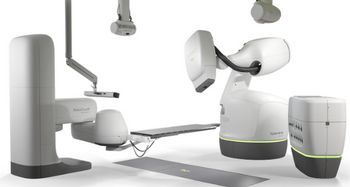
Accuray CyberKnife
 Accuray · Model CyberKnife
Robotic radiosurgery system that offers highly precise, non-surgical treatment for tumors and lesions anywhere in the body - including the prostate, lung, brain, spine, liver, pancreas and kidney - with the added accuracy of automatic, real-time tumor tracking and motion synchronization. This new level of precision gives treatment teams the confidence to deliver state-of-the-art treatments for a wide range of cancers and functional disorders, while minimizing dose to healthy tissue and helping preserve patients’ quality of life.
Typical Failure Modes
Compiled for this model from its own documentation and established engineering knowledge for this equipment class - not from a verified service record. Confirm against the manufacturer's service manual.
Magnetron RF output degradation / arcing
HighSymptoms: Beam-on faults, dose-rate low or unstable, high-voltage / arc warnings, treatment interlocks.
Root cause: Magnetron at end of life, waveguide arcing, or SF6 pressure loss in the RF path.
Real-time tumor tracking / imaging drift
HighSymptoms: Tracking loses lock during treatment, targeting error exceeds tolerance, frequent re-imaging.
Root cause: kV X-ray source or amorphous-silicon detector degradation, marker/tracking-camera calibration drift, or synchrony model instability.
Robotic manipulator joint / encoder fault
HighSymptoms: Manipulator position error, collision or E-stop, jerky motion, node reachability errors.
Root cause: Worn harmonic-drive gear or a joint encoder / servo fault on the KUKA-based arm.
Chiller / thermal management fault
MediumSymptoms: Over-temperature interlocks, dose-rate instability, coolant-flow alarms.
Root cause: Chiller pump, heat-exchanger fouling, or low coolant.
Collimator changer (Iris / MLC / fixed) fault
MediumSymptoms: Collimator will not change or index at the Xchange table, field-size errors.
Root cause: Xchange mechanism, Iris tungsten-segment drive, or MLC leaf-motor / position-camera fault.
Serviceable Parts & Consumables
Serviceable items for this model, compiled from its documentation and engineering knowledge for this equipment class. Service class and relative cost are estimates, not manufacturer figures; no part numbers are given. Confirm intervals and pricing against the manufacturer.
Magnetron
OEM service; RF path and dosimetry re-commissioning required.
Class Periodic replacementRel. cost $$$$R&R Expert-level
kV X-ray tube / imaging source
Class Periodic replacementRel. cost $$$$R&R Expert-level
Amorphous-silicon image detector
Class Major service partRel. cost $$$$R&R Difficult
Robotic joint / harmonic-drive & encoder assembly
Class Major service partRel. cost $$$$R&R Expert-level
Chiller pump / heat exchanger
Class Major service partRel. cost $$$R&R Difficult
SF6 gas / waveguide pressurisation service
Class Frequent wear itemRel. cost $$R&R Moderate
| Part | Service class | Relative cost | R&R difficulty |
|---|---|---|---|
| Magnetron OEM service; RF path and dosimetry re-commissioning required. | Periodic replacement | $$$$ | Expert-level |
| kV X-ray tube / imaging source | Periodic replacement | $$$$ | Expert-level |
| Amorphous-silicon image detector | Major service part | $$$$ | Difficult |
| Robotic joint / harmonic-drive & encoder assembly | Major service part | $$$$ | Expert-level |
| Chiller pump / heat exchanger | Major service part | $$$ | Difficult |
| SF6 gas / waveguide pressurisation service | Frequent wear item | $$ | Moderate |
Relative cost: $ lowest · $$$$ highest service-part cost for this equipment class. Not a price.
Troubleshooting Approach
A starting sequence for this model, compiled from its documentation and engineering knowledge for this equipment class. Follow the manufacturer's service documentation for the actual procedure.
Symptom: Beam-on / RF fault with arcing warnings
- This is an OEM-service system - a BMET's role is triage and coordination, not board-level RF repair.
- Record the exact fault codes from the treatment delivery console and the equipment-room logs.
- Check chiller status and coolant flow first - thermal faults masquerade as RF faults.
- Verify SF6 / waveguide pressure is in range.
- Escalate a confirmed magnetron or waveguide fault to Accuray with the logs; do not attempt to run treatments until physics has re-verified output.
Symptom: Tracking loses lock during treatment
- Note which tracking algorithm was in use (6D skull, fiducial, Xsight spine/lung, Synchrony).
- Check the kV imaging system - image quality, source output and detector performance via the built-in diagnostics.
- Review the daily QA / targeting (E2E) results for a trend.
- Verify the tracking-camera and room lighting conditions for Synchrony marker tracking.
- Escalate a confirmed imaging-chain degradation to Accuray; coordinate with physics before further clinical use.