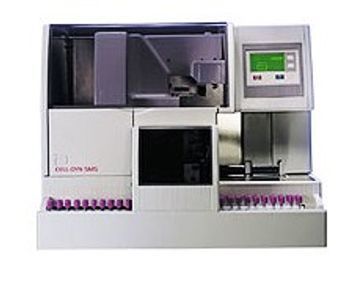
Abbott SMS
 Abbott · Model SMS
Up to 80 slides per hour Open and Closed tube sampling 5 individual staining stations with separate rinse station and drying ove Accepts standard 75 x 25 x 1-mm painted-end microscope slides Any quality staining reagents can be used Multiple slides per sample Sample rack compatibility with the CELL-DYN Sapphire™ and the CELL-DYN Ruby.
Key tips
- ·Run QC controls before trusting any repair - an analyzer that passes self-test can still report clinically wrong results.
- ·Rule out a reagent lot change before opening the instrument - it can look exactly like a hardware fault.
- ·Centrifuge rotors have a hard retirement age/cycle limit regardless of visible condition - don't eyeball it.
Typical Failure Modes
Compiled for this model from its own documentation and established engineering knowledge for this equipment class - not from a verified service record. Confirm against the manufacturer's service manual.
Reagent / paraffin transfer or handling fault
HighSymptoms: Stations not filling or draining, retort not filling (processor), transport arm mis-places baskets, error alarm halts the run.
Root cause: Worn pump / valve, a blocked line, a level-sensor fault, or a transport-drive / gripper fault.
Retort / chamber pressure or vacuum fault (processor)
MediumSymptoms: Pressure / vacuum not achieved, poor infiltration, seal alarm.
Root cause: Worn retort door seal, a vacuum / pressure-pump fault, or a valve.
Poor or inconsistent staining
MediumSymptoms: Slides over- / under-stained, uneven, station-time drift.
Root cause: Exhausted reagents, wrong programme, incorrect agitation, or a timing / arm fault.
Heater / paraffin-bath / oven fault
MediumSymptoms: Paraffin not molten or too hot, oven not at temperature, bath alarm.
Root cause: Heater or temperature-sensor fault.
Fume-extraction / carbon-filter fault
LowSymptoms: Reagent fumes in the room, filter-change overdue.
Root cause: Saturated carbon filter or a fan fault.
Serviceable Parts & Consumables
Serviceable items for this model, compiled from its documentation and engineering knowledge for this equipment class. Service class and relative cost are estimates, not manufacturer figures; no part numbers are given. Confirm intervals and pricing against the manufacturer.
Reagent / paraffin pump & valves
Class Periodic replacementRel. cost $$$R&R Difficult
Retort / reagent-vessel seals
Class Periodic replacementRel. cost $$R&R Fairly easy
Transport-arm drive / gripper (stainer)
Class Periodic replacementRel. cost $$$R&R Difficult
Bath / oven heater & temperature sensor
Class Major service partRel. cost $$R&R Moderate
Activated-carbon fume filter
Class Frequent wear itemRel. cost $R&R Easy
| Part | Service class | Relative cost | R&R difficulty |
|---|---|---|---|
| Reagent / paraffin pump & valves | Periodic replacement | $$$ | Difficult |
| Retort / reagent-vessel seals | Periodic replacement | $$ | Fairly easy |
| Transport-arm drive / gripper (stainer) | Periodic replacement | $$$ | Difficult |
| Bath / oven heater & temperature sensor | Major service part | $$ | Moderate |
| Activated-carbon fume filter | Frequent wear item | $ | Easy |
Relative cost: $ lowest · $$$$ highest service-part cost for this equipment class. Not a price.
PM Checklist
Preventive-maintenance tasks typical of this equipment class. Perform to the manufacturer's procedure and your facility's policy - this is general reference, not a schedule for this specific unit.
- ·Daily QC controls run and reviewed
- ·Calibration verification per assay
- ·Routine cleaning and decontamination
- ·Scheduled reagent-path and pump-tubing maintenance
Troubleshooting Approach
A starting sequence for this model, compiled from its documentation and engineering knowledge for this equipment class. Follow the manufacturer's service documentation for the actual procedure.
Symptom: Error alarm halts a run
- Note the alarm / error code and check the history log.
- Confirm reagent, paraffin and water levels and correct vessel placement.
- Check the affected station / retort fills and drains fully.
- Inspect seals and the transport arm.
- Follow the service manual for the specific alarm; replace the pump, valve or seal as isolated.
Symptom: Poor or inconsistent staining / processing
- Confirm the correct programme and station times.
- Fit fresh reagents and confirm fill levels.
- Check agitation / dwell and the water supply where used.
- Run a control slide / block and compare to a reference.
- Escalate a timing or transport-arm fault to the OEM.
Typical Location
Where this class of equipment is typically deployed - general reference, not this unit's own placement record.
- Central / core laboratory
- Point-of-care testing stations
- Blood bank
- Microbiology lab
Documents & Manuals
No documents available for this device yet.
Troubleshoot this device with Bio
Describe a symptom or error code. Bio answers from this device's own documented error codes, failure modes, parts, and guides.
Ask Bio