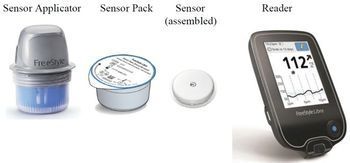
Abbott Freestyle Libre 14 Day Flash Glucose Monitoring
 Abbott · Model Freestyle Libre 14 Day Flash Glucose Monitoring
How does it work? The patient uses the sensor applicator to apply the sensor to the back of their upper arm. The sensor has a small flexible metal wire that goes just below the skin where it generates a small electrical signal in response to the amount of sugar that is present in fluid under the skin (interstitial glucose). This electrical signal is converted into a blood glucose reading, and is transmitted to a dedicated, mobile device (reader) when a user scans the reader a short distance above the sensor. The system does not require calibration with fingertip blood samples using a blood glucose meter. When is it used? The FreeStyle Libre Flash Glucose Monitoring System is indicated for the management of diabetes in persons age 18 and older. It is designed to replace blood glucose testing with a fingerstick for diabetes treatment decisions. The FreeStyle Libre detects trends and tracks patterns aiding in the detection of episodes of hyperglycemia (too high glucose) and hypoglycemia (too low glucose), to help patients make acute and long-term therapy adjustments. Interpretation of the FreeStyle Libre readings should be based on the glucose trends and several sequential readings over time. The System is intended for single patient use and requires a prescription. What will it accomplish? People with diabetes can use the information from this device to make diabetes treatment decisions (for example, whether to administer insulin or carbohydrates). Information from the device can also be used to help determine patterns in glucose levels and make long-term adjustments to diabetes treatment plans to keep blood glucose levels in a safe range.
Typical Failure Modes
Compiled for this model from its own documentation and established engineering knowledge for this equipment class - not from a verified service record. Confirm against the manufacturer's service manual.
Sensor will not start or gives no readings
HighSymptoms: Reader does not detect the sensor, no glucose value on scan, "sensor error" or "try again in 10 minutes".
Root cause: Sensor still in the 60-minute warm-up, a damaged or improperly applied sensor, or scanning near metal / strong RF.
Problems at the application site
MediumSymptoms: Sensor lifting, bleeding, irritation, or falls off before day 14.
Root cause: Poor adhesion (site not clean/dry), applied over hair or a bony area, or knocked during wear.
Reader will not power on or hold charge
MediumSymptoms: Blank reader, will not turn on, short battery life.
Root cause: Depleted internal battery or a charging-port / cable fault.
Blood glucose / ketone strip error
LowSymptoms: Error when using the built-in BG/ketone strip port.
Root cause: Faulty or expired strip, or the strip port.
Reader / app pairing fails (recall history)
MediumSymptoms: Reader or phone app will not pair.
Root cause: Software fault where the device incorrectly treats its security certificate as expired - subject of an Abbott recall/update.
Serviceable Parts & Consumables
Serviceable items for this model, compiled from its documentation and engineering knowledge for this equipment class. Service class and relative cost are estimates, not manufacturer figures; no part numbers are given. Confirm intervals and pricing against the manufacturer.
Reader (rechargeable)
Class Periodic replacementRel. cost $$R&R Easy
Sensor (14-day)
Single-use; replace on error or at end of wear.
Class ConsumableRel. cost $R&R Easy
Sensor applicator
Class ConsumableRel. cost $R&R Easy
USB charging cable
Class Periodic replacementRel. cost $R&R Easy
Blood glucose / ketone test strips
Class Frequent wear itemRel. cost $R&R Easy
| Part | Service class | Relative cost | R&R difficulty |
|---|---|---|---|
| Reader (rechargeable) | Periodic replacement | $$ | Easy |
| Sensor (14-day) Single-use; replace on error or at end of wear. | Consumable | $ | Easy |
| Sensor applicator | Consumable | $ | Easy |
| USB charging cable | Periodic replacement | $ | Easy |
| Blood glucose / ketone test strips | Frequent wear item | $ | Easy |
Relative cost: $ lowest · $$$$ highest service-part cost for this equipment class. Not a price.
Troubleshooting Approach
A starting sequence for this model, compiled from its documentation and engineering knowledge for this equipment class. Follow the manufacturer's service documentation for the actual procedure.
Symptom: Sensor will not start / no readings
- Wait the full 60-minute warm-up after application.
- Hold the reader within a few cm of the sensor and away from metal surfaces.
- If it reports a sensor error, note any error code and apply a new sensor to a clean, dry, hairless area on the back of the upper arm.
- Perform a reader self-test from the settings menu.
- Contact Abbott customer service with the sensor serial and error if a new sensor also fails.
Symptom: Reader will not power on
- Charge for at least a few hours with the supplied cable and a known-good USB source.
- Try another cable / charger.
- Note the run time from a full charge.
- Perform a reader test if it powers up.
- Replace the reader if it will not hold charge.
Documents & Manuals
Safety & Recalls
Synced live from the FDA openFDA API.
- RECALL
The device is unable to pair with the mobile app due to the device incorrectly determining the certificate has expired.
Troubleshoot this device with Bio
Describe a symptom or error code. Bio answers from this device's own documented error codes, failure modes, parts, and guides.
Ask Bio