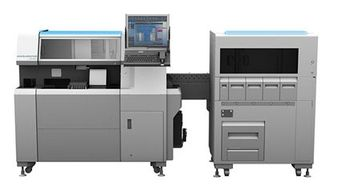
Abbott ACCELERATOR p540
 Abbott · Model ACCELERATOR p540
Standalone Laboratory Automation Solution You can optimize your laboratory’s performance and use of resources by using the ACCELERATOR p540 to streamline your preanalytical process. The ACCELERATOR p540 also helps you to increase your workload capacity and improve result turnaround times by reducing the opportunities for error and providing performance consistency. Paired with Abbott Diagnostic’s Service Solutions your lab can achieve enhanced efficiency, optimized productivity and maximized safety through automation and informatics configured to your needs.
Key tips
- ·Run QC controls before trusting any repair - an analyzer that passes self-test can still report clinically wrong results.
- ·Rule out a reagent lot change before opening the instrument - it can look exactly like a hardware fault.
- ·Centrifuge rotors have a hard retirement age/cycle limit regardless of visible condition - don't eyeball it.
Typical Failure Modes
Compiled for this model from its own documentation and established engineering knowledge for this equipment class - not from a verified service record. Confirm against the manufacturer's service manual.
Sample-transport / track fault
HighSymptoms: Carriers / pucks jam, stall, or mis-route; track-error message; throughput drops.
Root cause: Worn track belts / drive, a diverter / gate fault, or a carrier-sensor fault.
Robotic gripper / pick-place fault
MediumSymptoms: Tubes dropped or mis-placed, gripper-position error, aliquotting mis-aligned.
Root cause: Worn gripper / robot drive or an encoder / home-sensor fault.
Centrifuge module fault
MediumSymptoms: Inline centrifuge imbalance, lid-lock error, will not spin.
Root cause: Drive / bearing wear, a lid-lock fault, or an imbalance-sensor fault.
Decapper / recapper / aliquotter fault
MediumSymptoms: Caps not removed / applied, aliquot volumes off, station jams.
Root cause: Worn decapper jaws, aliquot-probe / syringe wear, or a station-drive fault.
Middleware / connectivity fault
HighSymptoms: Analysers or the LIS drop off the line, rules not applying, samples stuck in a queue.
Root cause: The automation middleware / server or a network link.
Serviceable Parts & Consumables
Serviceable items for this model, compiled from its documentation and engineering knowledge for this equipment class. Service class and relative cost are estimates, not manufacturer figures; no part numbers are given. Confirm intervals and pricing against the manufacturer.
Track belts / drive components
Class Periodic replacementRel. cost $$$R&R Difficult
Robotic gripper / drive assembly
Class Periodic replacementRel. cost $$$R&R Difficult
Centrifuge-module drive / lid-lock
Class Periodic replacementRel. cost $$$R&R Difficult
Decapper jaws / aliquot-probe & syringe
Class Periodic replacementRel. cost $$R&R Moderate
Carrier / position sensors
Class Periodic replacementRel. cost $$R&R Moderate
| Part | Service class | Relative cost | R&R difficulty |
|---|---|---|---|
| Track belts / drive components | Periodic replacement | $$$ | Difficult |
| Robotic gripper / drive assembly | Periodic replacement | $$$ | Difficult |
| Centrifuge-module drive / lid-lock | Periodic replacement | $$$ | Difficult |
| Decapper jaws / aliquot-probe & syringe | Periodic replacement | $$ | Moderate |
| Carrier / position sensors | Periodic replacement | $$ | Moderate |
Relative cost: $ lowest · $$$$ highest service-part cost for this equipment class. Not a price.
PM Checklist
Preventive-maintenance tasks typical of this equipment class. Perform to the manufacturer's procedure and your facility's policy - this is general reference, not a schedule for this specific unit.
- ·Daily QC controls run and reviewed
- ·Calibration verification per assay
- ·Routine cleaning and decontamination
- ·Scheduled reagent-path and pump-tubing maintenance
Troubleshooting Approach
A starting sequence for this model, compiled from its documentation and engineering knowledge for this equipment class. Follow the manufacturer's service documentation for the actual procedure.
Symptom: Carriers jamming or mis-routing
- Clear the jam and note the station / diverter where it occurs.
- Inspect the track belts and the diverter gates.
- Check the carrier / position sensors are clean and aligned.
- Run the station self-test / calibration.
- Replace the belt, gate or sensor as isolated.
Symptom: Analysers or LIS dropping off the line
- Check the middleware server and its connections to each analyser and the LIS.
- Confirm the network switch / links.
- Restart the affected connection / driver per the OEM procedure.
- Verify rules and routing are active.
- Escalate a middleware-server fault to the OEM / IT.
Typical Location
Where this class of equipment is typically deployed - general reference, not this unit's own placement record.
- Central / core laboratory
- Point-of-care testing stations
- Blood bank
- Microbiology lab
Documents & Manuals
No documents available for this device yet.
Troubleshoot this device with Bio
Describe a symptom or error code. Bio answers from this device's own documented error codes, failure modes, parts, and guides.
Ask Bio