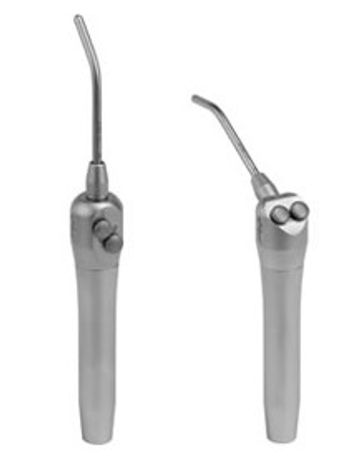
A dec Warm Water Syringe
 A dec · Model Warm Water Syringe
Balanced design: The syringe is ergonomically correct - well-balanced and lightweight with flexible silicone tubing Quick-connect (International only): Allows the operator to conveniently connect or disconnect the syringe head for autoclaving Temperature control: Improves patient comfort with water at just the right temperature Adjustable temperature settings: Allows the service technician to adjust the water temperature to fit the operator's preferred setting Retrofittable: Compatible with the full line of A-dec 500 and 300 systems Supports self-contained water: Works in conjunction with A-dec's self-contained water system. Shuts off automatically when the water supply is interrupted Syringe is well-balanced and lightweight with flexible silicone tubing Quick-connect terminal allows operator to conveniently connect or disconnect the syringe head for autoclaving Offers warm water at just the right temperature Water temperature can be adjusted to fit the operator's preferred setting Compatible with all A-dec 500 systems, including models 532, 533, 541, 542, 545, and 551 Works in conjunction with A-dec's self-contained water system.
Key tips
- ·Biological-indicator verification applies to dental sterilizers exactly the same as hospital CSSD - no exception for smaller units.
- ·"Sounds different" is often the first real report of handpiece bearing wear, not an outright failure - investigate early rather than waiting.
Typical Failure Modes
Compiled for this model from its own documentation and established engineering knowledge for this equipment class - not from a verified service record. Confirm against the manufacturer's service manual.
Output / performance below spec
HighSymptoms: Compressor will not build pressure / cycles constantly; vacuum weak; curing light low irradiance; scanner poor scans.
Root cause: Wear in the core mechanism (compressor head, vacuum pump, LED / lamp, scanner optics) or a control fault.
Water / moisture / drain fault (compressor)
MediumSymptoms: Water in the air lines, drain not working, desiccant exhausted.
Root cause: Auto-drain fault or an exhausted air-dryer / desiccant.
Overheating / thermal cut-out
MediumSymptoms: Unit stops after a period, hot, restarts when cool.
Root cause: Cooling-fan fault, a blocked intake, or a worn motor.
Control / switch / timer fault
MediumSymptoms: Will not start / stop on demand, timer or mode selection unresponsive.
Root cause: Pressure switch, timer, or control board.
Noise / vibration
LowSymptoms: Loud operation, rattling, walking across the floor.
Root cause: Worn mounts, bearings, or loose panels.
Serviceable Parts & Consumables
Serviceable items for this model, compiled from its documentation and engineering knowledge for this equipment class. Service class and relative cost are estimates, not manufacturer figures; no part numbers are given. Confirm intervals and pricing against the manufacturer.
Core mechanism rebuild kit (compressor head / pump / LED)
Class Periodic replacementRel. cost $$R&R Moderate
Air-dryer / desiccant / auto-drain (compressor)
Class Frequent wear itemRel. cost $R&R Fairly easy
Cooling fan
Class Periodic replacementRel. cost $R&R Fairly easy
Pressure switch / timer / control board
Class Major service partRel. cost $$R&R Moderate
Anti-vibration mounts / bearings
Class Periodic replacementRel. cost $R&R Moderate
| Part | Service class | Relative cost | R&R difficulty |
|---|---|---|---|
| Core mechanism rebuild kit (compressor head / pump / LED) | Periodic replacement | $$ | Moderate |
| Air-dryer / desiccant / auto-drain (compressor) | Frequent wear item | $ | Fairly easy |
| Cooling fan | Periodic replacement | $ | Fairly easy |
| Pressure switch / timer / control board | Major service part | $$ | Moderate |
| Anti-vibration mounts / bearings | Periodic replacement | $ | Moderate |
Relative cost: $ lowest · $$$$ highest service-part cost for this equipment class. Not a price.
PM Checklist
Preventive-maintenance tasks typical of this equipment class. Perform to the manufacturer's procedure and your facility's policy - this is general reference, not a schedule for this specific unit.
- ·Daily handpiece lubrication and autoclave cycle verification
- ·Compressor moisture-trap draining
- ·Annual full PM
Troubleshooting Approach
A starting sequence for this model, compiled from its documentation and engineering knowledge for this equipment class. Follow the manufacturer's service documentation for the actual procedure.
Symptom: Poor phaco / vacuum performance / weak power
- Fit a fresh tip and test-tune the handpiece in a beaker of BSS.
- Fit a new cassette / tubing and re-prime.
- Run the fluidics / vacuum self-test and check for leaks at the cassette.
- Verify vacuum and rise time against the service spec.
- Send the handpiece for service or exchange if it will not tune.
Symptom: Cassette / tubing not recognised / priming fails / fluid leak
- Reseat the cassette and confirm it clicks home.
- Check the cassette-detection switch.
- Inspect the peristaltic / Venturi pump and the fluidics seals.
- Re-run prime and tune.
- Replace the detection switch or the pump components as isolated.
Symptom: Footpedal fault (positions not registering, wireless not pairing)
- Check the footpedal cable / connector or re-pair the wireless pedal.
- Test each pedal position and treadle range.
- Replace the footpedal.
- Confirm the console responds to every position.
- Update the console firmware if a pedal issue is a known fault.
Typical Location
Where this class of equipment is typically deployed - general reference, not this unit's own placement record.
- Dental operatory
- Oral surgery suite
- CSSD (dental sterilizers)
Documents & Manuals
Troubleshoot this device with Bio
Describe a symptom or error code. Bio answers from this device's own documented error codes, failure modes, parts, and guides.
Ask Bio