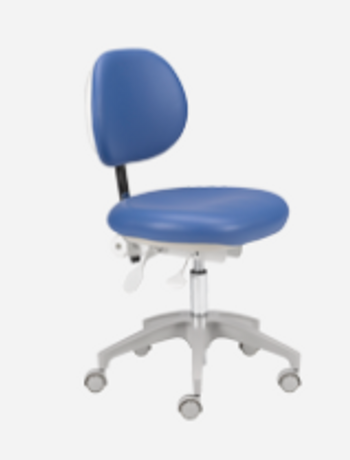
A dec 400
 A dec · Model 400
Ergonomic tilt. Helps you maintain the natural curve of your back reducing strain and fatigue. Large, anatomically-shaped backrest. Hugs the lower back. Easy-to-reach levers. Allow incremental or dynamic hip angle adjustments and seat height adjustment. Rolled edge. Helps reduce pressure on the legs and allows for proper circulation. Two cylinder heights (A-dec 400 doctor’s stool). Measure from hips to the feet. Above 32" - choose tall cylinder. Under 32" - choose short cylinder. Height-adjustable foot ring (A-dec 400 assistant’s stool). Helps assistant maintain correct posture. Adjustable torso support (A-dec 400 Assistant’s stool). Easily locks in place and can be converted for left or right-handed operators.
Key tips
- ·Biological-indicator verification applies to dental sterilizers exactly the same as hospital CSSD - no exception for smaller units.
- ·"Sounds different" is often the first real report of handpiece bearing wear, not an outright failure - investigate early rather than waiting.
Typical Failure Modes
Compiled for this model from its own documentation and established engineering knowledge for this equipment class - not from a verified service record. Confirm against the manufacturer's service manual.
Output / performance below spec
HighSymptoms: Compressor will not build pressure / cycles constantly; vacuum weak; curing light low irradiance; scanner poor scans.
Root cause: Wear in the core mechanism (compressor head, vacuum pump, LED / lamp, scanner optics) or a control fault.
Water / moisture / drain fault (compressor)
MediumSymptoms: Water in the air lines, drain not working, desiccant exhausted.
Root cause: Auto-drain fault or an exhausted air-dryer / desiccant.
Overheating / thermal cut-out
MediumSymptoms: Unit stops after a period, hot, restarts when cool.
Root cause: Cooling-fan fault, a blocked intake, or a worn motor.
Control / switch / timer fault
MediumSymptoms: Will not start / stop on demand, timer or mode selection unresponsive.
Root cause: Pressure switch, timer, or control board.
Noise / vibration
LowSymptoms: Loud operation, rattling, walking across the floor.
Root cause: Worn mounts, bearings, or loose panels.
Serviceable Parts & Consumables
Serviceable items for this model, compiled from its documentation and engineering knowledge for this equipment class. Service class and relative cost are estimates, not manufacturer figures; no part numbers are given. Confirm intervals and pricing against the manufacturer.
Core mechanism rebuild kit (compressor head / pump / LED)
Class Periodic replacementRel. cost $$R&R Moderate
Air-dryer / desiccant / auto-drain (compressor)
Class Frequent wear itemRel. cost $R&R Fairly easy
Cooling fan
Class Periodic replacementRel. cost $R&R Fairly easy
Pressure switch / timer / control board
Class Major service partRel. cost $$R&R Moderate
Anti-vibration mounts / bearings
Class Periodic replacementRel. cost $R&R Moderate
| Part | Service class | Relative cost | R&R difficulty |
|---|---|---|---|
| Core mechanism rebuild kit (compressor head / pump / LED) | Periodic replacement | $$ | Moderate |
| Air-dryer / desiccant / auto-drain (compressor) | Frequent wear item | $ | Fairly easy |
| Cooling fan | Periodic replacement | $ | Fairly easy |
| Pressure switch / timer / control board | Major service part | $$ | Moderate |
| Anti-vibration mounts / bearings | Periodic replacement | $ | Moderate |
Relative cost: $ lowest · $$$$ highest service-part cost for this equipment class. Not a price.
PM Checklist
Preventive-maintenance tasks typical of this equipment class. Perform to the manufacturer's procedure and your facility's policy - this is general reference, not a schedule for this specific unit.
- ·Daily handpiece lubrication and autoclave cycle verification
- ·Compressor moisture-trap draining
- ·Annual full PM
Troubleshooting Approach
A starting sequence for this model, compiled from its documentation and engineering knowledge for this equipment class. Follow the manufacturer's service documentation for the actual procedure.
Symptom: Output below spec
- Measure the actual output (pressure / vacuum / irradiance) against the spec.
- Inspect the core mechanism for wear.
- Check filters, intakes and drains.
- Rebuild or replace the core mechanism.
- Re-verify output after service.
Symptom: Overheats or will not start on demand
- Confirm airflow and clean the intake / fan.
- Check the pressure switch / timer operates.
- Let it cool and check the thermal cut-out.
- Replace the switch, fan or motor as isolated.
- Confirm normal duty-cycle operation.
Typical Location
Where this class of equipment is typically deployed - general reference, not this unit's own placement record.
- Dental operatory
- Oral surgery suite
- CSSD (dental sterilizers)
Documents & Manuals
Troubleshoot this device with Bio
Describe a symptom or error code. Bio answers from this device's own documented error codes, failure modes, parts, and guides.
Ask Bio