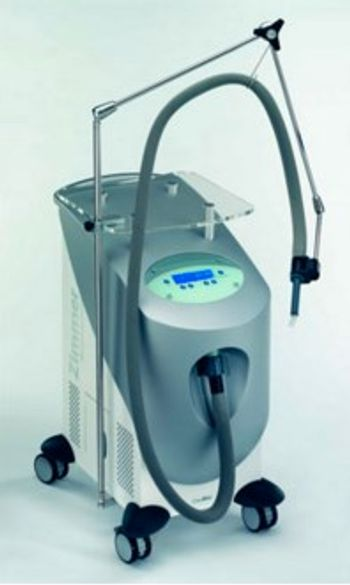
Zimmer Cryo Mini
 Zimmer · Model Cryo Mini
Easy Maintenance. Economic. Versatility. Easy Operation. Quick and Efficient Application. Noise Reducing Design. Warm up Status Indicator. Hands Free Operation.
Key tips
- ·Verify true laser output with an external power meter, not the console readout - the display drifts independently of real delivered energy.
- ·Never bypass a door interlock, key switch, or footswitch safety to finish a treatment - laser safety interlocks are not optional.
- ·Most low-output complaints trace to the delivery fiber or handpiece, not the laser source - inspect and swap those first.
- ·Intermittent mid-treatment shutdowns are usually cooling-related - check coolant level and flow before suspecting the diode or lamp.
Typical Failure Modes
Compiled for this model from its own documentation and established engineering knowledge for this equipment class - not from a verified service record. Confirm against the manufacturer's service manual.
No or low laser output
HighSymptoms: Weak or no output at the delivery device, treatment ineffective, power not reaching the set value.
Root cause: Laser module / lamp / diode-bar ageing, a damaged delivery fibre / handpiece / applicator, or a driver / power-supply fault.
Cooling / thermal shutdown
HighSymptoms: Unit shuts down after a period, over-temperature or low-flow alarm.
Root cause: Chiller / TEC fault, low or contaminated coolant, a failed pump, or blocked airflow.
Delivery fibre / handpiece / applicator fault
MediumSymptoms: Burn marks at the tip, high loss, intermittent output, applicator not recognised.
Root cause: Damaged or contaminated fibre / applicator / connector.
Skin-cooling / contact-cooling fault (aesthetic)
MediumSymptoms: Skin cooling not delivered, cooling / cryogen alarm.
Root cause: Contact-cooling / cryogen supply, a valve, or the tip.
Footswitch / interlock / key fault
MediumSymptoms: Laser will not fire, key / interlock / footswitch error.
Root cause: Footswitch, door interlock, or key-switch fault.
Serviceable Parts & Consumables
Serviceable items for this model, compiled from its documentation and engineering knowledge for this equipment class. Service class and relative cost are estimates, not manufacturer figures; no part numbers are given. Confirm intervals and pricing against the manufacturer.
Laser module / lamp / diode bar
Power re-calibration required after replacement.
Class Periodic replacementRel. cost $$$$R&R Expert-level
Delivery fibre / handpiece / applicator
Class Frequent wear itemRel. cost $$$R&R Fairly easy
Chiller / TEC components & coolant filter
Class Periodic replacementRel. cost $$$R&R Difficult
Contact-cooling tip / cryogen valve (aesthetic)
Class Periodic replacementRel. cost $$R&R Moderate
Footswitch
Class Periodic replacementRel. cost $$R&R Fairly easy
| Part | Service class | Relative cost | R&R difficulty |
|---|---|---|---|
| Laser module / lamp / diode bar Power re-calibration required after replacement. | Periodic replacement | $$$$ | Expert-level |
| Delivery fibre / handpiece / applicator | Frequent wear item | $$$ | Fairly easy |
| Chiller / TEC components & coolant filter | Periodic replacement | $$$ | Difficult |
| Contact-cooling tip / cryogen valve (aesthetic) | Periodic replacement | $$ | Moderate |
| Footswitch | Periodic replacement | $$ | Fairly easy |
Relative cost: $ lowest · $$$$ highest service-part cost for this equipment class. Not a price.
PM Checklist
Preventive-maintenance tasks typical of this equipment class. Perform to the manufacturer's procedure and your facility's policy - this is general reference, not a schedule for this specific unit.
- ·Laser output power verification against a calibrated external power meter
- ·Cooling-system check: coolant level, flow rate, and filter / heat-exchanger condition
- ·Delivery-system inspection: handpiece, delivery fiber or articulated arm, and output optics
- ·Interlock, key-switch, emergency-stop, and footswitch function test
- ·Beam-alignment and optical-path check per the service manual
- ·Annual full PM and electrical safety test
Troubleshooting Approach
A starting sequence for this model, compiled from its documentation and engineering knowledge for this equipment class. Follow the manufacturer's service documentation for the actual procedure.
Symptom: No or low output
- Measure output at the delivery device with a laser power meter against the setting.
- Fit a known-good delivery fibre / handpiece / applicator.
- Confirm the cooling system runs and coolant is at level and clean.
- Check the key, interlock and footswitch are satisfied.
- Escalate a confirmed laser-module or driver fault to the OEM; recalibrate power after any module work.
Symptom: Thermal shutdown
- Confirm the cooling fans / pump run and airflow is clear.
- Check the coolant level and replace the coolant filter.
- Let the unit cool and restart.
- Clean the air filters / vents.
- Monitor for recurrence during a treatment.
Technical Specs
- Height
- 650 mm
- Length
- 600 mm
- Weight
- 35.5 kg
- Width
- 335 mm
Typical Location
Where this class of equipment is typically deployed - general reference, not this unit's own placement record.
- Operating rooms and surgical procedure suites
- Dermatology and medical-aesthetic clinics
- ENT, gynecology, and specialty procedure rooms
- Outpatient surgical centers
Documents & Manuals
Safety & Recalls
Synced live from the FDA openFDA API.
- RECALL
Five complaints received where surgeon was unable to remove and/or connect the inserter with the stem during surgery due to excess material remaining within the taper. Issue may lead to clinically significant extension of surgery to find a replacement.
- RECALL
Elevated levels of bacterial endotoxin and residual debris remain on the devices due to cleaning issue.
- RECALL
The product was potentially being packaged without a taper adapter.
- RECALL
Correction to update the surgical technique for the Compress System. To make users aware of the changes that were made only to the selection criteria section on page 42 regarding which array to use in the placement of the anti-rotation pins.
- RECALL
Zimmer Biomet is conducting a lot specific medical device recall for two lots of the Orthopedic Salvage System (OSS) and the Comprehensive Shoulder System. The investigation determined that the Mini Humeral Stem is potentially labeled as the Bowed IM Stem lot. The associated risk of this product issue is a potential extension of surgery <30 minutes if a replacement is readily available.
- RECALL
Lack of adequate validation and controls to ensure that product cleanliness parameters were consistently met.
- RECALL
A raw material anomaly was discovered in four lots of raw material and has the potential to be on or below the surface of the device components which can increase the risk of instrument fracture
- RECALL
Possibility that the patient label inside the product box was incorrectly labeled. The outer box label and actual product are correctly identified but the internal patient label could be incorrect.
- RECALL
A small hole may be present in the inner tray of specific lots of sterile Hip and Trauma Implant Screws.
- RECALL
As a result of the insufficient sealer calibration data for product packaged in firm's Building II between August 2010 and April 2013. The affected products are sterile.
- RECALL
Devices were placed in a shipper carton without the appropriate number of the Instructions for Use (IFU). Packaging specifications require that each sales unit is accompanied by an IFU. Only one IFU was present in the shipper carton, instead of one IFU per each of the two sales units.
- RECALL
Zimmer recently conducted a review of all historic packaging validations at its Zimmer Manufacturing B.V. (ZMBV) facility in Ponce, Puerto Rico. Based on this review, it was determined that the packaging operations conducted in the Building 1 packaging operation at this facility were not properly validated. As a result, Zimmer conducted seal integrity testing to evaluate if previously packaged product from this facility met the established requirements for sterile barrier integrity. The acceptance criteria established for this testing was 99% reliability with a 90% confidence interval. These packaging tray configurations met the acceptance criteria for sterile barrier integrity of both the inner and outer trays, however, Zimmer has decided to recall all manufacturing lots that have not expired and that were sterile packaged in the ZMBV facility Building 1 packaging operations.
- RECALL
Zimmer is recalling Pathfinder NXT Fixed Percutaneous Rod Holder, because complaints have been received that the rod holder tip may crack or break when the rod is manipulated during surgery.
Troubleshoot this device with Bio
Describe a symptom or error code. Bio answers from this device's own documented error codes, failure modes, parts, and guides.
Ask Bio