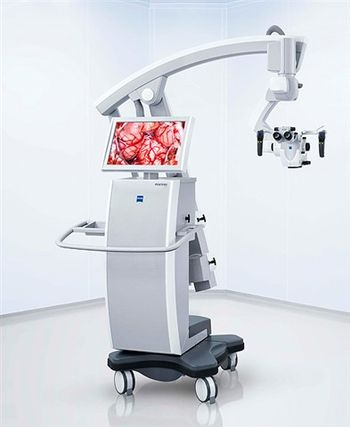
ZEISS OPMI PENTERO 900
 ZEISS · Model OPMI PENTERO 900
Apochromatic optics Razor-sharp video images in full HD quality Innovative intraoperative fluorescence modules Smooth system handling via touchscreen, handgrips, mouth switch or wireless foot control panel Superior functionality, e.g. with the Foldable Tube f170/f260 AutoBalance and AutoDrape for fast system set-up Interacts with current and emerging workplace technologies (e.g. Neuromonitoring) Creates an optimal OR experience with workflow-based solutions Integrated interface for navigation and neuro-monitoring.
Typical Failure Modes
Compiled for this model from its own documentation and established engineering knowledge for this equipment class - not from a verified service record. Confirm against the manufacturer's service manual.
System error shown in the data-injection display
HighSymptoms: Error message in the eyepiece data injection, function inhibited.
Root cause: An internal subsystem fault - acknowledge via the right-handgrip pushbutton or touchscreen; if it will not clear, service is required.
Failure of control functions (zoom / focus)
HighSymptoms: Motorised zoom and focus will not respond.
Root cause: Drive or control fault - set the emergency switch to emergency mode and operate zoom/focus manually.
Suspension / AutoBalance fault
HighSymptoms: Head drifts, AutoBalance fails, arm will not hold after draping.
Root cause: Balance drive or the magnetic brakes; re-balance after any accessory change.
Illumination (xenon) fault
MediumSymptoms: No or dim light, lamp error.
Root cause: Xenon lamp module at end of life or its igniter/power supply.
Touchscreen / handgrip / foot-control input fault
MediumSymptoms: One input method unresponsive.
Root cause: Touchscreen, handgrip, mouth switch or wireless foot-control panel fault.
Serviceable Parts & Consumables
Serviceable items for this model, compiled from its documentation and engineering knowledge for this equipment class. Service class and relative cost are estimates, not manufacturer figures; no part numbers are given. Confirm intervals and pricing against the manufacturer.
Xenon lamp module
Class Frequent wear itemRel. cost $$R&R Moderate
Balance drive / magnetic brake assembly
Class Major service partRel. cost $$$$R&R Expert-level
Zoom / focus motor assembly
Class Major service partRel. cost $$$R&R Difficult
Wireless foot-control panel
Class Major service partRel. cost $$$R&R Fairly easy
Touchscreen assembly
Class Major service partRel. cost $$$R&R Difficult
| Part | Service class | Relative cost | R&R difficulty |
|---|---|---|---|
| Xenon lamp module | Frequent wear item | $$ | Moderate |
| Balance drive / magnetic brake assembly | Major service part | $$$$ | Expert-level |
| Zoom / focus motor assembly | Major service part | $$$ | Difficult |
| Wireless foot-control panel | Major service part | $$$ | Fairly easy |
| Touchscreen assembly | Major service part | $$$ | Difficult |
Relative cost: $ lowest · $$$$ highest service-part cost for this equipment class. Not a price.
Troubleshooting Approach
A starting sequence for this model, compiled from its documentation and engineering knowledge for this equipment class. Follow the manufacturer's service documentation for the actual procedure.
Symptom: System error on the touchscreen / data injection
- Acknowledge the message via the right-handgrip pushbutton or the touchscreen.
- If it clears, watch for recurrence and log it.
- If it will not clear, attach an out-of-order sign and contact the ZEISS service representative.
- Do not use for surgery until cleared.
- Record the error text for service.
Symptom: Zoom / focus will not run
- Set the emergency switch (7) to emergency mode (position 2).
- Operate zoom and focus manually.
- Hold the microscope by its body, not the handgrips, and overcome the brake to position it.
- Complete or abort the case safely.
- Contact ZEISS service for the drive fault.
Technical Specs
- Weight
- 358 kg
- Focusing
- Motorized
- Magnification
- 1:5
Documents & Manuals
Troubleshoot this device with Bio
Describe a symptom or error code. Bio answers from this device's own documented error codes, failure modes, parts, and guides.
Ask Bio