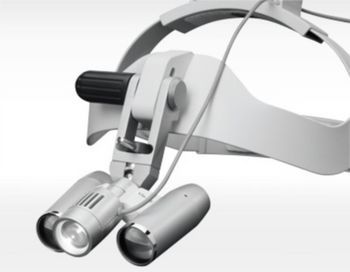
ZEISS EyeMag Light II
 ZEISS · Model EyeMag Light II
Two powerful rechargeable battery packs Charging cradle Offers coaxial light, resulting in minimal shadow formation Clearly defined illuminated field.
Key tips
- ·Never defeat or bypass a return-electrode monitoring (REM) alarm to finish a case - it's a direct burn risk.
- ·Verify OR table battery backup - a table that loses power mid-procedure is a real, documented incident type.
- ·Track surgical light lamp-hours rather than waiting for failure - a sudden failure mid-case is avoidable.
Typical Failure Modes
Compiled for this model from its own documentation and established engineering knowledge for this equipment class - not from a verified service record. Confirm against the manufacturer's service manual.
No or dim light output
HighSymptoms: Headlight out, dim, flickering, or colour shift.
Root cause: LED module / xenon lamp at end of life, a driver / power-supply fault, or a fibre-optic / light-cable fault.
Fibre-optic cable fault
MediumSymptoms: Noticeably dim spot, dark speckle in the beam.
Root cause: Broken fibres in the light cable (common wear item).
Battery / belt-pack fault (portable LED)
MediumSymptoms: Short run time, will not charge, cuts out.
Root cause: Aged battery pack.
Headband / focus / mechanical fault
LowSymptoms: Headband will not hold adjustment, spot will not focus, hinge loose.
Root cause: Worn headband ratchet or focus mechanism.
Fan / thermal fault (light source)
LowSymptoms: Source overheats or shuts down, loud fan.
Root cause: Failed or clogged cooling fan.
Serviceable Parts & Consumables
Serviceable items for this model, compiled from its documentation and engineering knowledge for this equipment class. Service class and relative cost are estimates, not manufacturer figures; no part numbers are given. Confirm intervals and pricing against the manufacturer.
LED module / xenon lamp
Class Frequent wear itemRel. cost $$R&R Fairly easy
Fibre-optic light cable
Class Frequent wear itemRel. cost $$R&R Easy
Battery / belt pack (portable)
Class Periodic replacementRel. cost $$R&R Fairly easy
Driver / power supply
Class Major service partRel. cost $$R&R Moderate
Headband ratchet / focus assembly
Class Periodic replacementRel. cost $$R&R Fairly easy
| Part | Service class | Relative cost | R&R difficulty |
|---|---|---|---|
| LED module / xenon lamp | Frequent wear item | $$ | Fairly easy |
| Fibre-optic light cable | Frequent wear item | $$ | Easy |
| Battery / belt pack (portable) | Periodic replacement | $$ | Fairly easy |
| Driver / power supply | Major service part | $$ | Moderate |
| Headband ratchet / focus assembly | Periodic replacement | $$ | Fairly easy |
Relative cost: $ lowest · $$$$ highest service-part cost for this equipment class. Not a price.
PM Checklist
Preventive-maintenance tasks typical of this equipment class. Perform to the manufacturer's procedure and your facility's policy - this is general reference, not a schedule for this specific unit.
- ·Pre-case functional check
- ·Electrosurgical return-electrode cable inspection
- ·Table hydraulic / mechanical inspection
- ·Annual electrical safety test and full PM
Troubleshooting Approach
A starting sequence for this model, compiled from its documentation and engineering knowledge for this equipment class. Follow the manufacturer's service documentation for the actual procedure.
Symptom: No or dim light
- Check the lamp / LED hours and replace the module if near / past its rating.
- Inspect the fibre-optic cable for dark fibres against a bright light and swap it.
- Confirm the battery is charged (portable) or the source powers up.
- Replace the driver / power supply if the source will not light.
- Verify full brightness with a known-good cable.
Symptom: Short battery run time (portable)
- Charge fully and check the charger.
- Run a battery capacity check if supported.
- Replace the battery / belt pack.
- Confirm run time returns to spec.
- Inspect the pack connector and cable.
Typical Location
Where this class of equipment is typically deployed - general reference, not this unit's own placement record.
- Operating rooms
- Procedure rooms
- Interventional suites
Documents & Manuals
No documents available for this device yet.
Safety & Recalls
Synced live from the FDA openFDA API.
- RECALL
The manufacturer confirmed that the opto-semiconductor sensors can be triggered by exposure to incandescent lighting. The safety interlock is in place to prevent unintended exposure to Class 3B laser radiation.
Troubleshoot this device with Bio
Describe a symptom or error code. Bio answers from this device's own documented error codes, failure modes, parts, and guides.
Ask Bio