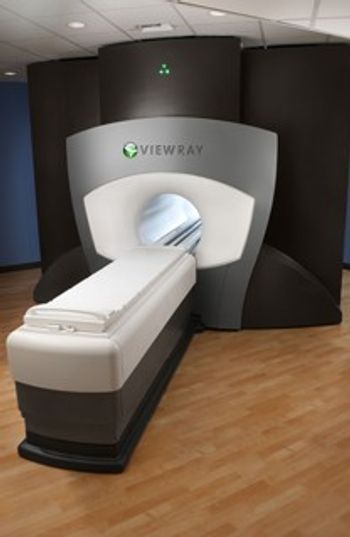
ViewRay MRI-Guided Radiation Therapy System
 ViewRay · Model MRI-Guided Radiation Therapy System
A rotating gantry assembly with three Cobalt-60 teletherapy heads and three multileaf collimators. A split-magnet MRI system for volumetric and multiplanar soft-tissue imaging. A patient couch, two in-room couch control panels, and a laser positioning system to facilitate initial patient setup. A control console, located just outside the treatment room, to start and stop treatment and monitor status. An operator console for MRI acquisition, patient positioning, dose prediction and reoptimization, and real-time tumor tracking. Integrated treatment planning and delivery software for creating treatment plans and managing the treatment delivery process. A planning station for defining structures and constraints and planning and optimizing treatments. Plan reviews may be conducted remotely. A database server containing patient and machine data used by the system.
Key tips
- ·Never bypass a radiation interlock to "just get the image" - this is one of the few true zero-tolerance rules in BMET work.
- ·Trend image-quality phantom results over time - drift shows up before an outright failure does.
- ·Portable/mobile units take real physical abuse from transport - check wheel locks and cable strain reliefs more often than fixed units.
Typical Failure Modes
Compiled for this model from its own documentation and established engineering knowledge for this equipment class - not from a verified service record. Confirm against the manufacturer's service manual.
RF coil fault / poor SNR
HighSymptoms: Low signal-to-noise, shading, or a dead region in images; coil not detected or fails the coil check.
Root cause: Damaged RF coil element, a coil-cable / connector fault, or a preamp fault.
Gradient fault / image distortion
HighSymptoms: Geometric distortion, gradient-amplifier faults, acoustic change, over-temperature trips.
Root cause: Gradient-amplifier fault, gradient-coil cooling problem, or a gradient-coil fault.
Cryogen / cold-head / compressor fault
HighSymptoms: Rising helium boil-off, cold-head noise or stall, He level dropping, compressor alarms.
Root cause: Cold-head at end of life, a helium-compressor fault, or a chilled-water problem.
Chilled water / cooling fault
MediumSymptoms: System-cooling alarms, gradient or RF over-temperature, scans aborting.
Root cause: Facility chilled-water supply, the heat exchanger, or internal pumps.
Patient table / positioning fault
MediumSymptoms: Table will not dock, drive or index; landmarking errors.
Root cause: Table drive, docking sensor, or encoder fault.
Reconstruction / host / network fault
MediumSymptoms: Recon errors, host hangs, images will not reach PACS.
Root cause: Recon or host computer fault, or the network / storage.
Serviceable Parts & Consumables
Serviceable items for this model, compiled from its documentation and engineering knowledge for this equipment class. Service class and relative cost are estimates, not manufacturer figures; no part numbers are given. Confirm intervals and pricing against the manufacturer.
RF receive coil (exchange)
Class Major service partRel. cost $$$$R&R Moderate
Cold head
Planned replacement; He boil-off rises as it wears.
Class Periodic replacementRel. cost $$$$R&R Difficult
Helium compressor / adsorber
Class Major service partRel. cost $$$$R&R Difficult
Gradient amplifier module
Class Major service partRel. cost $$$$R&R Expert-level
Chilled-water pump / heat exchanger
Class Major service partRel. cost $$$R&R Difficult
Patient table drive / encoder
Class Major service partRel. cost $$$R&R Difficult
| Part | Service class | Relative cost | R&R difficulty |
|---|---|---|---|
| RF receive coil (exchange) | Major service part | $$$$ | Moderate |
| Cold head Planned replacement; He boil-off rises as it wears. | Periodic replacement | $$$$ | Difficult |
| Helium compressor / adsorber | Major service part | $$$$ | Difficult |
| Gradient amplifier module | Major service part | $$$$ | Expert-level |
| Chilled-water pump / heat exchanger | Major service part | $$$ | Difficult |
| Patient table drive / encoder | Major service part | $$$ | Difficult |
Relative cost: $ lowest · $$$$ highest service-part cost for this equipment class. Not a price.
PM Checklist
Preventive-maintenance tasks typical of this equipment class. Perform to the manufacturer's procedure and your facility's policy - this is general reference, not a schedule for this specific unit.
- ·Daily QC per modality: image-quality phantom test
- ·Tube and detector inspection
- ·Annual state-required radiation safety survey
- ·Vendor-scheduled preventive maintenance
Troubleshooting Approach
A starting sequence for this model, compiled from its documentation and engineering knowledge for this equipment class. Follow the manufacturer's service documentation for the actual procedure.
Symptom: Poor SNR or a dead region with one coil
- Swap in a known-good coil of the same type and repeat the scan.
- Run the coil-check / coil-QA tool.
- Inspect the coil housing and cable for damage; reseat the connector.
- Scan the ACR / QA phantom and compare SNR to baseline.
- Quarantine and exchange the faulty coil.
Symptom: Rising helium boil-off or cold-head noise
- Log the helium level and boil-off trend daily.
- Check the cold-head sound and the compressor pressures against spec.
- Confirm the chilled-water supply temperature and flow.
- Schedule a cold-head / compressor service before the level reaches the OEM action point.
- Never let the magnet approach a quench threshold - escalate urgently.
Typical Location
Where this class of equipment is typically deployed - general reference, not this unit's own placement record.
- Radiology / Imaging department
- Emergency Department (portable units)
- Operating Room (C-arms)
- Cath lab
- Bedside ICU (portable X-ray)
Documents & Manuals
No documents available for this device yet.
Safety & Recalls
Synced live from the FDA openFDA API.
- RECALL
Software anomalies affecting the French, German and Italian versions of treatment delivery system (TDS) software.
- RECALL
There is a potential that components of the receive coil can reach elevated temperatures which has the potential to cause a burn injury to the patient or user.
- RECALL
Registering dose and structures in the treatment delivery workflow could result in an alignment discrepancy between the imported previously delivered dose and the displayed patient anatomy and structures. The MRIdian TPDS software shows this misalignment to the user in the predicted dose-volume histogram (DVH). The misalignment impact may not be obvious to the user. During plan re-optimization the previously delivered dose would be incorrectly accounted for by the software. This may result in unexpectedly higher or lower dose than the intended dose calculated for the subsequent treatment plan. When this occurs in the treatment planning workflow, the registration fails to align the dose with the image and the user is unable to proceed.
- RECALL
A discrepancy between optimization and planning forward dose calculation between adaptive optimizations and AQA dose calculations can occur.
- RECALL
Issue with transferring treatment regiment from one system to another. Adequate instructions for transferring treatment plan(s) are not provided within the operator's manual or within the software operating system.
- RECALL
When editing the isocenter or the couch position of the plan while in the treatment workflow (in the Points screen) and re-optimizing, the software will not prompt the user to shift the couch to the new isocenter. As a result there is the potential to deliver dose to the initial isocenter rather than the new location.
- RECALL
The system loaded a completion fraction in the incorrect order after a treatment interruption.
- RECALL
ViewRay discovered that in the event that an encoder breaks or fails on the Patient Handling System (PHS, or couch), when attempting to restart the system, the couch could move unexpectedly.
- RECALL
The software was failing to determine new patient locations if imaging is not enabled during treatment.
- RECALL
ViewRay received a report that the couch moved unexpectedly into the bore after performing a RTCS reboot.
- RECALL
The software was not correctly using the RT (Radiation Therapy) to MR (Magnetic Resonance image) coordinate correction for non HFS (Head First Supine) patient orientations, resulting in slice mismatch error.
Troubleshoot this device with Bio
Describe a symptom or error code. Bio answers from this device's own documented error codes, failure modes, parts, and guides.
Ask Bio