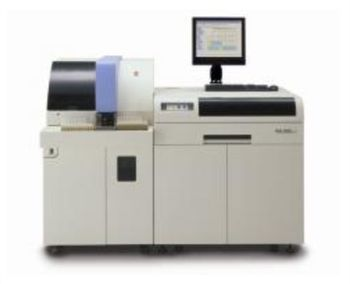
Tosoh Bioscience AIA-1800
 Tosoh Bioscience · Model AIA-1800
Throughout of 180 results per hour. User friendly Windows-based software. AIA-Pack reagent loading of 620 test cups. Sample capacity of 170 samples on standard module with continuous access. STAT positions for urgent samples. Reflex testing. Clot and level sensing. Disposable pipette tips. This eliminates sample carryover. Automated dilution and pre-treatment of samples. Rapid, automated daily maintenance, which reduces hands on time. Full Quality control programme using Westgard Rules and Levey Jennings plot with statistics. Analyte consumption check.
Key tips
- ·Run QC controls before trusting any repair - an analyzer that passes self-test can still report clinically wrong results.
- ·Rule out a reagent lot change before opening the instrument - it can look exactly like a hardware fault.
- ·Centrifuge rotors have a hard retirement age/cycle limit regardless of visible condition - don't eyeball it.
Typical Failure Modes
Compiled for this model from its own documentation and established engineering knowledge for this equipment class - not from a verified service record. Confirm against the manufacturer's service manual.
QC / calibration failure on an assay
HighSymptoms: Controls out of range, calibration fails, flagged results on one or more assays.
Root cause: Reagent pack issue, a probe / dispense fault, incubation-temperature drift, or a detector / optics fault.
Sample / reagent probe or pipettor fault
MediumSymptoms: Short aspiration, no dispense, clot / level-sense errors, carryover.
Root cause: Clogged or bent probe, a syringe / pump fault, or a level-sense fault.
Wash / aspiration station fault
MediumSymptoms: High background / noise, poor precision, elevated blanks.
Root cause: Blocked wash-station nozzles or a wash-pump / vacuum fault.
Incubator temperature fault
MediumSymptoms: Assay drift or bias, incubation-temperature alarm.
Root cause: Incubator heater or temperature-sensor fault.
Detector / luminometer / photometer fault
MediumSymptoms: Low signal, high CV, detector-error message.
Root cause: PMT / detector ageing or an optics fault.
Serviceable Parts & Consumables
Serviceable items for this model, compiled from its documentation and engineering knowledge for this equipment class. Service class and relative cost are estimates, not manufacturer figures; no part numbers are given. Confirm intervals and pricing against the manufacturer.
Sample / reagent probe
Class Periodic replacementRel. cost $$R&R Moderate
Syringe / dispense pump
Class Periodic replacementRel. cost $$R&R Moderate
Wash-station nozzles / pump tubing
Class Frequent wear itemRel. cost $R&R Moderate
Incubator heater / temperature sensor
Class Major service partRel. cost $$R&R Moderate
Detector / PMT module
Class Major service partRel. cost $$$R&R Difficult
| Part | Service class | Relative cost | R&R difficulty |
|---|---|---|---|
| Sample / reagent probe | Periodic replacement | $$ | Moderate |
| Syringe / dispense pump | Periodic replacement | $$ | Moderate |
| Wash-station nozzles / pump tubing | Frequent wear item | $ | Moderate |
| Incubator heater / temperature sensor | Major service part | $$ | Moderate |
| Detector / PMT module | Major service part | $$$ | Difficult |
Relative cost: $ lowest · $$$$ highest service-part cost for this equipment class. Not a price.
PM Checklist
Preventive-maintenance tasks typical of this equipment class. Perform to the manufacturer's procedure and your facility's policy - this is general reference, not a schedule for this specific unit.
- ·Daily QC controls run and reviewed
- ·Calibration verification per assay
- ·Routine cleaning and decontamination
- ·Scheduled reagent-path and pump-tubing maintenance
Troubleshooting Approach
A starting sequence for this model, compiled from its documentation and engineering knowledge for this equipment class. Follow the manufacturer's service documentation for the actual procedure.
Symptom: QC or calibration failure
- Run fresh controls and recalibrate the affected assay.
- Confirm the reagent pack is in date, mixed and correctly loaded.
- Clean the probes and wash stations.
- Check the incubator temperature against a reference.
- Escalate a detector / optics fault to the OEM.
Symptom: Probe or pipettor fault
- Inspect the probe for a bend or clog and clear it.
- Run the fluidics prime.
- Check the syringe / pump and tubing for leaks or air.
- Verify level sensing and probe position.
- Replace the probe or syringe as found and re-run QC.
Technical Specs
- Height
- 125 cm
- Length
- 93 cm
- Weight
- 300 kg
- Width
- 165 cm
Typical Location
Where this class of equipment is typically deployed - general reference, not this unit's own placement record.
- Central / core laboratory
- Point-of-care testing stations
- Blood bank
- Microbiology lab
Documents & Manuals
No documents available for this device yet.
Safety & Recalls
Synced live from the FDA openFDA API.
- RECALL
The Test cup lot F level 1 low-quality control results values for the device were lower than expected on the Automated Immunoassay Analyzer (AIA) which could cause falsely elevated or falsely low total testosterone results. Such erroneous test results may lead to additional testing/diagnostic interventions and in limited cases, may lead to a delay in diagnosis and/or initiation of unnecessary or incorrect clinical treatment measures.
- RECALL
Decreased stability for five (5) lots of Calibrator Sets and Calibration Verification Test Sets, resulting in a decrease measured concentration of HCG up to 20%.
- RECALL
The Substrate Monitoring System in the AIA-900 Analyzer did not detect an empty substrate bottle. The issue may lead to erroneous immunoassay test results.
- RECALL
A display screen software issue on the analyzer causes the display to freeze when display screen is touched at the same time as a command from the instrument firmware, causing the instrument to stop. As a result, the run is aborted and the results are not retrievable.
- RECALL
The AIA-2000 bar code scanners depend on the quiet zone to help identify the bar code. The lack of an adequate quiet zone can cause the bar code scanner to confuse the bar codes with text or graphics resulting in the scanner ignoring a valid symbol. This results in an error in reading the barcode: Error Code 2220 Unable to read barcode on reagent bottle. In some cases, the quiet zone is too short and an error in barcode reading occurs. The problem is intermittent and not all vials (6 vials are available per set) have been reported to fail. The only risk to patients or users is a delay in results. The company recommends (optional) that customers pre-screen the vials to identify affected products. Customers can contact the company for reimbursement of any affected products. The company has implemented barcode checks as a temporary solution and will replace the barcode printer on the produc
- RECALL
Potential for fluorescein interference to cause inaccurately elevated results for certain Tosoh AIA assays
- RECALL
Tosoh Bioscience has become aware of a potential issue with the pickup arm and pickup arm motor on the AIA-900 Analyzer. If the pickup arm or pickup arm motor malfunctions, the analyzer will cease to function and result in an inability to test patient samples. This may cause a delay in testing and reporting patient results. Tosoh has received fifty-one (51) complaints related to this issue with no serious injuries reported.
- RECALL
Tosoh Bioscience has become aware of a potential issue with the axis base of the turntable rotation drive motor on the AIA-900 Analyzer. If the tension of the timing belt between the turntable rotation pulley and drive motor is not adjusted correctly, it is possible to increase the lateral load on the motor axis resulting in the inclination and damage of the motor axis. Since January 12, 2017, Tosoh has been inspecting the tension of the timing belt during scheduled preventative maintenance visit and correcting the analyzers where this issue has been observed. If the drive motor fails, the AIA-900 analyzer will cease to function and will be unavailable for use. If this issue occurs, there may be a delay in testing and reporting patient test results. Tosoh has received five (5) complaints related to this issue with no serious injuries reported.
- RECALL
There is a possibility that the liquid suction pump on some AIA-2000 analyzers may not perform as intended and cause an insufficient volume of wash solution to be removed during the washing step. Incomplete washing of the sample may result in falsely elevated test results for the sandwich assays and falsely decreased test results for the competitive binding assays. Insufficient washing is detectable through review of the calibration data and QC trending. For example, if incomplete washing occurs, the reported values for the zero- calibration rate will be above the acceptance range. The calibration value may shift and the instrument will not calibrate successfully. If this issue occurs, there may be a delay in testing and reporting patient test results. There have been no user or patient injuries reported related to this issue.
- RECALL
A software issue may cause the liquid volume detection entries for 2nd and 3rd reagent bottles to be overwritten with the data from the 1st reagent bottle. Tosoh has released software version 2.51 (or later) to fix the problem. This failure is mitigated by the hardware design. The consequence would be a slight delay in testing patient sample or reporting patient result.
- RECALL
The firm has implemented new product labeling changes for the Tosoh AIA-360 Analyzer. These labeling changes affect the Tosoh Quick Reference Guide, Training Manual and Training DVD previously provided by Tosoh Bioscience. These changes are being made to align the Tosoh Quick Reference Guide and associated training materials to the Operators Manual and provide clarification to the requirement that the maintenance of the B/F probe is to be performed by Tosoh a field service representative, the requirement for use of 70% Ethanol during daily shutdown procedures and the requirement for use of CAP Class 1 reagent grade water for dilution of the concentrated wash and diluent solutions and reconstitution of lyophilized reagents. Failure to follow these requirements may negatively affect system performance, lead to corrosion of instrument components over time, or result in bacterial contaminati
- RECALL
Distribution of unapproved product labeling
- RECALL
The assay can potentially generate erroneously elevated or erroneously decreased HbA1c patient results.
- RECALL
Asfotase Alfa (Strensiq) interferes with certain Tosoh assays which potentially causes falsely increased or falsely decreased immunoassay test results, depending upon the assay.
- RECALL
Falsely elevated progesterone assay values will occur when using certain progesterone assay part numbers due to cross reactivity of DHEA-S, a metabolite of the DHEA (dehydroepiandrosterone) supplement.
- RECALL
The firm has become aware of a potential issue that may affect the mixing motor drive harness and mixing home detection sensor relay harness on your AIA-900 Analyzer. It is possible that the harnesses could rub against the Plarail chain during operation and result in premature wear. If observed, this issue will cause the following system error to be reported D.lane Mix home overrun error [4093] . If observed, this issue will cause the AIA-900 Analyzer not to function and the D.lane Mix home overrun error [4093] will be reported by the system. Replacement of the motor drive harness and mixing home detection sensor relay harness will mitigate the potential for premature wear and effectively prevent this issue from causing the system error. If the sensor relay harness fails, the AIA-900 analyzer will cease to function and will be unavailable for use. If this issue occurs, there ma
- RECALL
This recall has been initiated due to a potential malfunction of the photo interrupter (Pl). The potential malfunction has been attributed to aging and premature deterioration of the Pl collector current.
- RECALL
The firm has become aware of a potential issue with the AIA-360 analyzer that could prevent the table home sensor from detecting the table home position. If the malfunction with the table home sensor occurs on the AIA-360, the sensor board may need to be replaced. If the home sensor fails to detect the home position, the AIA-360 analyzer will cease to function and will be unavailable for use. If this issue occurs, there may be a delay in testing and reporting patient test results. Tosoh has received three (3) complaints related to this issue with no serious injuries reported.
- RECALL
The label contains two different methodologies. Quality Control values for non-FDA approved methodology (CL) are on the label in addition to the FDA approved methodology values (AIA). Two sets of instructions were included on the label.
- RECALL
Visual inspection of the pipette tips indicated that some of the tips were not uniform in size/length which was causing error messages on the analyzers.
- RECALL
Some combinations of Calibrator lots and AlA PACKS resulted in Calibrator #6 not giving a value, making the calibration unacceptable.
- RECALL
The value after reconstitution appeared to be lower than the assigned value on the label. The measured value for Lot BCAL05R was 5.3%, whereas the value on the label is 5.7%. The criteria of the value is +/- 0.3%.
- RECALL
Reports of low calibration rate value flags; Use of the recalled product may result in failure to calibrate the instrument
- RECALL
The inner foil packs of AIA-PACK ST TT3, Lot FX17440 contain an incorrect expiration date of 10/2005. The outer box is labeled with the correct expiration date of 10/2006.
- RECALL
On 10/30/04, the firm initiated the recall and its notification was via letters requesting return of affected devices.
- RECALL
A software upgrade was released by the firm for its AIA-600 II analyzers, in that washing deficiencies caused by the analyzer were corrected.
Troubleshoot this device with Bio
Describe a symptom or error code. Bio answers from this device's own documented error codes, failure modes, parts, and guides.
Ask Bio