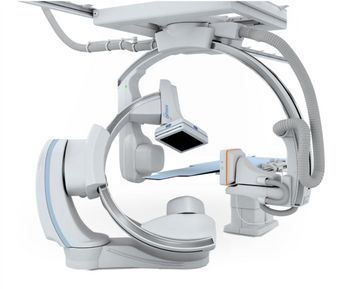
Toshiba Infinix
 Toshiba · Model Infinix
Instant image display at fluoroscopy initiation to ensure critical information is immediately available Head-to-toe coverage Designed to fit in conventionally sized cardiovascular suites Advanced image processing technology to increase resolution and virtually eliminate lag 3D imaging Parallel processing Freedom to configure room set up based on procedure needs Low contrast imaging option High speed acquisition Flexible and accurate C-arm positioning reduces overall exposure by shortening exam times.
Key tips
- ·Never bypass a radiation interlock to "just get the image" - this is one of the few true zero-tolerance rules in BMET work.
- ·Trend image-quality phantom results over time - drift shows up before an outright failure does.
- ·Portable/mobile units take real physical abuse from transport - check wheel locks and cable strain reliefs more often than fixed units.
Typical Failure Modes
Compiled for this model from its own documentation and established engineering knowledge for this equipment class - not from a verified service record. Confirm against the manufacturer's service manual.
Fluoro image quality / dose fault
HighSymptoms: Noisy or dim fluoro, dose creep, poor DSA, ABC not tracking.
Root cause: Flat-panel detector degradation or the dose / image-processing chain.
No or inconsistent exposure / generator error
HighSymptoms: Fluoro or cine inhibited, generator error code, tube-arc faults.
Root cause: HV generator, the X-ray tube, or the filament supply.
C-arm / L-arm positioner fault
MediumSymptoms: Gantry will not angulate, rotate or reach a stored position; collision trips.
Root cause: Positioner drive, encoder, brake, or collision sensors.
Table motion / tableside-control fault
MediumSymptoms: Table float, tilt, height or cradle will not respond; tableside module dead.
Root cause: Table drive, the tableside control module, or its cable.
Hemodynamic / recording or injector-interface fault
MediumSymptoms: Pressures / ECG missing on the hemo system, injector arm / interface fault.
Root cause: Hemo transducer inputs, the recording PC, or the injector interface.
Tube cooling / duty-cycle lockout
LowSymptoms: Fluoro / cine inhibited after a run, tube-heat alarm.
Root cause: Tube heat limit or a heat-exchanger fault.
Serviceable Parts & Consumables
Serviceable items for this model, compiled from its documentation and engineering knowledge for this equipment class. Service class and relative cost are estimates, not manufacturer figures; no part numbers are given. Confirm intervals and pricing against the manufacturer.
Flat-panel detector (exchange)
Class Major service partRel. cost $$$$R&R Expert-level
X-ray tube assembly
Class Periodic replacementRel. cost $$$$R&R Expert-level
HV generator components
Class Major service partRel. cost $$$$R&R Expert-level
Positioner drive / encoder / brake
Class Major service partRel. cost $$$R&R Difficult
Table drive / tableside control module
Class Major service partRel. cost $$$R&R Difficult
Heat exchanger / cooling components
Class Major service partRel. cost $$$R&R Difficult
| Part | Service class | Relative cost | R&R difficulty |
|---|---|---|---|
| Flat-panel detector (exchange) | Major service part | $$$$ | Expert-level |
| X-ray tube assembly | Periodic replacement | $$$$ | Expert-level |
| HV generator components | Major service part | $$$$ | Expert-level |
| Positioner drive / encoder / brake | Major service part | $$$ | Difficult |
| Table drive / tableside control module | Major service part | $$$ | Difficult |
| Heat exchanger / cooling components | Major service part | $$$ | Difficult |
Relative cost: $ lowest · $$$$ highest service-part cost for this equipment class. Not a price.
PM Checklist
Preventive-maintenance tasks typical of this equipment class. Perform to the manufacturer's procedure and your facility's policy - this is general reference, not a schedule for this specific unit.
- ·Daily QC per modality: image-quality phantom test
- ·Tube and detector inspection
- ·Annual state-required radiation safety survey
- ·Vendor-scheduled preventive maintenance
Troubleshooting Approach
A starting sequence for this model, compiled from its documentation and engineering knowledge for this equipment class. Follow the manufacturer's service documentation for the actual procedure.
Symptom: Poor fluoro image or dose creeping
- Image a phantom at a fixed geometry and compare to the room baseline.
- Check the flat-panel detector performance via service diagnostics.
- Review the dose trend / DAP log.
- Escalate a confirmed detector degradation to the OEM.
- Re-verify dose rate and image quality after correction.
Symptom: Generator error / no exposure
- Record the exact error code and phase.
- Confirm mains and all room interlocks (doors, tube position).
- Confirm the tube is not in a thermal lockout.
- Run tube conditioning / seasoning.
- Escalate a confirmed HV / tube fault; verify output after repair.
Typical Location
Where this class of equipment is typically deployed - general reference, not this unit's own placement record.
- Radiology / Imaging department
- Emergency Department (portable units)
- Operating Room (C-arms)
- Cath lab
- Bedside ICU (portable X-ray)
Documents & Manuals
No documents available for this device yet.
Safety & Recalls
Synced live from the FDA openFDA API.
- RECALL
It was found that during a procedure the Peak Skin Dose (PSD) value displayed by the Dose Tracking System (DTS) was larger than the DTS expected value. This issue occurs when the power for the Angio Workstation is turned on after the power for the Infinix system is turned on.
- RECALL
Although the Flat Panel Detector (FPD) touch sensor is activated during use, the error message is displayed and the audible signal continues sounding during the table movement of longitudinal tilt, the movement of longitudinal tilt does not stop.
- RECALL
Lost and incorrect images. When using the "F-Rec" fluoroscopy image acquisition recording option in the "manual mode" an infrequent software error may cause images from another study to be displayed on the monitor. The acquired images may be lost requiring additional image acquisitions to be performed.
- RECALL
Under some conditions during high doses procedures the cumulative air kerma display may reach its maximum capability and fail to display the accrued value.
- RECALL
Audible signal is not available at all times when using the HLC fluoroscopy mode. Special means of activation are not designed in for selection of High Level Controls, as required by regulation.
- RECALL
System Lock-up: When performing DAS One Shot, the system may lockup due to a software timing error.
- RECALL
It was found during a study, arcing might occur in the transformer of the high voltage generator, XTP-8100G and XTBP-8100G displaying an error message and interrupting fluoroscopy.
Troubleshoot this device with Bio
Describe a symptom or error code. Bio answers from this device's own documented error codes, failure modes, parts, and guides.
Ask Bio