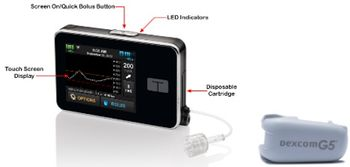
Tandem t:slim X2 Insulin Pump with Basal-IQ Technology
 Tandem · Model t:slim X2 Insulin Pump with Basal-IQ Technology
How does it work? The t: slim X2 Insulin Pump with Basal-IQ Technology works by measuring glucose levels and automatically adjusts insulin delivery by either administering or withholding insulin. The t: slim X2 Insulin Pump with Basal-IQ Technology is designed to communicate with a CGM to continuously display glucose readings, trend information, alerts, alarms, in addition to infusion pump data. The CGM measures sugar (glucose) levels and the insulin pump can be programmed to automatically suspend delivery of insulin when the sensor glucose level falls below a predefined glucose level. Every 5 minutes, the Basal-IQ technology feature of the insulin pump assesses the user's glucose information provided by the CGM and predicts whether glucose levels will fall too low in the next 30 minutes or if glucose levels are already too low. Under these conditions, the pump will suspend insulin delivery; otherwise insulin delivery to the user continues as normal. After insulin delivery is suspended, delivery resumes when the system detects the user's glucose levels begin to rise. When is it used? The t: slim X2 Insulin Pump with Basal-IQ Technology (the System) is used for the continuous delivery of basal insulin (at user selectable rates) and administration of insulin boluses (in user selectable amounts) in persons six years of age and older with diabetes. The t: slim X2 Insulin Pump with Basal-IQ Technology can be used solely as an insulin pump, with the Dexcom G5 Mobile CGM, or with a compatible integrated continuous glucose monitoring (iCGM) system. When used with a compatible CGM the t: slim X2 Insulin Pump with Basal-IQ Technology displays continuous glucose measurements and automatically suspend delivery of insulin to the user based on the glucose levels. The System is intended for single patient use, requires a prescription, and is intended for use with NovoLog or Humalog U-100 insulin. What will it accomplish? People with diabetes can use the glucose information from the CGM to help determine patterns in their glucose levels. The t: slim X2 Insulin Pump with Basal-IQ Technology can alert users when glucose levels are approaching potentially dangerously high (hyperglycemic) and/or dangerously low (hypoglycemic) levels. The t: slim X2 Insulin Pump with Basal-IQ Technology can also help people with diabetes make long-term adjustments to their treatment plan to keep blood glucose levels in a safe range. The Basal IQ feature of the insulin pump provides the user with additional diabetes management assistance by temporarily suspending insulin delivery when the glucose sensor detects or predicts a future low glucose level, and resumes insulin delivery when the glucose level begins to rise. When should it not be used? The t: slim X2 Insulin Pump with Basal-IQ Technology should not be used by: Patients whose vision and/or hearing does not allow the user to recognize System alerts. Patients unable or unwilling to: Test blood glucoselevels as recommended by their healthcare professional; Demonstrate adequate carbohydrate-counting skills (preferred, not required); Maintain sufficient diabetes self-care skills; or See their healthcare professional(s) regularly Patients should not expose their sensor or transmitter to Magnetic Resonance Imaging (MRI) equipment, diathermy services or other devices that generate strong magnetic fields (for example, x-ray, CT scan, or other types of radiation). Exposure to a strong magnetic field has not been evaluated and can cause the device to malfunction, result in serious injury or be unsafe. If the sensor or transmitter are exposed to a strong magnetic field, use should be discontinued. Taking medications with acetaminophen including but not limited to Tylenol, cold medicine, or paracetamol while wearing the Dexcom G5 Mobile Sensor may falsely raise sensor glucose readings. The level of inaccuracy depends on the amount of acetaminophen active in the body and may be different for each person.
Key tips
- ·Free-flow protection must be verified on every PM - a failed anti-free-flow clamp is a direct overdose risk.
- ·Test occlusion alarms in both directions - failing to alarm when it should is more dangerous than a false alarm.
- ·Battery run-time complaints are the most common real-world nuisance call - a full charge/discharge cycle test catches most of them.
Typical Failure Modes
Compiled for this model from its own documentation and established engineering knowledge for this equipment class - not from a verified service record. Confirm against the manufacturer's service manual.
Failure / error message stops delivery
HighSymptoms: The pump alarms and displays an error message / code and stops.
Root cause: A subsystem fault indexed in the service manual - motor / drive, a sensor, set-detection, or a board.
Occlusion alarm / pressure fault
MediumSymptoms: Repeated occlusion alarms, delivery stops, or an occlusion is missed.
Root cause: Kinked or clamped line, a closed roller clamp, a positional patient tube, pressure-sensor drift, or an improperly loaded set.
Air-in-line alarm
MediumSymptoms: Frequent air-in-line alarms, delivery stops.
Root cause: Air in the set, an improperly loaded set, or an ultrasonic air-detector fault.
Flow-rate accuracy drift
MediumSymptoms: Delivered volume outside tolerance on the annual test, especially at low rates.
Root cause: Worn pumping mechanism / plunger drive.
Battery will not hold charge
MediumSymptoms: Short run time, low-battery early after a full charge.
Root cause: Aged battery pack.
Door / plunger / sensor mechanical wear
LowSymptoms: Set will not load, door will not latch, plunger grip poor.
Root cause: Worn door latch, plunger jaws, or anti-free-flow mechanism.
Serviceable Parts & Consumables
Serviceable items for this model, compiled from its documentation and engineering knowledge for this equipment class. Service class and relative cost are estimates, not manufacturer figures; no part numbers are given. Confirm intervals and pricing against the manufacturer.
Battery pack
Class Periodic replacementRel. cost $$R&R Fairly easy
Pumping mechanism / rotor / plunger drive
Class Major service partRel. cost $$$R&R Difficult
Pressure / air-detector sensor assembly
Class Major service partRel. cost $$R&R Moderate
Door / latch / anti-free-flow assembly
Class Major service partRel. cost $$R&R Moderate
Drive motor / gearbox
Class Major service partRel. cost $$$R&R Difficult
| Part | Service class | Relative cost | R&R difficulty |
|---|---|---|---|
| Battery pack | Periodic replacement | $$ | Fairly easy |
| Pumping mechanism / rotor / plunger drive | Major service part | $$$ | Difficult |
| Pressure / air-detector sensor assembly | Major service part | $$ | Moderate |
| Door / latch / anti-free-flow assembly | Major service part | $$ | Moderate |
| Drive motor / gearbox | Major service part | $$$ | Difficult |
Relative cost: $ lowest · $$$$ highest service-part cost for this equipment class. Not a price.
PM Checklist
Preventive-maintenance tasks typical of this equipment class. Perform to the manufacturer's procedure and your facility's policy - this is general reference, not a schedule for this specific unit.
- ·Occlusion pressure and flow-rate accuracy verification
- ·Battery conditioning cycle
- ·Door latch and air-in-line sensor inspection
- ·Post-drop functional check before return to service
- ·Annual PM per manufacturer schedule
Troubleshooting Approach
A starting sequence for this model, compiled from its documentation and engineering knowledge for this equipment class. Follow the manufacturer's service documentation for the actual procedure.
Symptom: Alarm with an error message / code, delivery stopped
- Note the exact error message or code from the display.
- Look it up in the pump's technical service manual troubleshooting section.
- Run the biomed diagnostics / service utilities to exercise the named subsystem (motor / drive, a sensor, set-detection, a board).
- Follow the manual's parts-replacement procedure for that fault.
- Run the full scheduled-maintenance test set, including a flow-accuracy check, after any repair.
Symptom: Occlusion alarm / pressure fault (or a missed occlusion)
- Check the line for kinks, closed clamps and a closed roller clamp; check the patient site and cannula.
- Reload the administration set correctly, clearing all air.
- Confirm the set is an approved type for this pump.
- Run the pressure-sensor / force-sensor test in the service menu.
- Replace the set; refer the pump if the pressure sensor or pumping mechanism is indicated.
Symptom: Air-in-line alarm / free-flow or feed not delivering
- Prime the set fully and reload it; tap out micro-bubbles at the drip chamber.
- Confirm the set seats correctly against the air-in-line detector / rotor.
- Clean the ultrasonic air-detector window.
- Run the air-detector (or rotor / cassette) test in diagnostics.
- Replace a worn pumping mechanism / anti-free-flow assembly if flow accuracy or detection is out.
Symptom: Battery will not hold charge / short run time
- Fully charge, then run a battery run-down / capacity test in the service menu.
- Check the charging circuit and contacts.
- Replace the battery pack when capacity is below the service limit.
- Recalibrate the battery gauge if the pump supports it.
- Confirm run time meets spec after replacement.
Typical Location
Where this class of equipment is typically deployed - general reference, not this unit's own placement record.
- Patient care floors
- ICU
- OR
- Oncology / infusion centers
- Home health (portable pumps)
Documents & Manuals
Safety & Recalls
Synced live from the FDA openFDA API.
- RECALL
The Czech language user guide contained multiple translation errors. The most significant error was that it incorrectly instructs users to verify that the infusion set is connected to the body, when it should instead direct users to confirm that the infusion set is not connected to the body. Following this instruction could result in unintended insulin delivery, potentially leading to a hypoglycemic event.
- RECALL
Insulin pump includes a vibration motor that gives tactile feedback for any alerts, alarms, or malfunctions. Pump may exhibit false vibration motor failure due to a software issue causing Malfunction 12: "Pump cannot operate, the mobile app can no longer receive data from the pump. Insulin delivery and any active CGM Sessions have been stopped", which could result in hyperglycemia.
- RECALL
A software defect in versions 7.9.0.1 and 7.10.1 of the pump software for Tandem t:slim X2 and version 7.9.0.1 of the Tandem Mobi pump with Control-IQ+ technology that are paired with a G7 sensor may result in an unexpected automatic insulin correction bolus (autobolus ) which could result in hypoglycemia.
- RECALL
Insulin pumps manufactured with speakers from Revision A and B may malfunction ("Malfunction 16") which prevents audible alerts and causes the pumps to become inoperable and stop infusing insulin which could result in a hyperglycemic event, which may lead to injury and/or hospitalization.
- RECALL
an app defect that occurs when the phone is set to a right-to-left language, which causes app-pump pairing issues and graphical defects, which can potentially lead to incorrect therapy decisions and subsequent hypoglycemia or hyperglycemia.
- RECALL
A software defect in Version 7.9 of the pump software for Tandem t:slim X2 and Tandem Mobi pumps, when used with Control IQ+ technology, will cause the pump to incorrectly interpolate glucose trends when the Estimated Glucose Value (EGV) is above 255 mg/dL at the start or end of a gap in data collection due to a lapse in connection from a paired continuous glucose monitor (CGM) sensor, which can lead to under-delivery or over-delivery of insulin based on inaccurate result leading to severe cases of hypoglycemia or hyperglycemia.
- RECALL
During normal use, the mobile app version 2.7 may crash and be automatically relaunched by the iOS operating system. This cycle intermittently repeats, which leads to excessive Bluetooth communication that may result in pump battery drain and may lead to the pump shutting down sooner than typically expected. Pump shutdown will cause insulin delivery to suspend, which could lead to an under-delivery of insulin and may result in hyperglycemia, including severe hyperglycemia.
- RECALL
Insulin pumps may have the following issues: 1) Malfunction 6 Non-Volatile Memory, 2) Inaccurate (Fluctuating) Battery Life Display, 3) Touchscreen Staying On, 4) Unexpected Open Loop, that can be mitigated with a software update. Issues could result in hypoglycemia, hyperglycemia or diabetic ketoacidosis.
- RECALL
Insulin pumps may display unexpected fluctuation of the remaining battery life so ensure pump battery life does not fall below 25% remaining power. If the battery life drops to less than 5%, insulin delivery will continue for 30 minutes and then the pump will power off and insulin delivery will stop. If the battery reaches 1%, then insulin delivery will stop, which could lead to hyperglycemia.
- RECALL
The fuel gauge, the component that reads and reports the battery parameters to the pump, could provide inaccurate readings, which present to the user in one of two ways: A) by triggering a Malfunction 4 Alarm, or B) by triggering a succession of notifications prior to the pump shutting off, including Alert 2 (Battery Low), Alert 3 (Battery Very Low) and Alarm 12 (Battery Very Low). The alarms in both scenarios notify the user that the pump has stopped delivering insulin.
- RECALL
Specific lots of insulin cartridges that are used with the T:slim Insulin Pump may be at risk for leaking. A cartridge leak could result in the device delivering too much or too little insulin, which can lead to a serious adverse event.
Related calculators
From BioLab, for work done with this kind of equipment.
Troubleshoot this device with Bio
Describe a symptom or error code. Bio answers from this device's own documented error codes, failure modes, parts, and guides.
Ask Bio