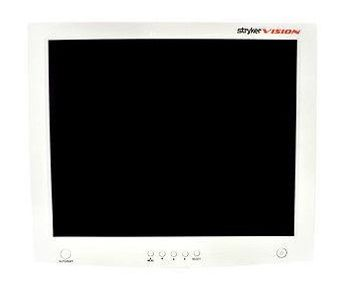
Stryker Vision Flat Panel Monitor
 Stryker · Model Vision Flat Panel Monitor
Stryker Vision Flat Panel Monitor.
Key tips
- ·When no category-specific guidance fits, default to the manufacturer's own service manual and the general troubleshooting method in the Engineer's Guide.
- ·Run an incoming and annual electrical safety test regardless of how niche the device is.
Typical Failure Modes
Failure patterns typical of this equipment class - general BMET reference, not verified against this exact unit's own service history unless flagged. Severity is a category-level estimate.
Touch panel / control fault
MediumSymptoms: Unresponsive touch, drifting calibration.
Root cause: Touch overlay or controller board wear.
Power supply fault
MediumSymptoms: Won't power on, intermittent shutdown.
Root cause: Internal power supply module aging.
Display panel fault
HighSymptoms: Dead pixels, backlight failure, or no image at all.
Root cause: LCD/LED panel or backlight driver aging.
Video input / signal fault
MediumSymptoms: No signal, wrong input source, or image artifacts.
Root cause: Input board, cable, or connector fault.
Serviceable Parts & Consumables
The parts a BMET typically services on this class of equipment. Service class and relative cost are general engineering estimates for the category, not figures from this unit's documentation. Part numbers appear only when pulled from this unit's own service manual. Always confirm intervals and pricing against the manufacturer.
Video input board
Class Major service partRel. cost $$R&R Fairly easy
Touch panel overlay
Class Periodic replacementRel. cost $$R&R Fairly easy
Power supply module
Class Periodic replacementRel. cost $$R&R Fairly easy
Display panel / backlight assembly
Class Major service partRel. cost $$$$R&R Difficult
| Part | Service class | Relative cost | R&R difficulty |
|---|---|---|---|
| Video input board | Major service part | $$ | Fairly easy |
| Touch panel overlay | Periodic replacement | $$ | Fairly easy |
| Power supply module | Periodic replacement | $$ | Fairly easy |
| Display panel / backlight assembly | Major service part | $$$$ | Difficult |
Relative cost: $ lowest · $$$$ highest service-part cost for this equipment class. Not a price.
PM Checklist
Preventive-maintenance tasks typical of this equipment class. Perform to the manufacturer's procedure and your facility's policy - this is general reference, not a schedule for this specific unit.
- ·Follow the manufacturer's PM schedule
- ·Perform incoming and annual electrical safety testing per facility biomedical program
Troubleshooting Approach
A structured starting point derived from the failure modes above. Follow the manufacturer's service documentation for the actual procedure.
Symptom: Display panel fault
- Confirm the presentation - typically dead pixels, backlight failure, or no image at all.
- Check the most likely cause first: lCD/LED panel or backlight driver aging.
- Inspect the affected subsystem against the manufacturer's inspection checklist.
- If the fault is confirmed and not a field adjustment, service or replace the display panel / backlight assembly per the manufacturer's service documentation.
- Return the device to service only after the manufacturer's functional and applicable electrical-safety checks pass.
- Record the findings, any parts used, and the verification results in the maintenance history.
Symptom: Video input / signal fault
- Confirm the presentation - typically no signal, wrong input source, or image artifacts.
- Check the most likely cause first: input board, cable, or connector fault.
- Inspect the affected subsystem against the manufacturer's inspection checklist.
- If the fault is confirmed and not a field adjustment, service or replace the video input board per the manufacturer's service documentation.
- Return the device to service only after the manufacturer's functional and applicable electrical-safety checks pass.
- Record the findings, any parts used, and the verification results in the maintenance history.
Typical Location
Where this class of equipment is typically deployed - general reference, not this unit's own placement record.
- Varies by device - check the unit's own manual for facility placement guidance
Documents & Manuals
No documents available for this device yet.
Safety & Recalls
Synced live from the FDA openFDA API.
- RECALL
The mounts on the monitor may have an insufficient weld.
- RECALL
Stryker C2 NerveMonitor's design and instructions may not optimally address usability issues related to the functionality of the device, which may result in use errors potentially causing or contributing to nerve injury.
- RECALL
The mounts on the monitor may have an insufficient (missing or incomplete) weld.
- RECALL
An incorrect sterility status on the label, non-sterile products labeled as sterile
- RECALL
Stryker Orthopaedics has received two customer complaints regarding Duracon Tibial Wedge implants puncturing the packaging's Tyvek lid(s).
- RECALL
Stryker has initiated the recall of its Aria Standard and Specialty Implant Inserters due to complaints of product fracturing.
- RECALL
During the use of the SHAPE Arm there is the potential for the monitor mount to come off of the SHAPE Arm if the lock washer and screw are not present.
- RECALL
Stryker has received complaints from customers relating to fracture along the weld that binds the handle to the shaft of the static inserter.
- RECALL
When positioning the display located on top of the video cart, it is possible for the user to apply excessive force and push the display up and out of the mounting arm. This can result in the display falling upon the user/patient.
- RECALL
Stryker has become aware that there is a low likelihood of incomplete engagement of the Spring Arm Circlip during service or replacement of the Spring Arm. If the Spring Arm Circlip is not fully seated, the Spring Arm could separate and fall along with the surgical lights or monitors mounted to the end of the Spring Arm. To date, there have been no serious injuries reported from the incomplete e
- RECALL
The firm identified two complaints have been reported indicating that the product inside the package did not match with the label information. The product was labeled as Flat Proximal Pressurizer P/N 0206-556-000 while the product inside the package was Femoral Pressurizer P/N 0206-566-000.
- RECALL
Some of the pitch shafts were not properly welded which results in the monitor becoming unlevel.
- RECALL
Knob parts stick together, resulting in poor functionality of the knob.
- RECALL
Circlip component used to suspend flat panel and navigation arm system may become dislodged.
- RECALL
Paint chips: Shroud used to cover cables on the Stryker Vision 3 flat panel monitor (monitor used in surgery rooms during procedures) was not manufactured/painted to specification, resulting in the possibility that paint chips could fall off and fall into non-sterile and/or sterile fields during surgery. For further information, please contact Stryker Communications Corporation by telephone at 97
- RECALL
The pressure indicated may be inaccurate, and this inaccuracy may be not detectable by the user.
- RECALL
Certain sterile packed drills with center tip may penetrate the foam and blister resulting in loss of sterility.
Troubleshoot this device with Bio
Describe a symptom or error code. Bio answers from this device's own documented error codes, failure modes, parts, and guides.
Ask Bio