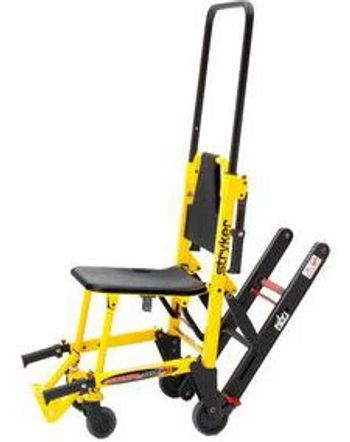
Stryker Stair-PRO
 Stryker · Model Stair-PRO
Patient Stair Transport Stretcher With its Stair-TREAD system, this chair enables caregivers to transport a patient down stairs without lifting.
Key tips
- ·Casters and the wheel-lock brake take the most day-to-day wear - check both every PM, not just on complaint.
- ·A cracked weld or loose frame joint is a safety-critical finding - pull the unit from service until it's repaired.
Typical Failure Modes
Compiled for this model from its own documentation and established engineering knowledge for this equipment class - not from a verified service record. Confirm against the manufacturer's service manual.
Hydraulic height / Trendelenburg will not lift or holds poorly
HighSymptoms: Pump will not raise the deck, or the deck settles under load.
Root cause: Worn hydraulic pump / seals, an internal valve leak, or low hydraulic fluid.
Brake / steer castor fault
MediumSymptoms: Brake will not hold, fifth-wheel steer ineffective, castor shimmy.
Root cause: Worn brake linkage, castors, or the fifth-wheel mechanism.
Backrest / Fowler mechanism fault
MediumSymptoms: Backrest will not raise / hold, gas strut weak, pneumatic assist failed.
Root cause: Worn gas spring / strut or the release mechanism.
Siderail / IV pole / accessory fault
LowSymptoms: Siderails will not latch or drop, IV pole loose, litter attachments worn.
Root cause: Worn latches, detents, or accessory sockets.
Powered drive fault (powered stretchers)
MediumSymptoms: Drive assist will not engage or is weak, drive-fault code.
Root cause: Drive battery, motor / controller, or the throttle.
Serviceable Parts & Consumables
Serviceable items for this model, compiled from its documentation and engineering knowledge for this equipment class. Service class and relative cost are estimates, not manufacturer figures; no part numbers are given. Confirm intervals and pricing against the manufacturer.
Hydraulic pump / seal kit
Class Major service partRel. cost $$R&R Moderate
Castor / brake-linkage set
Class Periodic replacementRel. cost $$R&R Moderate
Backrest gas spring / strut
Class Periodic replacementRel. cost $$R&R Fairly easy
Siderail latch / accessory sockets
Class Major service partRel. cost $$R&R Fairly easy
Drive battery (powered stretchers)
Class Periodic replacementRel. cost $$R&R Fairly easy
| Part | Service class | Relative cost | R&R difficulty |
|---|---|---|---|
| Hydraulic pump / seal kit | Major service part | $$ | Moderate |
| Castor / brake-linkage set | Periodic replacement | $$ | Moderate |
| Backrest gas spring / strut | Periodic replacement | $$ | Fairly easy |
| Siderail latch / accessory sockets | Major service part | $$ | Fairly easy |
| Drive battery (powered stretchers) | Periodic replacement | $$ | Fairly easy |
Relative cost: $ lowest · $$$$ highest service-part cost for this equipment class. Not a price.
PM Checklist
Preventive-maintenance tasks typical of this equipment class. Perform to the manufacturer's procedure and your facility's policy - this is general reference, not a schedule for this specific unit.
- ·Caster / wheel and brake function check
- ·Frame, weld, and mounting-hardware inspection
- ·Upholstery / surface condition check
- ·Annual full PM
Troubleshooting Approach
A starting sequence for this model, compiled from its documentation and engineering knowledge for this equipment class. Follow the manufacturer's service documentation for the actual procedure.
Symptom: Hydraulic height / Trendelenburg will not lift or holds poorly
- Check the hydraulic fluid level.
- Pump the deck up under load and time how fast it settles.
- Inspect the pump and cylinder for external leaks.
- Rebuild the pump with the seal kit or bleed the system per the manual.
- Confirm it holds at full height under the rated load.
Symptom: Brake / steer castor will not hold / castor shimmy
- Inspect the brake linkage and each castor.
- Adjust the central-brake linkage.
- Replace worn castors and the fifth-wheel components.
- Confirm the brake holds on an incline and the steer-lock engages.
- Check all four corners brake evenly.
Symptom: Backrest / Fowler will not raise or hold
- Check the gas spring / strut and the release mechanism.
- Confirm the pneumatic assist (where fitted) holds.
- Replace a weak gas strut.
- Confirm the backrest holds at several angles under load.
- Inspect the pivot hardware for wear.
Symptom: Siderails / IV pole / accessories loose or will not latch
- Inspect the latches, detents and accessory sockets for wear.
- Adjust or replace worn latch hardware.
- Confirm the siderails lock up and drop cleanly.
- Check the IV pole and litter attachments are secure.
- Load-test any patient-support accessory.
Typical Location
Where this class of equipment is typically deployed - general reference, not this unit's own placement record.
- Ambulance / transport vehicles
- Emergency Department
- Inter-facility transport teams
Documents & Manuals
Safety & Recalls
Synced live from the FDA openFDA API.
- RECALL
Neurovascular devices did not meet the minimum sample size required for endotoxin testing during manufacturing processes and are out of compliance with the AAMI ST72 standard, so these devices may exceed the acceptable limits of endotoxin levels; high levels of endotoxins may increase the risk of fever, shock and aseptic meningitis.
- RECALL
The microcatheter IFU contains an intended use that has not been evaluated by the FDA.
- RECALL
Base leg assembly may bend and result in difficulty engaging/disengaging from fastener, difficulty loading/unloading from ambulance, difficulty raising or lowering the cot, cot tip, or erratic or unintended motion.
- RECALL
Transport Cot has insufficient volume of epoxy to assemblies installed in the head section and foot sectioning system may result in separation of head end or foot end from the cot and result in unexpected disengagement while loading/unloading or transport.
- RECALL
Cot may experience unintended motion due to damaged cables. Potential risk of soft tissue injury to patients such as scrapes or bruises resulting from the cot lowering faster than expected.
- RECALL
Ambulance Cots may not meet crash test standard BS EN 1789
- RECALL
Laser etching which indicates whether the device is in compression or distraction mode appears to be on the wrong side of the lever arm
- RECALL
Stryker Neurovascular has become aware that some 3-Pack Stroke Fast Packs were manufactured using a carton sleeve where the pre-printed contents on the back of the sleeve did not match the physical contents of the pack.
- RECALL
Complaints of smoke coming from the foot end of the cot. This reportedly occurred when either the battery was placed into the cot or shortly after placing the battery into the cot. In addition to the alleged smoking, one of the reports had also noted that when the user attempted to lower the cot (prior to the alleged smoking) the device went into high speed retract and then a few moments later i
- RECALL
The Foot Rest Kit may have the wrong pivot spacers making the joint more susceptible to relaxation and prone to fatigue. There is a moderate risk of injury to the patient should the handles become detached during use.
- RECALL
Device will not able to assign the correct time/date stamp for saved filed after December 31, 2009. On Jan 1, 2010, the device system date for all SDC Pro 2 units will re-start from 1 Oct 2001 and begin incrementing from that point onwards. The system date will be incorrect and users will not be able to correct this issue. Problem will not affect how pictures or videos are captured using SDC Pro
- RECALL
The front of the handle may become detached from the chair, which could result in a patient fall or an operator injury.
- RECALL
Handle could come off. The bolts may back out over time, resulting in a risk of dropping the patient and/or injury to transport personnel, a delay in medical treatment, or a delay in evacuation.
- RECALL
The head section wheel assembly may flex outward from the cot because the head section wheel bolts, which hold the assembly upright, may back out.
- RECALL
Locking pins may be installed backward, and cot may drop from highest to lowest position when the users are not prepared for the drop.
Troubleshoot this device with Bio
Describe a symptom or error code. Bio answers from this device's own documented error codes, failure modes, parts, and guides.
Ask Bio