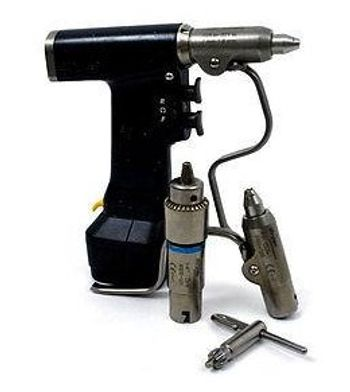
Stryker SET-0175
 Stryker · Model SET-0175
Stryker SET-0175 is classified as Power Tools (Surgical & OR). No manufacturer description has been sourced for this model yet.
Key tips
- ·Never defeat or bypass a return-electrode monitoring (REM) alarm to finish a case - it's a direct burn risk.
- ·Verify OR table battery backup - a table that loses power mid-procedure is a real, documented incident type.
- ·Track surgical light lamp-hours rather than waiting for failure - a sudden failure mid-case is avoidable.
Typical Failure Modes
Compiled for this model from its own documentation and established engineering knowledge for this equipment class - not from a verified service record. Confirm against the manufacturer's service manual.
Weak or no power / stalls under load
HighSymptoms: Handpiece runs slow, stalls when drilling / cutting, or does not run at all.
Root cause: Worn motor / turbine, worn gears / bearings, a low or aged battery, or (pneumatic) low supply pressure / a worn hose.
Overheats in use
MediumSymptoms: Handpiece or attachment gets hot quickly, burn / thermal-necrosis risk.
Root cause: Worn bearings / gears, a dry / seized attachment, or over-duty use.
Battery will not hold charge (battery tools)
HighSymptoms: Few cases per charge, will not reach full charge, sudden shutdown.
Root cause: Aged battery pack or a charger fault.
Chuck / coupling / attachment fault
MediumSymptoms: Bur / blade / pin slips or will not lock, attachment wobbles, quick-coupler worn.
Root cause: Worn chuck / collet or coupling.
Trigger / control fault
MediumSymptoms: Speed will not vary, forward/reverse or oscillate will not select, trigger sticks.
Root cause: Worn trigger / control mechanism or its seals.
Serviceable Parts & Consumables
Serviceable items for this model, compiled from its documentation and engineering knowledge for this equipment class. Service class and relative cost are estimates, not manufacturer figures; no part numbers are given. Confirm intervals and pricing against the manufacturer.
Motor / turbine assembly
Class Periodic replacementRel. cost $$$R&R Difficult
Gear / bearing service kit
Class Periodic replacementRel. cost $$R&R Difficult
Battery pack (battery tools)
Class Periodic replacementRel. cost $$$R&R Fairly easy
Chuck / collet / quick-coupler
Class Periodic replacementRel. cost $$R&R Moderate
Trigger / seal kit
Class Periodic replacementRel. cost $$R&R Moderate
| Part | Service class | Relative cost | R&R difficulty |
|---|---|---|---|
| Motor / turbine assembly | Periodic replacement | $$$ | Difficult |
| Gear / bearing service kit | Periodic replacement | $$ | Difficult |
| Battery pack (battery tools) | Periodic replacement | $$$ | Fairly easy |
| Chuck / collet / quick-coupler | Periodic replacement | $$ | Moderate |
| Trigger / seal kit | Periodic replacement | $$ | Moderate |
Relative cost: $ lowest · $$$$ highest service-part cost for this equipment class. Not a price.
PM Checklist
Preventive-maintenance tasks typical of this equipment class. Perform to the manufacturer's procedure and your facility's policy - this is general reference, not a schedule for this specific unit.
- ·Pre-case functional check
- ·Electrosurgical return-electrode cable inspection
- ·Table hydraulic / mechanical inspection
- ·Annual electrical safety test and full PM
Troubleshooting Approach
A starting sequence for this model, compiled from its documentation and engineering knowledge for this equipment class. Follow the manufacturer's service documentation for the actual procedure.
Symptom: Weak, stalling or no power
- Fit a fully charged battery (battery tools) or confirm the pneumatic supply pressure and hose.
- Fit a fresh, sharp attachment and confirm it seats and locks.
- Run the handpiece off the patient and listen / feel for bearing or gear roughness.
- Service the handpiece (bearings / gears / seals) or replace the motor.
- Confirm rated speed and torque and normal running temperature after service.
Symptom: Overheats
- Use sharp attachments and observe the duty cycle.
- Check the attachment / coupling is not dragging or dry.
- Feel for bearing roughness.
- Service the bearings / gears.
- Confirm the handpiece runs cool under a normal load.
Technical Specs
- Function
- Drill
Typical Location
Where this class of equipment is typically deployed - general reference, not this unit's own placement record.
- Operating rooms
- Procedure rooms
- Interventional suites
Documents & Manuals
No documents available for this device yet.
Safety & Recalls
Synced live from the FDA openFDA API.
- RECALL
There has been an increased amount in reported complaints consistently describing leaking from the handpiece during use.
- RECALL
Due to nonconforming products being inadvertently distributed.
- RECALL
Stryker identified non-conforming instruments that are components of the Tritanium X TL sets. The firm found non-conformances with the TL Inserter, TL Draw Rod, Tube Set/Syringe Adapter Assembly, and Syringe Plunger that could lead to device failure during a procedure.
- RECALL
The firm has become aware of a potential problem that their Catheters may break/fracture and/or kink/bend if improperly removed from the packaging/dispenser hoop or during catheter use.
- RECALL
The heated tube sets were consistently leaking and detaching from the cassette.
- RECALL
There were two potential interference conditions identified with the way the tubing set attaches to the inserter.
- RECALL
Stryker Sustainability Solutions is recalling the Fuhrman Pleural & Pneumopericardial Drainage Set due to receiving complaints that it broke off in the pleural cavity while inserting the device into the patient.
- RECALL
Stryker has received a complaint from customers relating to a fracture during the use of the Specialty Audible Torque Wrench in surgery.
- RECALL
Tritanium Patella Inserter Instrument fracture during implantation. .
- RECALL
Stryker Osteosynthesis has become aware that LEFT GAMMA3 nails are marked as right nails.
- RECALL
Multiple complaints have reported the hex tip of the torque wrench fracturing during final tightening.
- RECALL
Paramed Corporation (d/b/a, Descent Control Systems), a manufacturer and distributor of patient transport devices, merged with an affiliate of Stryker Corporation in August 2009. As part of the due diligence process, Paramed's powered Mobility Offers Versatility (MV) chair was reviewed to identify potential compliance issues in relation to product documentation and classification.
- RECALL
The gravity steam, Ethylene Oxide (EO) and STERRAD 100S sterilization methods are being removed from the "Instructions for Use"; due to the firm's evaluation that identified original validation was not done at worst case conditions.
- RECALL
Stryker Spine has received reports that after sterilization but prior to surgery, cracks were noticed at the tantalum marker / PEI tube interface. This can likely be attributed to differences in the rate of thermal expansion between the markers and the sleeve during the sterilization cycle.
- RECALL
All of the failures lead to the patient receiving less medication than intended. Certain lots of the pain pump have a high failure rate associated with a cracked port housing which leads to internal or external leaks. Some lots have a high failure rate associated with E2 errors.
- RECALL
The instructions for use (IFU) has been revised for health care professionals. The indication for use has been changed to remove site specific pain management. The firm has revised the warning to not use the pump around joint spaces. A warning has been added regarding the use of the pump with anticoagulants in epidural applications. A special reminder to users to always evaluate the potential
- RECALL
Literature did not include the design change to a smaller cannulation diameter.
- RECALL
The catheter may break when removed from the body, or the catheter may have kinks or be occluded such that the patient will not receive the intended quantity of medication.
- RECALL
An electronic failure during preparation of the unit, or during patient use, may cause the pump to shut down.
- RECALL
Potential Breakage: Stryker Orthopaedics became aware that there is the potential for the tip of the AxSOS Screwdriver and the AxSOS Torque Limiter to break.
- RECALL
There is a potential for the pump to overinfuse.
- RECALL
Stryker Trauma has become aware that five lots of the Gamma3 Set Screwdriver have hexagon tips that were not hardened to specification. If the screwdriver tip were to deform intra-operatively, the correct positioning of the set screw would not be possible, which could lead to lateral or medial migration of the lag-screw.
- RECALL
Device for which sterility may be compromised as evidenced by a loss of package integrity.
- RECALL
Stryker Orthopaedics became aware that when attempting to position the Triathlon Femoral Sizer, the pre-setting may slip from l (left knee) to R (right knee) and vice verse intraoperatively.
- RECALL
Product sterility may have been compromised by an inadequate package seal.
Troubleshoot this device with Bio
Describe a symptom or error code. Bio answers from this device's own documented error codes, failure modes, parts, and guides.
Ask Bio