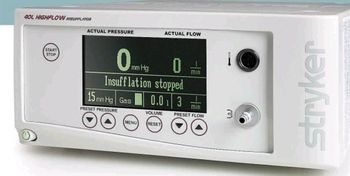
Stryker High Flow 40-Liter Insufflator
 Stryker · Model High Flow 40-Liter Insufflator
The highest flow rate available on the market. Neonatal mode offers increased sensitivity and floew rates as low as.1 liters per minute. LCD display provides surgeons with ongoing status messages. Sidne compatibility allows the surgeon to control the insufflator with voice commands. Software driven to allow for future upgrades. Built in gas heating technology. Video on-screen display Safety. Surgivent-electronic venting system for added safety. Visual and audible warning signals. Safety Relief Value. Internal Leakage Detection.
Key tips
- ·A failed leak test means the scope does not get reprocessed or used - send it for repair, full stop.
- ·A shortened reprocessing cycle is a real infection-control failure, not a minor deviation - follow AAMI ST91 exactly.
- ·Track light-source lamp-hours against the manufacturer's limit rather than running to failure.
Typical Failure Modes
Compiled for this model from its own documentation and established engineering knowledge for this equipment class - not from a verified service record. Confirm against the manufacturer's service manual.
Will not reach or hold set intra-abdominal pressure
HighSymptoms: Pressure alarm, insufflation stops, cannot maintain pneumoperitoneum, high-flow alarm.
Root cause: CO2 supply low, a leak in the tubing / trocar, a solenoid / valve fault, or a pressure-sensor fault.
Poor video image
HighSymptoms: Noisy, dark, discoloured or out-of-focus image, dropouts, no image.
Root cause: Camera head / coupler fault, a camera-cable fault, or a CCU / video-processor fault.
White-balance / colour fault
MediumSymptoms: Cannot white-balance, persistent colour cast.
Root cause: Camera head sensor drift, a dirty coupler, or the light source colour temperature.
Gas heater fault (if fitted)
LowSymptoms: Gas delivered cold, heater alarm.
Root cause: Heating element or its sensor in the heated tubing / unit.
Output / connector fault
LowSymptoms: Signal only on one output, connector damage, HD/SDI dropout.
Root cause: Worn video output connector or an output board fault.
Serviceable Parts & Consumables
Serviceable items for this model, compiled from its documentation and engineering knowledge for this equipment class. Service class and relative cost are estimates, not manufacturer figures; no part numbers are given. Confirm intervals and pricing against the manufacturer.
Insufflator solenoid / valve block
Class Major service partRel. cost $$$R&R Difficult
Camera head / coupler
Class Periodic replacementRel. cost $$$R&R Moderate
Camera cable
Class Periodic replacementRel. cost $$R&R Fairly easy
Pressure-sensor / regulator assembly
Class Major service partRel. cost $$R&R Moderate
CCU / video-processor board
Class Major service partRel. cost $$$R&R Difficult
| Part | Service class | Relative cost | R&R difficulty |
|---|---|---|---|
| Insufflator solenoid / valve block | Major service part | $$$ | Difficult |
| Camera head / coupler | Periodic replacement | $$$ | Moderate |
| Camera cable | Periodic replacement | $$ | Fairly easy |
| Pressure-sensor / regulator assembly | Major service part | $$ | Moderate |
| CCU / video-processor board | Major service part | $$$ | Difficult |
Relative cost: $ lowest · $$$$ highest service-part cost for this equipment class. Not a price.
PM Checklist
Preventive-maintenance tasks typical of this equipment class. Perform to the manufacturer's procedure and your facility's policy - this is general reference, not a schedule for this specific unit.
- ·Leak testing before each reprocessing cycle
- ·Scope reprocessing per AAMI ST91
- ·Light source lamp-hour tracking
- ·Annual full PM
Troubleshooting Approach
A starting sequence for this model, compiled from its documentation and engineering knowledge for this equipment class. Follow the manufacturer's service documentation for the actual procedure.
Symptom: Will not hold set pressure
- Confirm the CO2 cylinder / supply is not empty and is at pressure.
- Leak-test the tubing set and all trocar / stopcock connections.
- Run the insufflator's self-test / calibration.
- Check the solenoid and pressure sensor per the service manual.
- Replace the tubing set; refer the valve block or sensor if the fault persists.
Symptom: Poor video image
- Clean and re-white-balance; inspect the scope lens / coupler.
- Swap the camera head and cable to isolate head vs CCU.
- Check the light cable and lamp hours.
- Try a second monitor / output cable.
- Replace the camera head or refer the CCU as isolated.
Technical Specs
- Height
- 5.83 in
- Length
- 18.7 in
- Weight
- 19.84 lbs
- Width
- 12.52 in
Typical Location
Where this class of equipment is typically deployed - general reference, not this unit's own placement record.
- Endoscopy suite / GI lab
- Operating Room
- Bronchoscopy suite
Documents & Manuals
Safety & Recalls
Synced live from the FDA openFDA API.
- RECALL
Potential for the Break-Away Femoral Nozzle the applicator tip connecting the cement cartridge, to disassemble or break off during use, can lead to the potential for loss of function of the ACM system and bio-incompatibility due to components falling into surgical site
- RECALL
Not able to achieve desired pressure and not holding pressure result from two different causes which have been reported to occur during initial set-up of the cuff onto the patient, may lead to operative site blood loss, hemorrhage or, in exceedingly rare situations, other major complications
- RECALL
There is a potential for the cuff to leak air leading to a loss of vascular occlusion.
- RECALL
The heated tube sets were consistently leaking and detaching from the cassette.
- RECALL
Issue with the process for detection of leaking Pressure Tourniquet Cuffs (PTC). Leaking PTC devices may result in excessive blood loss requiring surgical or medical intervention or systemic leakage of local anesthetic during Bier Block requiring medical intervention.
- RECALL
Stryker Neurovascular has become aware that some units of Target Nano product do not have the intended stretch resistance. The sutures inside the coil that provide stretch resistance may have been damaged during manufacturing which can lead to an increased occurrence of coil stretching.
- RECALL
When operating the device in high flow mode (40L/min, 15 mmHg) and connecting to a house gas inlet source, within seconds of insufflating the flow rate would drop to 0L/min and the red Check Gas Supply symbol would appear on the display, immediately suspending insufflation.
- RECALL
Sterility may be compromised, as the packaging may have channels in the packaging seal.
- RECALL
Device for which sterility may be compromised as evidenced by a loss of package integrity.
- RECALL
Non-sterilized product sold as sterile.
Troubleshoot this device with Bio
Describe a symptom or error code. Bio answers from this device's own documented error codes, failure modes, parts, and guides.
Ask Bio