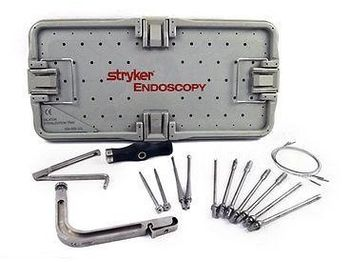
Stryker Cross-Screw System
 Stryker · Model Cross-Screw System
Stryker's Cross-Pin Instrumentation The Soft Tissue Femoral Fixation System provides the latest technology in femoral fixation for soft tissue allografts and autografts. The Stryker Cross-Screw System offers the sports medicine surgeon a more simple and secure method for ACL reconstruction utilizing soft tissue grafts. The implant comes in Titanium and Biosteon (HA/PLLA) material and the instrumentation is calculation free. Insertion of the cross-screw is over a rigid guide, helping to ensure accurate placement while the graft is pulled into place along its axis, allowing a tight tunnel-to-graft interface.
Key tips
- ·Never defeat or bypass a return-electrode monitoring (REM) alarm to finish a case - it's a direct burn risk.
- ·Verify OR table battery backup - a table that loses power mid-procedure is a real, documented incident type.
- ·Track surgical light lamp-hours rather than waiting for failure - a sudden failure mid-case is avoidable.
Typical Failure Modes
Compiled for this model from its own documentation and established engineering knowledge for this equipment class - not from a verified service record. Confirm against the manufacturer's service manual.
Will not power on or unexpected shutdown
HighSymptoms: The surgical & or is dead, reboots, or shuts down mid-use.
Root cause: Mains lead / fuse, an aged battery, or a power-supply board fault.
Battery will not hold charge
MediumSymptoms: Short run time on battery; low-battery alarm soon after a full charge.
Root cause: Aged rechargeable battery pack or a charger fault.
Display / control-panel fault
MediumSymptoms: Blank, dim or distorted display; unresponsive keys or touchscreen.
Root cause: Display, backlight, or control-board fault.
Fails self-test or calibration
MediumSymptoms: Power-on self-test or the scheduled performance check fails or is out of tolerance.
Root cause: Sensor drift or an internal board fault; recalibration or repair needed.
Serviceable Parts & Consumables
Serviceable items for this model, compiled from its documentation and engineering knowledge for this equipment class. Service class and relative cost are estimates, not manufacturer figures; no part numbers are given. Confirm intervals and pricing against the manufacturer.
Rechargeable battery pack
Class Periodic replacementRel. cost $$R&R Fairly easy
Power supply / mains board
Class Major service partRel. cost $$$R&R Difficult
Display / control-panel assembly
Class Major service partRel. cost $$$R&R Moderate
Cooling fan
Class Major service partRel. cost $R&R Moderate
| Part | Service class | Relative cost | R&R difficulty |
|---|---|---|---|
| Rechargeable battery pack | Periodic replacement | $$ | Fairly easy |
| Power supply / mains board | Major service part | $$$ | Difficult |
| Display / control-panel assembly | Major service part | $$$ | Moderate |
| Cooling fan | Major service part | $ | Moderate |
Relative cost: $ lowest · $$$$ highest service-part cost for this equipment class. Not a price.
PM Checklist
Preventive-maintenance tasks typical of this equipment class. Perform to the manufacturer's procedure and your facility's policy - this is general reference, not a schedule for this specific unit.
- ·Pre-case functional check
- ·Electrosurgical return-electrode cable inspection
- ·Table hydraulic / mechanical inspection
- ·Annual electrical safety test and full PM
Troubleshooting Approach
A starting sequence for this model, compiled from its documentation and engineering knowledge for this equipment class. Follow the manufacturer's service documentation for the actual procedure.
Symptom: Will not power on
- Confirm the outlet, mains lead and fuse.
- Try on battery, then on mains only, to isolate the supply.
- Look for a power indicator or POST code.
- Replace the fuse / battery / power supply as isolated.
- Run the self-test after any repair.
Symptom: Fails self-test or calibration
- Note the exact failure message / code.
- Power-cycle and repeat the self-test.
- Verify against a reference / simulator where one applies.
- Recalibrate per the service manual.
- Refer the affected board for service if it will not hold calibration.
Typical Location
Where this class of equipment is typically deployed - general reference, not this unit's own placement record.
- Operating rooms
- Procedure rooms
- Interventional suites
Documents & Manuals
No documents available for this device yet.
Safety & Recalls
Synced live from the FDA openFDA API.
- RECALL
May exhibit endotoxin levels greater than 2.15 EU/device, fever and inflammation may occur from endotoxin exposure and meningitis may only occur if there is contact with cerebrospinal fluid and thus, neurosurgical/spinal procedures may be considered a population at greatest risk.
- RECALL
Seal integrity of the blister pack may be compromised and sterility cannot be assured
- RECALL
Stryker Instruments and Stryker Leibinger GmbH & Co. KG are voluntarily recalling certain serial numbers Thoracic Pedicle Feelers that are used in conjunction with the Stryker Navigation System because the settings on the machine were higher than intended. This change led to increased energy directed onto the tip of the Thoracic Pedicle Feeler which caused material degradation where the laser marks exist. There is the potential for the tip of the Thoracic Pedicle Feeler to break.
- RECALL
Stryker received a report from the field indicating that a 5.5 mm Cancellous Bone Screw 40 mm was identified in packaging associated with a 6.5 mm Cancellous Bone Screw 25 mm.
- RECALL
Stryker received a report that the length of the cannulated screw asnis III, article # 604640 Lot R11482, was incorrect.
- RECALL
Stryker Osteosynthesis has become aware that LEFT GAMMA3 nails are marked as right nails.
- RECALL
Stryker Orthopaedics has received a report indicating that the scale of the AxSOS Calibrated Drill Bit 4.3,,X263mm, flat , manufactured by Stryker Osteosynthesis, is incorrect. The incorrect scale could result in the surgeon selecting a screw that is 10mm longer than intended.
- RECALL
Stryker has received reports from the field indicating that certain lots of 6.5mm Cancellous Bone Screws are either associated with a product mix or potentially associated with a product mix. Packaging associated with a 35 mm screw may contain a 25mm screw. Conversely, packaging associated with a 25mm screw may contain a 35mm screw.
- RECALL
Aviator drill bits are 10 mm longer than the Reflex Hybrid drill bits and are not interchangeable which could lead to over-drilling by as much as 10 mm.
- RECALL
The front cover of Instructions For Use (IFU) #NOLI135B03Rev02 was improperly marked with a "Sterile" logo in the lower right corner. The products these IFUs were packed with are sold as "Non-Sterile" and require sterilization before use in surgery.
- RECALL
Two product complaints reported that the Glenoid Reamer Spanner (Lot F3W7017) would not properly connect to the Glenoid Spherical Reamer.
- RECALL
An incorrect laser mark was noted on specific lots of product, incorrectly implying a stem size of 9, when the product is actually size 8.
- RECALL
Two National Joint Registries suggest that the EIUS Unicompartmental System is associated with a higher revision rate then the unicompartmental devices.
- RECALL
Variations in the outer diameter of the shaft of the External Compression Device and the inner diameter of the Nail Holding Screw may make assembly of these 2 instruments not possible.
- RECALL
During a sampling inspection, 2 lots of screws did not meet shear and torsion testing specifications.
- RECALL
The Xia 3 8.5mm Polyaxial screws, lot A91109 were anodized turquoise instead of Fuchsia. The turquoise color is reserved for the 9.5 mm Xia 3 screws.
- RECALL
The threaded tip of the Reflex Hybrid Screw Extractor has been found to fracture the head of the screw, causing problems in removing the screw and possible damage to the screw and/or plate while attempting to remove the screw.
- RECALL
The cross-cuts are missing on the device, which will result in poor cutting and overheating and/or smoking of the device.
- RECALL
Raw material supplied by a third party used to manufacture various medical devices does not comply with metallurgical requirements outlines in ASTM standard for titanium surgical implants.
- RECALL
The Reflex Hybrid 4.0 x 14 mm Variable, Self Tapping Bone Screw, Lot NSZ, was determined to have been anodized with the incorrect color for that screw.
- RECALL
Screws do not have locking threads
- RECALL
Mislabeled: One lot of screws (05x70mm) is labeled as containing 70mm, but may actually contain 75mm length screws.
- RECALL
Stryker Orthopaedics became aware that a box labeled as Duracon Total Knee Distal Femoral Locking Screws for 5 mm spacer, may actually contain a 10 mm screw.
- RECALL
Design Flaw: The design did not prevent over angulation of the screws when the recommended instrument, All in One Guide, was not used.
- RECALL
The firm has been made aware that one lot of 6.5 Cancellous Bone Screws 25mm was packaged and labeled as 25 mm in length when it maybe 20 mm in length.
- RECALL
Stryker Orthopaedics was informed by the manufacturer, that in some instances, the sterile blister package of the referenced G/K, T2 condyle and some S2 screw products may become damaged during shipping and handling which may result in a potential breach of the sterile barrier.
- RECALL
The medical device is misbranded in that the package is labeled as Biosteon Interference Screw in fact contains Biosteon Cross Pin. This mislabeling could disrupt surgery preparation resulting in surgery delay.
- RECALL
The label on the outside of the shipping box has an incorrect description of the screw diameter.
Troubleshoot this device with Bio
Describe a symptom or error code. Bio answers from this device's own documented error codes, failure modes, parts, and guides.
Ask Bio