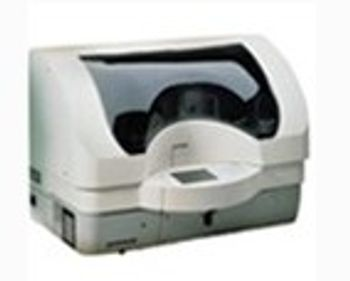
Roche Elecsys 1010
 Roche · Model Elecsys 1010
Innovative bar coding system for reagents. Liquid level and clot detection. Bi-directional interfacing. Calibrators and controls offering large data capacity. Refurbished with 90 day parts warranty. Reagents, controls, and consumables may be available. Service contracts may be available.
Key tips
- ·When no category-specific guidance fits, default to the manufacturer's own service manual and the general troubleshooting method in the Engineer's Guide.
- ·Run an incoming and annual electrical safety test regardless of how niche the device is.
Typical Failure Modes
Compiled for this model from its own documentation and established engineering knowledge for this equipment class - not from a verified service record. Confirm against the manufacturer's service manual.
Out of calibration / accuracy suspect
HighSymptoms: Readings disagree with a reference standard, verification check outside tolerance.
Root cause: Normal drift - the instrument needs its scheduled factory / accredited calibration (at least every 12 months).
Will not power on / battery fault
MediumSymptoms: Dead unit, short battery life, will not charge.
Root cause: Depleted or aged battery, or a power / charger fault.
Test lead / probe / adapter fault
MediumSymptoms: Open or intermittent readings, connection errors, a specific function fails.
Root cause: Worn or broken test leads, mains adapters, patient-lead adapters, or a sensor cable.
A measurement / simulation function fails
MediumSymptoms: One parameter (leakage, insulation, ECG / SpO2 / IBP simulation, defib / pacer energy, ventilator flow / pressure, light / dose) errors or is out of range while others work.
Root cause: An internal source / measurement circuit fault on that channel.
PC / software communication fault
LowSymptoms: The automation / logging software will not connect.
Root cause: USB cable / port or driver.
Serviceable Parts & Consumables
Serviceable items for this model, compiled from its documentation and engineering knowledge for this equipment class. Service class and relative cost are estimates, not manufacturer figures; no part numbers are given. Confirm intervals and pricing against the manufacturer.
Test-lead / adapter set
Class Periodic replacementRel. cost $$R&R Easy
Battery
Class Periodic replacementRel. cost $$R&R Easy
Calibration (factory / accredited)
At least every 12 months per the manufacturer.
Class Frequent wear itemRel. cost $$R&R Easy
Communication cable
Class Periodic replacementRel. cost $R&R Easy
| Part | Service class | Relative cost | R&R difficulty |
|---|---|---|---|
| Test-lead / adapter set | Periodic replacement | $$ | Easy |
| Battery | Periodic replacement | $$ | Easy |
| Calibration (factory / accredited) At least every 12 months per the manufacturer. | Frequent wear item | $$ | Easy |
| Communication cable | Periodic replacement | $ | Easy |
Relative cost: $ lowest · $$$$ highest service-part cost for this equipment class. Not a price.
PM Checklist
Preventive-maintenance tasks typical of this equipment class. Perform to the manufacturer's procedure and your facility's policy - this is general reference, not a schedule for this specific unit.
- ·Follow the manufacturer's PM schedule
- ·Perform incoming and annual electrical safety testing per facility biomedical program
Troubleshooting Approach
A starting sequence for this model, compiled from its documentation and engineering knowledge for this equipment class. Follow the manufacturer's service documentation for the actual procedure.
Symptom: Accuracy suspect / verification check outside tolerance
- Confirm the instrument's calibration certificate is within date (at least every 12 months).
- Verify against a known reference - a decade box, a reference meter, or a second analyser.
- Check the test leads, mains adapters and patient-lead adapters for damage and reseat them.
- If a single function is out (leakage, insulation, a simulation channel, energy, flow / pressure, light / dose), note it for the calibration lab.
- Send the unit for its scheduled factory / accredited calibration if it is due or fails verification.
Symptom: A measurement or simulation function fails while others work
- Repeat the failing function into a known load / source / reference.
- Swap the associated lead / adapter / sensor cable.
- Update the firmware if an update addresses it.
- Check the internal battery / supply is healthy.
- Return the unit for repair of that channel.
Symptom: Will not power on / short battery life
- Fit fresh batteries or confirm the AC adapter output.
- Check the fuse and power switch.
- Try a different outlet / adapter.
- Replace the battery pack.
- Refer the power supply if it will not run on a known-good adapter.
Symptom: PC / logging software will not connect
- Reseat the USB / serial cable and try another port.
- Confirm the driver and the COM-port / baud settings.
- Restart the software and the instrument.
- Try a known-good cable.
- Update the software / firmware to compatible versions.
Typical Location
Where this class of equipment is typically deployed - general reference, not this unit's own placement record.
- Varies by device - check the unit's own manual for facility placement guidance
Documents & Manuals
Safety & Recalls
Synced live from the FDA openFDA API.
- RECALL
Issues identified: 1) Results vary by Instrument Platform; 2) Calibrator Lot-to-Lot Variability. Issues may lead to delayed or incorrect diagnosis, as well as delay of treatment or incorrect treatment.
- RECALL
Recall reason is possible sporadic false negative conventional troponin results. Roche has confirmed an issue with running Elecsys Troponin I/Troponin I STAT and Elecsys proBNP II/proBNP II STAT on the cobas e 601 and 602 modules. When the proBNP II analyte is measured immediately before the Troponin I analyte on the same module, a decreased recovery on Troponin I was observed.
- RECALL
Recent internal verification studies found the current RF interference claim to no longer be met for the assay on the cobas e 411, 601, and 602 analyzers. Therefore, the claim has been updated.
- RECALL
The firm has received an increased number of complaints concerning non-reproducible elevated results ("high flyers") for one lot of Elecsys CA 19-9 reagent, which may affect clinical interpretation.
- RECALL
Current software version of the Anti-HAV IgM APP-file (version 06.05-101) downloaded an erroneous Border Area setting, (1.0 1.00) instead of (0.90 1.10).
- RECALL
Performance issues with certain lots of the Elecsys Anti-CCP assay on the cobas e 411 analyzer; MODULAR ANALYTICS E 170 module; and cobas e 601, 602, and 801 modules with plasma samples.
- RECALL
Potential for erroneous result messages for the Anti-HAV IgM assay when run on the cobas e 602 module. Discrepant result reporting may result.
- RECALL
The device may give a falsely elevated result that is non-reproducible. If vitamin D level is monitored by laboratory tests and adapted based on the result, a dosage reduction of vitamin D supplementation cannot be excluded, and as a consequence, vitamin D deficiency may develop over time.
- RECALL
Product exhibits a decreased recovery of patient samples on the cobas e 801 module compared to the MODULAR ANALYTICS E 170, cobas e 411, 601, and 602 analyzers.
- RECALL
A software malfunction can occur on the cobas e 411 and Elecsys 2010 analyzers in the Sample& Control data file which may lead to a potential data mismatch.
- RECALL
e-barcode and value sheet for PreciControl Varia contains a typographical error for the target values for the Elecsys PTH (parathyroid hormone) and Elecsys PTH STAT immunoassays
- RECALL
Due to the risk of a recently identified cross reactivity, the Elecsys Estradiol assay should not be used when monitoring patient being treated with fulvestrant. Customers should be informed that fulvestrant will increase the apparent concentration of estradiol in women being treated with this drug. If treatment with fulvestrant has been altered or discontinued as a result of falsely elevated e
- RECALL
Roche Diagnostics internal investigations in R&D have shown that the claims for biotin interference and the sample stability given in the Elecsys -CrossLaps (-CL) assay package insert version 5, could not be reproduced. The -CrossLaps test results contribute to the monitoring of antiresorptive therapy. False low or false normal results may lead to delayed diagnosis and treatment of osteoporosi
- RECALL
An investigation has confirmed a considerably reduced recovery of Li-heparin plasma samples for Troponin I lot 163176 and Troponin I STAT lot 163177. In the worst case, Li-Heparin sample recovery may be as low as 50% of the serum recovery. Correct serum recovery has been confirmed for the affected lots. The issue is caused by the raw material lot (Poly-L-Lysin) instability. Poly-L-Lysin is the
- RECALL
Elecsys 2010 customers have reported getting no value and flag 48 results below expected value range after performing automatic dilution for a sample that previously recovered above the measuring range. Incorrect but believable results may occur for the CEA, Rubella IgG or SHBG assays. The other affected assays will generate either no value or a negative result, both of which are not bel
- RECALL
The test is not as sensitive, or as precise between runs, as claimed in the labeling. Low concentrations are observed only in saliva samples.
- RECALL
Negative bias caused by hemolysis interference at the low end of the reference range could cause erroneous diagnosis of hypoparathyroidism.
- RECALL
Gel-like particle formation; may result in a clot settling in the analyzer measuring cell, which will create a low signal and may cause incorrectly high or low QC and/or patient results depending on the assay method.
- RECALL
A false negative result may be reported.
- RECALL
There is the possibility of high results with sera expected to have non-detectable levels of tPSA if these reagent lots are used in combination on the Modular Analytics E170 analyzer.
- RECALL
Hemoglobin interference limitation revised downward; hemolyzed samples may result in false negative results.
Related calculators
From BioLab, for work done with this kind of equipment.
Troubleshoot this device with Bio
Describe a symptom or error code. Bio answers from this device's own documented error codes, failure modes, parts, and guides.
Ask Bio