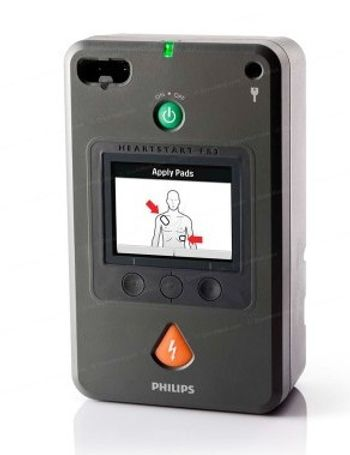
PHILIPS HeartStart FR3 with ECG and Rigid Case
 PHILIPS ELECTRONICS NORTH AMERICA CORPORATION · Model 860364
FR3 ECG, US English, Rigid System Bundle.
Intended use: A portable electronic device designed to automatically detect cardiac arrhythmias (ventricular fibrillation/pulseless ventricular tachycardia) in a sudden cardiac arrest (SCA) patient, after which it automatically activates defibrillation of the heart through application of electrical shocks to the chest surface. The device is placed in conspicuous public locations and is intended to be applied to the patient by a layperson. It consists of an external pulse generator (EPG) with a cardiac rhythm recognition system and a pair of skin-adhesive electrodes to monitor the rhythm and deliver the shocks; it also includes a non-rechargeable battery for energy.
Key tips
- ·A no-signal/flatline alarm gets checked on the patient first, not the monitor - rule out a real clinical event before troubleshooting.
- ·Recalibrate NIBP against a reference manometer, not just a self-test pass.
- ·Reused patient cables (SpO2, ECG leads) are a common source of intermittent-fault complaints - swap the cable before the module.
Typical Failure Modes
Compiled for this model from its own documentation and established engineering knowledge for this equipment class - not from a verified service record. Confirm against the manufacturer's service manual.
Will not power on or unexpected shutdown
HighSymptoms: The patient monitoring is dead, reboots, or shuts down mid-use.
Root cause: Mains lead / fuse, an aged battery, or a power-supply board fault.
Battery will not hold charge
MediumSymptoms: Short run time on battery; low-battery alarm soon after a full charge.
Root cause: Aged rechargeable battery pack or a charger fault.
Display / control-panel fault
MediumSymptoms: Blank, dim or distorted display; unresponsive keys or touchscreen.
Root cause: Display, backlight, or control-board fault.
Fails self-test or calibration
MediumSymptoms: Power-on self-test or the scheduled performance check fails or is out of tolerance.
Root cause: Sensor drift or an internal board fault; recalibration or repair needed.
Serviceable Parts & Consumables
Serviceable items for this model, compiled from its documentation and engineering knowledge for this equipment class. Service class and relative cost are estimates, not manufacturer figures; no part numbers are given. Confirm intervals and pricing against the manufacturer.
Rechargeable battery pack
Class Periodic replacementRel. cost $$R&R Fairly easy
Power supply / mains board
Class Major service partRel. cost $$$R&R Difficult
Display / control-panel assembly
Class Major service partRel. cost $$$R&R Moderate
Cooling fan
Class Major service partRel. cost $R&R Moderate
| Part | Service class | Relative cost | R&R difficulty |
|---|---|---|---|
| Rechargeable battery pack | Periodic replacement | $$ | Fairly easy |
| Power supply / mains board | Major service part | $$$ | Difficult |
| Display / control-panel assembly | Major service part | $$$ | Moderate |
| Cooling fan | Major service part | $ | Moderate |
Relative cost: $ lowest · $$$$ highest service-part cost for this equipment class. Not a price.
PM Checklist
Preventive-maintenance tasks typical of this equipment class. Perform to the manufacturer's procedure and your facility's policy - this is general reference, not a schedule for this specific unit.
- ·Routine cable and lead-wire inspection for fraying/wear
- ·Battery conditioning cycle
- ·NIBP calibration check against a reference manometer
- ·ECG / SpO2 accuracy verification against a patient simulator
- ·Annual electrical safety test
Troubleshooting Approach
A starting sequence for this model, compiled from its documentation and engineering knowledge for this equipment class. Follow the manufacturer's service documentation for the actual procedure.
Symptom: Will not power on
- Confirm the outlet, mains lead and fuse.
- Try on battery, then on mains only, to isolate the supply.
- Look for a power indicator or POST code.
- Replace the fuse / battery / power supply as isolated.
- Run the self-test after any repair.
Symptom: Fails self-test or calibration
- Note the exact failure message / code.
- Power-cycle and repeat the self-test.
- Verify against a reference / simulator where one applies.
- Recalibrate per the service manual.
- Refer the affected board for service if it will not hold calibration.
Technical Specs
- Height
- 13.4 in
- Length
- 7.7 in
- Weight
- 13.2 lbs base unit with 1 battery/pads and pads cable
- Defibrillator Type
- External, Automated (AED)
- Width
- 12.4 in
- MRI safety
- MR Unsafe
- Sterile
- No
- Single use
- No
- FDA distribution status
- Not in Commercial Distribution
- Device type (GMDN)
- Non-rechargeable public automated external defibrillator
- FDA product classification
- Automated External Defibrillators (Non-Wearable)
Typical Location
Where this class of equipment is typically deployed - general reference, not this unit's own placement record.
- ICU / CCU
- Emergency Department
- OR / PACU
- General med-surg floors
- Step-down units
- Telemetry units
Documents & Manuals
No documents available for this device yet.
Safety & Recalls
Synced live from the FDA openFDA API.
- RECALL
Philips has received several reports in which monitors with lithium ion batteries that had exceeded their battery life expectancy have overheated or ignited. These batteries should be replaced every 3 years or upon reaching 300 charge-discharge cycles. Although the Philips SureSigns VS & VM Monitors and View Station (VSV) can display actual information on either or both battery age and charge-discharge cycles, the existing labeling does not include full instructions on how to use this information to determine when to replace the battery. An overheated battery may in turn cause the device case to overheat and possibly melt or cause the device to ignite, which can cause injury to a patient, nearby users, or cause damage to property.
- RECALL
Inform users of correct placement of the disposable adhesive pad on the QCPR meter and inform users of injuries associated with proper performance of CPR. As required by Consent Decree of Permanent Injunction No. 1:17-cv-11955-DJC, entered October 31, 2017 between United States of America and Philips North America
- RECALL
Issue with ECG out cables. When a Philips monitor/defibrillator is receiving an ECG signal from an auxiliary bedside monitor via a sync cable or ECG out cable, the following can occur if the monitor/defibrillator experiences interference from electrical fast transients (EFTs): " On the HeartStart MRx and HeartStart XL, EFT noise may be misinterpreted as an R-wave. " On the HeartStart XL+, EFT noise can disable ECG monitoring and potentially interrupt demand mode pacing*. *Note: It is contrary to the XL+ Instructions for Use to perform demand mode pacing while using the ECG out cable or obtaining the ECG signal from a bedside monitor. The XL+ Instructions for Use includes the following warning: When pacing in Demand Mode, the ECG cable from the patient must be directly connected to the HeartStart XL+. If the user follows this warning, this problem cannot occur on the XL+.
- RECALL
Philips lntelliVue MX4O WLAN Patient Wearable Monitor may not automatically switch to Monitor Mode with audible alarms when association with central monitoring system is unsuccessful [incomplete]
- RECALL
The following MRx software issue has been identified: MRx model M3535A with software version F.03.06 and earlier, and model M3536A with version T.00.05 and earlier may stop the automated Ready-For-Use (RFU) test in an abnormal state when the device is turned off.
- RECALL
Multiple software and hardware issues with device that can affect its function.
- RECALL
When a Philips monitor/defibrillator is receiving an ECG signal from an auxiliary bedside monitor via a sync cable, the following can occur if the monitor/defibrillator experiences interference from electrical fast transients (EFTs) while connected to AC power: On the HeartStart MRx and HeartStart XL, EFT noise can be misinterpreted as an R-wave. On the HeartStart XL+, EFT noise can disable ECG monitoring, and potentially interrupt demand mode pacing.
Troubleshoot this device with Bio
Describe a symptom or error code. Bio answers from this device's own documented error codes, failure modes, parts, and guides.
Ask Bio