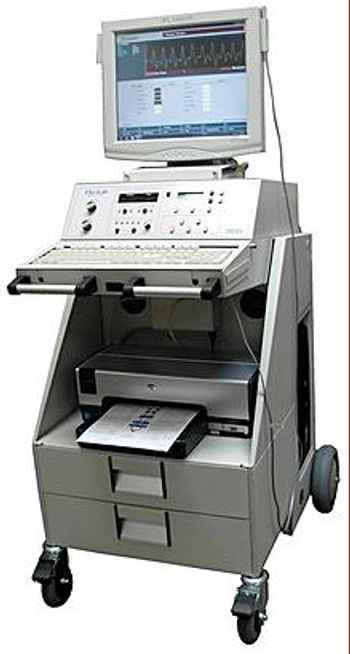
Parks Flo-Lab 2100-SX
 Parks · Model Flo-Lab 2100-SX
Tops in Testing Capabilities. Better Studies in Less Time. Designed to help you focus on performing the fastest, most accurate studies on all of your patients, even those with severe disease. Most accurate in the world-and the most flexible, user-friendly operation of any vascular system. Performs a full range of lower arterial, upper arterial, and venous studies, providing complete vascular diagnostic services for your patients.
Key tips
- ·When no category-specific guidance fits, default to the manufacturer's own service manual and the general troubleshooting method in the Engineer's Guide.
- ·Run an incoming and annual electrical safety test regardless of how niche the device is.
Typical Failure Modes
Compiled for this model from its own documentation and established engineering knowledge for this equipment class - not from a verified service record. Confirm against the manufacturer's service manual.
Cannot obtain / hold cuff pressures
HighSymptoms: Segmental cuffs will not inflate or hold, pressure leaks off, study will not complete.
Root cause: Worn cuffs / tubing / connectors, an internal pump / valve fault, or a manifold leak.
PPG / Doppler sensor fault
MediumSymptoms: Flat or noisy PPG / PVR waveform, no Doppler signal.
Root cause: Worn PPG probe or Doppler probe, or a probe-cable fault.
Pressure-transducer / calibration drift
MediumSymptoms: Recorded pressures implausible or biased, calibration fails.
Root cause: Transducer drift or a calibration issue.
Software / PC / report fault
MediumSymptoms: Study will not save, calculate ABI, or generate a report.
Root cause: Workstation PC, software, or the interface.
Printer fault
LowSymptoms: No or faint waveform printout.
Root cause: Printer or paper.
Serviceable Parts & Consumables
Serviceable items for this model, compiled from its documentation and engineering knowledge for this equipment class. Service class and relative cost are estimates, not manufacturer figures; no part numbers are given. Confirm intervals and pricing against the manufacturer.
Segmental cuffs & tubing set
Class Frequent wear itemRel. cost $$R&R Easy
PPG / Doppler probe & cable
Class Periodic replacementRel. cost $$R&R Fairly easy
Internal pump / valve manifold
Class Major service partRel. cost $$R&R Moderate
Pressure transducer
Class Major service partRel. cost $$R&R Moderate
Workstation PC / printer
Class Major service partRel. cost $$R&R Moderate
| Part | Service class | Relative cost | R&R difficulty |
|---|---|---|---|
| Segmental cuffs & tubing set | Frequent wear item | $$ | Easy |
| PPG / Doppler probe & cable | Periodic replacement | $$ | Fairly easy |
| Internal pump / valve manifold | Major service part | $$ | Moderate |
| Pressure transducer | Major service part | $$ | Moderate |
| Workstation PC / printer | Major service part | $$ | Moderate |
Relative cost: $ lowest · $$$$ highest service-part cost for this equipment class. Not a price.
PM Checklist
Preventive-maintenance tasks typical of this equipment class. Perform to the manufacturer's procedure and your facility's policy - this is general reference, not a schedule for this specific unit.
- ·Follow the manufacturer's PM schedule
- ·Perform incoming and annual electrical safety testing per facility biomedical program
Troubleshooting Approach
A starting sequence for this model, compiled from its documentation and engineering knowledge for this equipment class. Follow the manufacturer's service documentation for the actual procedure.
Symptom: Cannot obtain / hold cuff pressures / study will not complete
- Fit known-good segmental cuffs and tubing.
- Occlude each channel and confirm it holds pressure.
- Check the manifold and quick-connectors for leaks.
- Verify pressures against a calibrated manometer.
- Refer the internal pump / valve manifold if leaks persist.
Symptom: Flat or noisy PPG / PVR waveform / no Doppler signal
- Swap the PPG / Doppler probe and its cable.
- Confirm probe placement, skin contact and gel.
- Flex the cable while watching for dropout.
- Verify on a normal limb.
- Replace the probe if a known-good one works.
Symptom: Software / PC / report fault
- Restart the software and check the amplifier / interface link.
- Confirm the study saves and the ABI calculates.
- Check the printer.
- Update to compatible software.
- Escalate a persistent interface fault to the OEM.
Technical Specs
- Height
- 55 in
- Length
- 30 in
- Width
- 26.5 in
Typical Location
Where this class of equipment is typically deployed - general reference, not this unit's own placement record.
- Varies by device - check the unit's own manual for facility placement guidance
Documents & Manuals
Safety & Recalls
Synced live from the FDA openFDA API.
- RECALL
Parks Medical Electronics, Inc. was made aware of two incidents where an air supply tube from their PARKS PVR unit was inadvertently connected to an IV in the patient's arm instead of into the blood pressure cuff.
Troubleshoot this device with Bio
Describe a symptom or error code. Bio answers from this device's own documented error codes, failure modes, parts, and guides.
Ask Bio