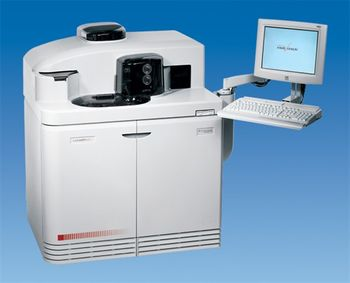
Ortho Clinical Diagnostics VITROS ECiQ
 Ortho Clinical Diagnostics · Model VITROS ECiQ
ADVANCED PROCESSING CENTER Ensures result integrity for quality result reporting Patient samples and reagents automatically metered into MicroWells INTELLICHECK Technology verification at each step Dual-logic processing optimizes assay performance and throughput REAGENT MANAGEMENT CENTER Optimizes labor by reducing operator intervention Up to 20 Integrated Reagent Packs loaded any time and stored on-board for continuous, random access operation Automatic Inventory Management monitors and verifies inventory, expiration, and calibration INTELLICHECK Technology verifies MicroWell dispense and assay reagent aspiration and dispense SAMPLING CENTER Reduces errors for worry-free result reporting Unique Save-the-Sample Clot/Bubble Detection preserves the specimen and minimizes redraw Disposable Tip Sample Metering verifies sample aspiration and dispense, while addressing carryover and cross-contamination concerns Universal Sample Trays accommodate primary, secondary, and microcollection containers and sample cups without adapters or pour-off containers e-CONNECTIVITY CENTER Maximizes system uptime and increases staff productivity Highly secure, real-time two-way communication between your system and our support teams Automatic Data Exchange and Remote Connectivity for immediate diagnostic and performance analysis Immediate resolution of technical issues without a service visit.
Key tips
- ·Run QC controls before trusting any repair - an analyzer that passes self-test can still report clinically wrong results.
- ·Rule out a reagent lot change before opening the instrument - it can look exactly like a hardware fault.
- ·Centrifuge rotors have a hard retirement age/cycle limit regardless of visible condition - don't eyeball it.
Typical Failure Modes
Compiled for this model from its own documentation and established engineering knowledge for this equipment class - not from a verified service record. Confirm against the manufacturer's service manual.
QC / calibration failure on an assay
HighSymptoms: Controls out of range, calibration fails, flagged results on one or more assays.
Root cause: Reagent pack issue, a probe / dispense fault, incubation-temperature drift, or a detector / optics fault.
Sample / reagent probe or pipettor fault
MediumSymptoms: Short aspiration, no dispense, clot / level-sense errors, carryover.
Root cause: Clogged or bent probe, a syringe / pump fault, or a level-sense fault.
Wash / aspiration station fault
MediumSymptoms: High background / noise, poor precision, elevated blanks.
Root cause: Blocked wash-station nozzles or a wash-pump / vacuum fault.
Incubator temperature fault
MediumSymptoms: Assay drift or bias, incubation-temperature alarm.
Root cause: Incubator heater or temperature-sensor fault.
Detector / luminometer / photometer fault
MediumSymptoms: Low signal, high CV, detector-error message.
Root cause: PMT / detector ageing or an optics fault.
Serviceable Parts & Consumables
Serviceable items for this model, compiled from its documentation and engineering knowledge for this equipment class. Service class and relative cost are estimates, not manufacturer figures; no part numbers are given. Confirm intervals and pricing against the manufacturer.
Sample / reagent probe
Class Periodic replacementRel. cost $$R&R Moderate
Syringe / dispense pump
Class Periodic replacementRel. cost $$R&R Moderate
Wash-station nozzles / pump tubing
Class Frequent wear itemRel. cost $R&R Moderate
Incubator heater / temperature sensor
Class Major service partRel. cost $$R&R Moderate
Detector / PMT module
Class Major service partRel. cost $$$R&R Difficult
| Part | Service class | Relative cost | R&R difficulty |
|---|---|---|---|
| Sample / reagent probe | Periodic replacement | $$ | Moderate |
| Syringe / dispense pump | Periodic replacement | $$ | Moderate |
| Wash-station nozzles / pump tubing | Frequent wear item | $ | Moderate |
| Incubator heater / temperature sensor | Major service part | $$ | Moderate |
| Detector / PMT module | Major service part | $$$ | Difficult |
Relative cost: $ lowest · $$$$ highest service-part cost for this equipment class. Not a price.
PM Checklist
Preventive-maintenance tasks typical of this equipment class. Perform to the manufacturer's procedure and your facility's policy - this is general reference, not a schedule for this specific unit.
- ·Daily QC controls run and reviewed
- ·Calibration verification per assay
- ·Routine cleaning and decontamination
- ·Scheduled reagent-path and pump-tubing maintenance
Troubleshooting Approach
A starting sequence for this model, compiled from its documentation and engineering knowledge for this equipment class. Follow the manufacturer's service documentation for the actual procedure.
Symptom: QC or calibration failure
- Run fresh controls and recalibrate the affected assay.
- Confirm the reagent pack is in date, mixed and correctly loaded.
- Clean the probes and wash stations.
- Check the incubator temperature against a reference.
- Escalate a detector / optics fault to the OEM.
Symptom: Probe or pipettor fault
- Inspect the probe for a bend or clog and clear it.
- Run the fluidics prime.
- Check the syringe / pump and tubing for leaks or air.
- Verify level sensing and probe position.
- Replace the probe or syringe as found and re-run QC.
Typical Location
Where this class of equipment is typically deployed - general reference, not this unit's own placement record.
- Central / core laboratory
- Point-of-care testing stations
- Blood bank
- Microbiology lab
Documents & Manuals
Safety & Recalls
Synced live from the FDA openFDA API.
- RECALL
The issue was mismatched diluent lots assembled into VITRO Chemistry Products Performance Verifier I and II. This issue has the potential to cause erroneous Quality Control (QC) results that could lead to testing delays and erroneous patient results. This issue caused positive or negative bias in the quantification of sodium (Na+) and total carbon dioxide (ECO2). The incorrect diluent into the Performance Verifier II exhibited a potential negative bias of up to 6 mmol/L for ECO2 and Na+ testing.
- RECALL
Reagent packs could potentially contain incorrect wells, which will generate incorrect, and potentially false negative, results.
- RECALL
Potential to cause biased results in the upper end of the reportable range for the quantitative measurement of Transferrin, C3, C4, IgA, IgG and IgM. Within the reference interval, the highest bias observed in selected sample testing investigation was +35.3% for IgM; -4.3% for IgG; +12.3% for IgA; -6.9% for C3; -6.6% for C4; and -17.8% for transferrin. Falsely elevated or reduced results could be reported depending on the analyte and/or sample concentration.
- RECALL
When processing MicroSlides, slides that utilize Slot 18 in the CM rotor may be mis-positioned. As a result, certain VITROS MicroSlides may produce erroneous results.
- RECALL
The reagent bottles may be swapped within the reagent pack, which may lead to false negative results or delayed results due to calibration failures, or quality control failures.
- RECALL
Etrombopag Interference for VITROS Chemistry Products: TBIL Slides, VITROS BuBc Slides and VITROS XT TBIL-ALKP Slides
- RECALL
Modifications to MicroWell Qualitative Assay Parameters Not Retained- may be inadvertently reset to default in certain circumstances
- RECALL
The Spanish and Swedish language versions of the IFU state that the assay can be tested with Plasma which is false and could result in biased results.
- RECALL
The specified reagent packs exhibit an increase in the frequency of unsuccessful calibrations.
- RECALL
Users may experience intermittent slide dispense issues with some cartridges due to the anti-backup platen failing to advance inside the cartridge.
- RECALL
Potential for sample fluid to be dispensed to an incorrect position on the MicroSlide, potentially leading to erroneous assay results being reported
- RECALL
One of the software algorithms used to detect sample dispense errors was inadvertently disabled. Because of this, sample dispense errors may lead to incorrect results being reported without an error code to alert the user.
- RECALL
Luminometer Malfunction May Cause Inability to Process MicroWell Assays on VITROS Systems
- RECALL
Negative bias results when using VITROS VALP Reagent, GEN 25.
- RECALL
The firm is extending their previous July 2018 recall to include additional product codes. Biased results may occur for these additional products at biotin concentrations which are lower than indicated in the current Instructions for Use.
- RECALL
Software anomaly may incorrectly extend the on-analyzer stability time for a loaded VITROS Reagent.
- RECALL
VITROS Chemistry Products dLDL Reagent GENs 26 and 27, negatively biased results
- RECALL
The reagent pack exhibits the potential for an increased frequency of calibration failures.
- RECALL
Potential for the VITROS 5600 Integrated System to dispense an insufficient sample volume onto a MicroSlide without suppressing the potentially incorrect result.
- RECALL
There is a potential for imprecise results when using the slides. Increase in imprecision when using PHYT coating 0165. This leads to higher and lower than expected results for both quality control samples and patient samples.
- RECALL
Potential for positively biased results
- RECALL
This product is not meeting the current storage labeling for unopened VITROS DAT Performance Verifiers causing customers to obtain lower than expected VITROS BENZ results when using this control.
- RECALL
The firm identified the potential for biased results to be generated when processing VITROS PHYT Slide product with citrate plasma specimen samples. The current Instructions for Use (IFU) and Assay Summary Chart state serum, heparin plasma, and citrate plasma as acceptable specimen types for use with the PHYT assay.
- RECALL
The company received a customer complaint for the inability to calibrate VITROS Chemistry Products dLDL Reagent when using VITROS FS Calibrator 1, Lot 91461 and ADD (DRV 5908). Assay Data Disk (ADD) DRV versions 5904, 5905, 5906, 5907, 5908, 5909, and 5910 are all affected by this issue.
- RECALL
There is a potential for variable negatively and positively biased urine protein results using VITROS UPRO Slides.
- RECALL
The device defect is a positive bias of up to 20% relative to the currently marketed Roche device. In addition, the firm states that during the investigation they discovered that the cleared reference interval (RI) was not set optimally at product launch in 2010 and that the upper limit in the IFU of 53.5pg/mL is too low and should be closer to 80 pg/mL. They are in the process of submitting the data to support the revised RI in a new 510K submission and will be changing the IFU once the 510K is cleared.
- RECALL
A field correction was issued by the firm for VITROS TSH reagent lot 5040 due to a higher than expected frequency of customer calibration curves falling outside of the calibration quality parameters and therefore unusable to process samples. Customers using VITROS TSH Lot 5040 will potentially experience an unexpected increase in the unsuccessful calibrations potentially causing a delay in testing and reporting results for VITROS TSH.
- RECALL
Ortho Clinical Diagnostics has issued a recall of their VITROS immunodiagnostics Estradiol Reagent assay. The firm was made aware of a potential cross-reactivity between the drug Fulvestrant and theVITROS Immunodiagnostic Estradiol Reagent assay. The firm conducted an internal investigation and was able to confirm biased positive (ranging from 1303-4046%) on Estradiol results, obtained from postmenopausal females taking Fulvestrant.
- RECALL
The signal/cutoff (s/c) results may increase throughout the open-reconstituted timeframe of the allowed 5 days. Increased results may occur on both the negative and positive Controls. The positive Control, although showing elevated results, was still within acceptable performance.
- RECALL
Ortho-Clinical Diagnostics confirmed that sample results generated from VITROS Immunodiagnostic Products Total T4 Reagent Packs may show a negative bias prior to the open pack storage limit of <= 8 weeks that is located in the Instructions for Use (IFU) for VITROS Immunodiagnostic Products Total T4 Reagent Pack.
- RECALL
Ortho Clinical Diagnostics started receiving customer complaints for biased results when using VITROS dTIBC Reagent GEN 30 product. Ortho's investigation confirmed that incorrect calibration mathematics were assigned to the Calibrator Kit 29 Lots 2915 and 2995 supporting dTIBC Reagent GEN 30 product.
- RECALL
Ortho Clinical Diagnostics (OCD) confirmed a potential for biased calcium (Ca) results to be generated when using VITROS Ca Slides, GEN29, and the VITROS 250/350/950/5,1 FS, 4600 Chemistry System or the VITROS 5600 Integrated System. An increase in negatively biased calcium results complaints prompted the investigation that identified this product issue.
- RECALL
Ortho Clinical Diagnostics (OCD) confirmed that specific lots of VITROS Immunodiagnostic Products AFP Reagent Pack product exhibit an increase in the reaction signal over time potentially resulting in the inability to calibrate and use the product.
- RECALL
There is an incorrect value (data/calibration mathematics) on ADDs. This incorrect value will prevent a successful calibration of the assay.
- RECALL
Ortho Clinical Diagnostics confirmed a software timing anomaly in which the VITROS 3600 and 5600 Systems may unexpectedly aspirate from or dispense into an unintended sample that may lead to erroneous or contaminated results.
- RECALL
When testing was conducted using certain lots, VITROS Systems generated results within the measuring range for samples known to not contain measurable hCG. The system reported results up to approximately 7.40 mIU/mL (IU/L) for patient samples that should have been less than the measuring range of the assay (<2.39 mIU/mL (IU/L)).
- RECALL
The two sets of wires (4 total wires) exiting from the EMI filters were switched, creating a situation where a module that is intended to be de-energized will remain energized only if the associated AC power cord is unplugged.
- RECALL
Software anomaly may allow VITROS Systems to sample and process assays while the fluids and reagent temperatures are not in the required temperature range for optimal processing. When this intermittent issue occurs, the VITROS Systems continue to operate and process results without notification to the User, possibly producing erroneous results.
- RECALL
Software Anomaly during ADD Installation on VITROS 5,1 FS Chemistry Systems using Software Versions 2.2.1 through 2.8. The user modified parameters would not be saved as expected, but remained changed to the default values obtained from the ADD disk.
- RECALL
The Immunodiagnostic Products Signal Reagent, Lot 3082 as the reagent packs may contain blank labels.
- RECALL
Software anomaly regarding urine samples that require acidified pretreatment. The software has allowed urine samples for assays that require acidified pretreatment to be metered from the same sample container as assays that required no pretreatment when the sample was programmed.
- RECALL
Software anomaly allows testing of multiple assays using a single urine specimen, regardless of the pretreatment requirements for each selected assay, potentially leading to biased patient results.
- RECALL
Software Anomaly; It is possible for the device to process samples with a cartridge other than the intended cartridge, potentially leading to erroneous patient results. If this anomaly occurred previously, an indication would be a series of results that were similar across multiple samples (i.e., results could be believable or outside of the Reportable Range for the intended assay).
- RECALL
In combination with the Batch Programming option (only) for programming samples, the hand-held barcode scanner unexpectedly skips sample cup positions within a sample tray. This issue only occurs when using the Batch Programming option; all other sample programming options function as intended.
- RECALL
Calibration may not occur when using calibrator barcode labels supplied with VITROS Chemisty Products Calibrator Kit 2.
- RECALL
Ortho Clinical Diagnostics (OCD) identified an anomaly with Software Version 3.0 and below on the VITROS 4600 Chemistry Systems and VITROS Integrated Systems. Internal testing confirmed that when using calibrator barcode labels supplied with VITROS Chemistry Products Calibrator Kits 1, 2, 3, 4, 6, or 9, an unexpected assay calibration may occur if assay targets are unassigned (i.e., hidden).
- RECALL
Customers may receive positively biased results when using VITROS Immunodiagnostic Products CA 19-9 Total Reagent Packs, Lot 1320 and VITROS CA 19-9 Calibrators, Lot 1320 on the VITROS ECi/ECiQ Immunodiagnostic Systems, the VITROS 3600 Immunodiagnostic System and the VITROS 5600 Integrated System. There is an unexpected observed change in CA 19-9 Calibrators, Lot 1320 calibrator values.
- RECALL
Ortho Clinical Diagnostics has identified an anomaly with VITROS System Software Version 3.0 and below. Internal testing confirmed that under very specific conditions, incorrect patient demographics were associated with a sample identification (ID) number.
- RECALL
Calibrator values assigned for the calibrator kit lots were released using a reference method that was undergoing validation for a new lot of European Reference Material (ERM). The validation process was not complete prior to calibrator value assignment for VITROS (R) Chemistry Products hsCRP Reagent (Product Code 6801739), Generation (GEN) 28.
- RECALL
Potential for biased results when a Multiple Window (MW) code is associated with results generated by the VITROS 4600 Chemistry System, the VITROS 5600 Integrated System and the VITROS 5,1 Chemistry System. MW codes may be associated with results from any of the following VITROS Chemistry Products using multiple point (multipoint) rate measurements. The MicroSlide assays that could be affected
- RECALL
Total T4 Calibrators and Reagent Packs may have calibration failures or low Quality Control results.
- RECALL
Ortho Clinical Diagnostics has determined that the VITROS Immunodiagnostic Products 25-OH Vitamin D Total Calibrators, Lots 0091 through 0235, used with VITROS Immunodiagnostic Products 25-OH Vitamin D Total Reagent Packs, may generate negatively biased results. As a result, users must immediately discontinue using all current lots of VITROS 25-OH Vitamin D Total Calibrators and Reagent Packs.
- RECALL
An incorrect assay value (0.3785) was printed on the product carton for the 460 nm wavelength (filter) that may cause a delay in the ability to obtain and report TBIL, Bu, Bc, and derived tests results. The correct assay value is 0.8658.
- RECALL
Ortho Clinical Diagnostics issued a Product Correction Notification for VITROS Immunodiagnostic Products Anti-HBs Calibrators and Anti-HBs Quantitative Reagent Packs due to false positive results.
- RECALL
Ortho Clinical Diagnostics issued a Product Correction Notification for VITROS Immunodiagnostic Products CA 125 II Reagent Pack and Calibrators due to a positive shift in patient results.
- RECALL
Inaccurate quality control results.
- RECALL
Ortho Clinical Diagnostics is recalling Slide Dispense cartridges used with some VITROS Chemistry Product Slides due to slide dispense issues.
- RECALL
Ortho Clinical Diagnostics is recalling CM/RT wear pads which are a component in the CM/RT incubator due to becoming worn before their replacement.
- RECALL
There is evidence that an electrical short within the systems connector has caused an accumulation of heat which has radiated back through the wiring harness causing the wires and connectors to melt.
- RECALL
Internal testing demonstrated that opened-reconstituted VITROS CK-MB Calibrators stored at -20 degrees Celsius (-4 degrees Farenheit) generated invalid calibrations that were detected by positively biased quality control results.
- RECALL
The firm is recalling the specific lot due to lower than expected results.
- RECALL
Ortho Clinical Diagnostics (OCD) received customer complaints of intermittent imprecision, outliers, or shifts in accuracy and control fluid values outside of expected intervals when using VITROS Chemistry Products PHBR Slides. OCD's investigation confirmed that positively biased values for patient samples could be obtained that may not be detected by quality control fluids.
- RECALL
Ortho-Clinical Diagnostics, Inc. (OCD) determined that extension springs on some VITROS Systems may be out of its manufacturing specifications. Extension springs are part of the slide alignment guide assembly. During an internal evaluation in its manufacturing facility, it was discovered that an extension spring had insufficient force. If the extension spring does not provide sufficient force, MicroSlides may not be properly positioned within the MicroSlide incubator which has the potential to cause imprecise results. Extension springs are just one component in the slide alignment assembly. OCD's evaluation determined that the probability of an out of specification extension spring alone adversely affecting results is unlikely.
- RECALL
Some VITROS Chemistry Products Vapor Adsorption Cartridge CAT No. 6800100 cartons incorrectly contain a Particulate Cartridge Part No. J19612. In some instances, the Particulate Cartridge has been inadvertently installed on the VITROS System instead of the intended VITROS Vapor Adsorption Cartridge which may bias results.
- RECALL
Ortho Clinical Diagnostics is recalling certain lots of the Vitros Anti-HBs Reagent packs an inability to obtain a valid calibration.
- RECALL
software automatically switches the lot when a vancomycin (VANC) or valproic acid (VALP) reagent is depleted or the operator manually changes the lot in use causing lack of verification of proper quality assessment.
- RECALL
Ortho Clinical Diagnostics is recalling VITROS 5600 Integrated System Software Version 1.6 and below because of an anomaly that may inadvertently add a surfactant to a CurveTip position.
- RECALL
Ortho-Clinical Diagnostics is recalling VITROS Chemistry Systems due to possible internal hard drive failure.
- RECALL
Ortho Clinical Diagnostics (OCD) received customer complaints regarding the loss of calibration data following the installation of a development Assay Data Disk (ADD) that was available in the on-screen mailbox on the Main Menu System Status screen of their VITROS 5600 Integrated System. OCD's investigation determined that ADD, Data Release Version (DRV) 9241 or 9251 was electronically transferr
- RECALL
Software design. The firm received a customer complaint regarding a qualitative positive THC (Cannabinoids) result obtained from a THC quality control fluid that was known to be negative when using VITROS Chemistry Products THC Reagent. A second customer complaint was received a month later. OCD's investigation concluded that under specific circumstances, incorrect qualitative results for Cannabi
- RECALL
Firm received complaints of biased results when using VITROS Signal Reagent, Lots 8350 and 8530. VITROS Signal Reagent is used with the VITROS Immunodiagnostic ECi/ECiQ laboratory system, and when used may produce inaccurate test results in some cases.
- RECALL
When using Vitro ECi Immunodiagnostic System with Vitros Anti-HBc IgM Reagent Packs and Anti-HAV IgM Reagent Packs, results of the 1st of two required re-test replicates may be negtively biased.
- RECALL
Label printing irregularities on cartons and/or bottles.
Troubleshoot this device with Bio
Describe a symptom or error code. Bio answers from this device's own documented error codes, failure modes, parts, and guides.
Ask Bio