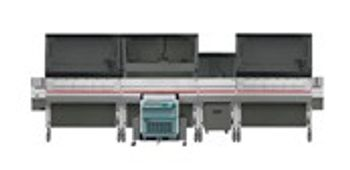
Ortho Clinical Diagnostics enGen Automation
 Ortho Clinical Diagnostics · Model enGen Automation
Auto-verify valid results. Boost productivity by processing more samples during all shifts without adding staff. MICROSLIDE/MICROTIP Technology ensures low maintenance. Balance workloads and eliminate workstation bottlenecks. Reduce exposure to biohazards. Results-based Routing handles re-runs, dilutions, and reflex testing without operator intervention. Streamline sample handling by eliminating operator interventions. Reduce time spent searching for with automated Sample Tracking. Eliminate barcode reading errors. Increase first-pass yields. Auto-verification combined with INTELLICHECK Technology delivers worry-free results. Results-based Routing optimizes workflow. Standardize turnaround times. Reduce potential for errors with fewer manual interventions. MICROSENSOR Technology ensures specimen integrity. Lower total cost by improving staff utilization while reducing errors and manual interventions. Expand functionality when lab is ready - start with preanalytical and simply add module or analyzer interfaces as you need them.
Key tips
- ·Run QC controls before trusting any repair - an analyzer that passes self-test can still report clinically wrong results.
- ·Rule out a reagent lot change before opening the instrument - it can look exactly like a hardware fault.
- ·Centrifuge rotors have a hard retirement age/cycle limit regardless of visible condition - don't eyeball it.
Typical Failure Modes
Compiled for this model from its own documentation and established engineering knowledge for this equipment class - not from a verified service record. Confirm against the manufacturer's service manual.
Assay / QC failure across a channel or the whole system
HighSymptoms: Controls out of range, calibration fails, flagged results, drift over a shift.
Root cause: Reagent or cuvette issue, lamp ageing, a probe / mixer / wash-station fault, or ISE-module problems.
Sample / reagent probe clog or crash
MediumSymptoms: Short aspiration, no dispense, clot detection, probe-position error.
Root cause: Clogged or bent probe, or a clot in the sample.
Cuvette / reaction-rotor fault
MediumSymptoms: High cuvette blanks, non-uniform results by position, rotor-drive error.
Root cause: Worn / scratched cuvettes or a wash fault, or a rotor-drive fault.
ISE module fault (Na / K / Cl)
MediumSymptoms: Electrolyte results biased or noisy, ISE calibration fails.
Root cause: Aged ISE electrodes / reference, or a pinch-valve / tubing fault.
Water / vacuum / pressure system fault
MediumSymptoms: Multiple station alarms, priming failures, poor wash.
Root cause: Water / DI supply quality, a pump, or a vacuum / pressure regulator.
Serviceable Parts & Consumables
Serviceable items for this model, compiled from its documentation and engineering knowledge for this equipment class. Service class and relative cost are estimates, not manufacturer figures; no part numbers are given. Confirm intervals and pricing against the manufacturer.
Sample / reagent probes
Class Periodic replacementRel. cost $$R&R Moderate
Photometer lamp
Class Frequent wear itemRel. cost $$R&R Moderate
Reaction cuvettes / segment
Class Frequent wear itemRel. cost $$R&R Easy
ISE electrodes (Na / K / Cl) & reference
Class Frequent wear itemRel. cost $$R&R Fairly easy
Peristaltic / pinch-valve tubing
Class Frequent wear itemRel. cost $R&R Moderate
| Part | Service class | Relative cost | R&R difficulty |
|---|---|---|---|
| Sample / reagent probes | Periodic replacement | $$ | Moderate |
| Photometer lamp | Frequent wear item | $$ | Moderate |
| Reaction cuvettes / segment | Frequent wear item | $$ | Easy |
| ISE electrodes (Na / K / Cl) & reference | Frequent wear item | $$ | Fairly easy |
| Peristaltic / pinch-valve tubing | Frequent wear item | $ | Moderate |
Relative cost: $ lowest · $$$$ highest service-part cost for this equipment class. Not a price.
PM Checklist
Preventive-maintenance tasks typical of this equipment class. Perform to the manufacturer's procedure and your facility's policy - this is general reference, not a schedule for this specific unit.
- ·Daily QC controls run and reviewed
- ·Calibration verification per assay
- ·Routine cleaning and decontamination
- ·Scheduled reagent-path and pump-tubing maintenance
Troubleshooting Approach
A starting sequence for this model, compiled from its documentation and engineering knowledge for this equipment class. Follow the manufacturer's service documentation for the actual procedure.
Symptom: Assay or QC failure
- Run fresh controls at all levels.
- Confirm reagents are in date, correctly loaded and mixed.
- Run the photometer check and replace the lamp if energy is low.
- Clean the probes, mixers and wash stations.
- Recalibrate the affected assay / ISE module and re-run QC.
Symptom: Probe clog or crash
- Inspect the probe for a bend or blockage and clear it.
- Run the fluidics prime / wash cycle.
- Check for a clot in the sample.
- Verify liquid-level sensing and probe positioning.
- Replace the probe if aspiration is still short.
Typical Location
Where this class of equipment is typically deployed - general reference, not this unit's own placement record.
- Central / core laboratory
- Point-of-care testing stations
- Blood bank
- Microbiology lab
Documents & Manuals
No documents available for this device yet.
Safety & Recalls
Synced live from the FDA openFDA API.
- RECALL
A software anomaly with TCA Software V4.2 may potentially cause a delay in reporting of results due to patient samples being routed to an unintended location when samples are reintroduced back onto the enGEN track
- RECALL
Software anomaly; Thermo-Fisher Scientific initially discovered and Ortho-Clinical Diagnostics, subsequently, confirmed a software anomaly that may potentially result in miss-associated sample IDs involving the communication between enGen TCAutomation (TCA) Bypass modules (manufactured by Thermo-Fisher Scientific) and the VITROS Analyzers. To date, no occurrences of this issue have been observed on Orthos enGen(TM) Systems. Sample IDs may become miss-associated with the actual sample being processed due to discrepant information passed to the analyzer through InOut communication device, triggered by a specific set of events occurring between the Bypass module and the analyzer. --- All of the following conditions must be present for the issue to potentially occur: (1.) The Bypass module is in the process of positioning Sample A at the aspiration position, and (2.) At least two additi
- RECALL
Ortho confirmed that it is possible for the mis-association of sample identification and assay results due to an error with Thermo Fishers centrifuge module. It is possible for mis-associated assay results to be reported from the laboratory prior to the identification of the Cross Check error on the enGen Laboratory Automation System. Assay results associated with the wrong patient and reported out of the laboratory could lead to inappropriate intervention with the potential for serious injury to the patient.
- RECALL
If the user selects the Comment or Interpretation option (in the enGEN .gsb file), and the numerical results fall between Negative and Reactive, the IM incorrectly displays the interpretive text as Borderline and sends the incorrect text to the LIS. The IFU states the interpretation term for these numerical result values is Retest?. The difference in terminology exists for US Markets only.
- RECALL
The electrical cable that supplies power to the cap vibratory feeder of the Recapper Module may loosen from its correct position above the vibration feeder support plate and migrate to under the support plate. If this occurs, the uncapped sample tubes may hit the cable, and sample fluid (e.g., serum) may splash from the tube and into another tube or onto the under carriage of the support plate.
- RECALL
Software anomaly may occur during the installation of an Assay Data Diskette (ADD) using Software Versions 2.2.1 through 2.8. If the user is utilizing User- Configured (Modified) parameters, ALL default settings are restored in the VITROS 5,1 FS Chemistry System from the ADD instead of retaining the user modified parameters.
- RECALL
Recapper Caps may fall off of, or be knocked from sample tubes placed in the storage racks of entry/exit modules. The gripper may grab a tube at the wrong height and drop the tube in the Rack Entry/Exit or Rack Exit module. These situations may result in splashing of bio-hazardous fluid. Sample cross-contamination may occur with an uncapped tube in the rack.
- RECALL
Software anomaly: potential buffer timeout issues when using enGen (TM) Laboratory Automation Systems Configured with TCAutomation (TM) Software v3.5.
- RECALL
Software anomaly: potential for delay in the reporting of patient sample test results when using enGen with TCAutomation Software v2.6 , v3.2 and v3.5 Configured with Bypass Modules for ADVIA Centaur, Abbott Architect, VITROS and/or Tosoh AIA Systems.
- RECALL
Software Anomaly: Ortho Clinical Diagnostics (OCD) has become aware that if a sample requires follow-up action, such as dilution or retesting due to a mechanical issue, it is possible for that sample to be routed to the sample storage drawer (Storage) prior to the completion of the necessary pending action. A delay in patient test result(s) reporting could occur as operator is not alerted that results have not been produced and that further actions are required.
- RECALL
Ortho Clinical Diagnostics issued an Urgent Product Correction Notification involving the enGen Select V5.0 & enGen Custom v3.2.2 due to an anomaly that affects the autoverification feature and custom rules that depend upon data elements used by the referenced enGen Systems.
- RECALL
Ortho Clinical Diagnostics received complaints of centrifuge buckets disconnecting from their supports during centrifugation when using the Hettich Rotanta 46 RSC Robotic Centrifuges, Models 4815, 4816 and 4817, that may be configured with enGen(TM) Laboratory Automation Systems.
- RECALL
Incorrect result calculations can occur (only affects derived results calculated by the VITROS WorkCentre)
Related calculators
From BioLab, for work done with this kind of equipment.
Troubleshoot this device with Bio
Describe a symptom or error code. Bio answers from this device's own documented error codes, failure modes, parts, and guides.
Ask Bio