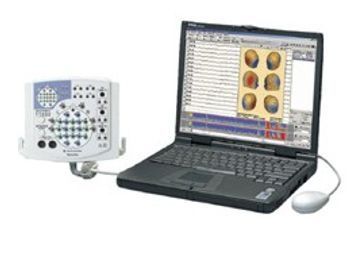
Nihon Kohden EEG-9100
 Nihon Kohden · Model EEG-9100
Neurofax µ is a complete and ready to use system. Comes with a notebook PC unit, isolation power supply, advanced electrode junction box and necessary standard accessories and standard software. A complete range of optional accessories and cart are also available. Portable and lightweight - you can easily carry a complete system in a car or airplane. Clean signal acquisition in any environment. Quality EEG recording is assured even in the electrically noisy OR or ICU. Neurofax µ has high performance, high sensitivity amplifiers, high frequency and simultaneous sampling, an ECG rejection filter, shielded electrodes and a high performance electrode junction box with USB connection.
Key tips
- ·Electrode impedance drives data quality more than almost any other single factor - check it before assuming an amplifier fault.
- ·Pre-case verification of intraoperative monitoring equipment isn't optional - a mid-case failure has direct surgical-decision consequences.
Typical Failure Modes
Compiled for this model from its own documentation and established engineering knowledge for this equipment class - not from a verified service record. Confirm against the manufacturer's service manual.
Noisy / high-impedance channels
HighSymptoms: Mains hum, drift or flat channels, persistently high electrode impedance, poor recording quality.
Root cause: Electrode / lead-wire wear, the electrode box (headbox) inputs, or poor skin prep / environment.
Headbox / amplifier fault
MediumSymptoms: A block of channels dead or saturated regardless of electrode, calibration / bio-cal fails.
Root cause: Headbox amplifier or its cable to the acquisition unit.
Amplifier-to-PC link / acquisition fault
MediumSymptoms: Recording drops, amplifier not detected, data gaps.
Root cause: USB / fibre / network link or a driver.
Photic stimulator / video / audio fault (diagnostic EEG/PSG)
LowSymptoms: Photic strobe not firing, no synchronised video, no audio.
Root cause: Photic lamp / trigger, the video camera, or the audio path.
PSG sensor fault (airflow / effort / SpO2 / limb)
LowSymptoms: A PSG channel (thermistor, pressure, RIP belt, SpO2, PLM) flat or noisy.
Root cause: Worn PSG sensor or its cable.
Serviceable Parts & Consumables
Serviceable items for this model, compiled from its documentation and engineering knowledge for this equipment class. Service class and relative cost are estimates, not manufacturer figures; no part numbers are given. Confirm intervals and pricing against the manufacturer.
Electrode lead set / headbox leads
Class Frequent wear itemRel. cost $$R&R Easy
Headbox / amplifier
Class Major service partRel. cost $$$R&R Moderate
Amplifier link cable / interface
Class Periodic replacementRel. cost $$R&R Fairly easy
Photic stimulator lamp (diagnostic)
Class Periodic replacementRel. cost $$R&R Fairly easy
PSG sensor set (airflow / effort / SpO2)
Class Frequent wear itemRel. cost $$R&R Easy
| Part | Service class | Relative cost | R&R difficulty |
|---|---|---|---|
| Electrode lead set / headbox leads | Frequent wear item | $$ | Easy |
| Headbox / amplifier | Major service part | $$$ | Moderate |
| Amplifier link cable / interface | Periodic replacement | $$ | Fairly easy |
| Photic stimulator lamp (diagnostic) | Periodic replacement | $$ | Fairly easy |
| PSG sensor set (airflow / effort / SpO2) | Frequent wear item | $$ | Easy |
Relative cost: $ lowest · $$$$ highest service-part cost for this equipment class. Not a price.
PM Checklist
Preventive-maintenance tasks typical of this equipment class. Perform to the manufacturer's procedure and your facility's policy - this is general reference, not a schedule for this specific unit.
- ·Electrode / lead impedance check
- ·Amplifier calibration
- ·Annual electrical safety test
Troubleshooting Approach
A starting sequence for this model, compiled from its documentation and engineering knowledge for this equipment class. Follow the manufacturer's service documentation for the actual procedure.
Symptom: Noisy or high-impedance channels
- Check and re-prep electrode sites; confirm impedances are balanced and low.
- Swap the affected leads and try different headbox inputs.
- Run the bio-calibration / calibration signal.
- Address mains interference (route cables, check the ground).
- Replace the lead set or headbox as isolated.
Symptom: Amplifier not detected / recording drops
- Reseat the amplifier-to-PC link at both ends.
- Restart the acquisition software and amplifier.
- Try a different port / cable.
- Update the driver / firmware if indicated.
- Replace the link cable or refer the amplifier.
Typical Location
Where this class of equipment is typically deployed - general reference, not this unit's own placement record.
- Neurology / EEG lab
- ICU (continuous EEG monitoring)
- Operating Room (intraoperative monitoring)
Documents & Manuals
No documents available for this device yet.
Related calculators
From BioLab, for work done with this kind of equipment.
Troubleshoot this device with Bio
Describe a symptom or error code. Bio answers from this device's own documented error codes, failure modes, parts, and guides.
Ask Bio