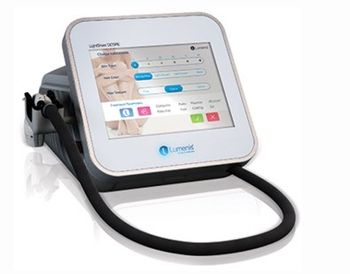
Lumenis LightSheer DESIRE
 Lumenis · Model LightSheer DESIRE
Satisfied Patients - Treatments are cost effective and large areas can be treated in less than 10 minutes, so you can see more satisfied patients. Faster Learning Curve - The system is simple to operate and has a friendly Graphic User Interface (GUI) and preset programs- For a faster learning curve and easy treatment delegation. Treatment Versatility - The handpieces have been ergonomically designed and can be switched using a simple 'Plug and Play' method-To allow versatility in treatment options and improved system handling. Multi-Location-Usage - The system is light and portable and can easily be transported from one place to another- To enable multi-location use. Upgrade - The system is up-gradable so it can grow with your business-To fit your needs in any given time and match your practice requirements so you can maximize revenues. Desirable Clinical Results - The LightSheer technology by Lumenis has been validated in numerous clinical studies and peer reviewed articles. Thousands of satisfied customers have been and are still benefiting from the gold standard performance and patient satisfaction. Faster Treatment - High-Speed Integrated Technology (HIT™) reduces treatment time by more than 75%. Using the 22x35mm spot size, large areas as the back and legs can be treated in less than 10 minutes. THE HIT ™ eliminates the lengthy preparation time need need for cooling or anesthetics. Ultimate Patient Comfort - High-Speed Integrated Technology (HIT™) uses a unique vacuum mechanism that activates the skin's tactile and pressure receptors to inhibit the transmission of pain. ChillTip™ Technology improves patient comfort by cooling the skin prior to treatment and continuously cooling it throughout the treatment. Clinically Validated Efficacy - Numerous clinical studies and peer review articles have validated the safety and efficacy of the technologies powering the LightSheer DESIRE. Thousands of satisfied customers have been and are still benefiting from the gold standard performance and patient satisfaction.
Key tips
- ·Verify true laser output with an external power meter, not the console readout - the display drifts independently of real delivered energy.
- ·Never bypass a door interlock, key switch, or footswitch safety to finish a treatment - laser safety interlocks are not optional.
- ·Most low-output complaints trace to the delivery fiber or handpiece, not the laser source - inspect and swap those first.
- ·Intermittent mid-treatment shutdowns are usually cooling-related - check coolant level and flow before suspecting the diode or lamp.
Typical Failure Modes
Compiled for this model from its own documentation and established engineering knowledge for this equipment class - not from a verified service record. Confirm against the manufacturer's service manual.
No or low laser output
HighSymptoms: Weak or no output at the delivery device, treatment ineffective, power not reaching the set value.
Root cause: Laser module / lamp / diode-bar ageing, a damaged delivery fibre / handpiece / applicator, or a driver / power-supply fault.
Cooling / thermal shutdown
HighSymptoms: Unit shuts down after a period, over-temperature or low-flow alarm.
Root cause: Chiller / TEC fault, low or contaminated coolant, a failed pump, or blocked airflow.
Delivery fibre / handpiece / applicator fault
MediumSymptoms: Burn marks at the tip, high loss, intermittent output, applicator not recognised.
Root cause: Damaged or contaminated fibre / applicator / connector.
Skin-cooling / contact-cooling fault (aesthetic)
MediumSymptoms: Skin cooling not delivered, cooling / cryogen alarm.
Root cause: Contact-cooling / cryogen supply, a valve, or the tip.
Footswitch / interlock / key fault
MediumSymptoms: Laser will not fire, key / interlock / footswitch error.
Root cause: Footswitch, door interlock, or key-switch fault.
Serviceable Parts & Consumables
Serviceable items for this model, compiled from its documentation and engineering knowledge for this equipment class. Service class and relative cost are estimates, not manufacturer figures; no part numbers are given. Confirm intervals and pricing against the manufacturer.
Laser module / lamp / diode bar
Power re-calibration required after replacement.
Class Periodic replacementRel. cost $$$$R&R Expert-level
Delivery fibre / handpiece / applicator
Class Frequent wear itemRel. cost $$$R&R Fairly easy
Chiller / TEC components & coolant filter
Class Periodic replacementRel. cost $$$R&R Difficult
Contact-cooling tip / cryogen valve (aesthetic)
Class Periodic replacementRel. cost $$R&R Moderate
Footswitch
Class Periodic replacementRel. cost $$R&R Fairly easy
| Part | Service class | Relative cost | R&R difficulty |
|---|---|---|---|
| Laser module / lamp / diode bar Power re-calibration required after replacement. | Periodic replacement | $$$$ | Expert-level |
| Delivery fibre / handpiece / applicator | Frequent wear item | $$$ | Fairly easy |
| Chiller / TEC components & coolant filter | Periodic replacement | $$$ | Difficult |
| Contact-cooling tip / cryogen valve (aesthetic) | Periodic replacement | $$ | Moderate |
| Footswitch | Periodic replacement | $$ | Fairly easy |
Relative cost: $ lowest · $$$$ highest service-part cost for this equipment class. Not a price.
PM Checklist
Preventive-maintenance tasks typical of this equipment class. Perform to the manufacturer's procedure and your facility's policy - this is general reference, not a schedule for this specific unit.
- ·Laser output power verification against a calibrated external power meter
- ·Cooling-system check: coolant level, flow rate, and filter / heat-exchanger condition
- ·Delivery-system inspection: handpiece, delivery fiber or articulated arm, and output optics
- ·Interlock, key-switch, emergency-stop, and footswitch function test
- ·Beam-alignment and optical-path check per the service manual
- ·Annual full PM and electrical safety test
Troubleshooting Approach
A starting sequence for this model, compiled from its documentation and engineering knowledge for this equipment class. Follow the manufacturer's service documentation for the actual procedure.
Symptom: No or low output
- Measure output at the delivery device with a laser power meter against the setting.
- Fit a known-good delivery fibre / handpiece / applicator.
- Confirm the cooling system runs and coolant is at level and clean.
- Check the key, interlock and footswitch are satisfied.
- Escalate a confirmed laser-module or driver fault to the OEM; recalibrate power after any module work.
Symptom: Thermal shutdown
- Confirm the cooling fans / pump run and airflow is clear.
- Check the coolant level and replace the coolant filter.
- Let the unit cool and restart.
- Clean the air filters / vents.
- Monitor for recurrence during a treatment.
Technical Specs
- Laser Type
- Diode
- Height
- 42 cm
- Length
- 60 cm
- Weight
- 32 kg
- Wavelength
- 805 nm
- Width
- 51 cm
Typical Location
Where this class of equipment is typically deployed - general reference, not this unit's own placement record.
- Operating rooms and surgical procedure suites
- Dermatology and medical-aesthetic clinics
- ENT, gynecology, and specialty procedure rooms
- Outpatient surgical centers
Documents & Manuals
Safety & Recalls
Synced live from the FDA openFDA API.
- RECALL
Device software treatment preset parameters for the XC treatment handpiece do not match the Operator Manual, and exceed recommended settings. Operator Manual parameters are lower than indicated for specific hair color and Fitzpatrick skin type resulting in insufficient treatment effect. May result in patient burns and hypopigmentation.
- RECALL
During hair removal treatment, patients' skin can experience burns due to debris accumulating on the sapphire crystal tip.
- RECALL
Software anomaly recorded incorrect filter in patient database and this may lead to patient skin burns.
Troubleshoot this device with Bio
Describe a symptom or error code. Bio answers from this device's own documented error codes, failure modes, parts, and guides.
Ask Bio