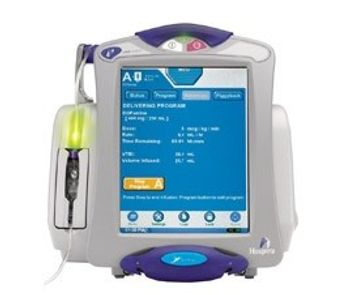
Hospira Symbiq
 Hospira · Model Symbiq
Rate accuracy of the Symbiq system is +/- 5% across the entire delivery range (0.1 - 1,000 mL/hr) allowing hospitals to meet the needs of all care areas. Deliver from a broad range of syringes (1 mL - 60 mL). Configurable - may be customized to meet the varying needs of different hospitals and care areas. 91 dosing units. Human factors engineering incorporated into the design of the Symbiq system. Simple programming for ease of use. Backlit color LCD touchscreen display features highly visible graphics and text and is designed to be viewed easily by a clinician with 20:40 vision. Quick-release rotating pole clamp to facilitate attaching devices or removing them from IV poles and bed rails. Tubing guides for line management. Daisy-chain power connection to minimize cord clutter. Secure pump to pump connection. Automated set loading mechanism.
Key tips
- ·Free-flow protection must be verified on every PM - a failed anti-free-flow clamp is a direct overdose risk.
- ·Test occlusion alarms in both directions - failing to alarm when it should is more dangerous than a false alarm.
- ·Battery run-time complaints are the most common real-world nuisance call - a full charge/discharge cycle test catches most of them.
Typical Failure Modes
Compiled for this model from its own documentation and established engineering knowledge for this equipment class - not from a verified service record. Confirm against the manufacturer's service manual.
Failure / error message stops delivery
HighSymptoms: The pump alarms and displays an error message / code and stops.
Root cause: A subsystem fault indexed in the service manual - motor / drive, a sensor, set-detection, or a board.
Occlusion alarm / pressure fault
MediumSymptoms: Repeated occlusion alarms, delivery stops, or an occlusion is missed.
Root cause: Kinked or clamped line, a closed roller clamp, a positional patient tube, pressure-sensor drift, or an improperly loaded set.
Air-in-line alarm
MediumSymptoms: Frequent air-in-line alarms, delivery stops.
Root cause: Air in the set, an improperly loaded set, or an ultrasonic air-detector fault.
Flow-rate accuracy drift
MediumSymptoms: Delivered volume outside tolerance on the annual test, especially at low rates.
Root cause: Worn pumping mechanism / plunger drive.
Battery will not hold charge
MediumSymptoms: Short run time, low-battery early after a full charge.
Root cause: Aged battery pack.
Door / plunger / sensor mechanical wear
LowSymptoms: Set will not load, door will not latch, plunger grip poor.
Root cause: Worn door latch, plunger jaws, or anti-free-flow mechanism.
Serviceable Parts & Consumables
Serviceable items for this model, compiled from its documentation and engineering knowledge for this equipment class. Service class and relative cost are estimates, not manufacturer figures; no part numbers are given. Confirm intervals and pricing against the manufacturer.
Battery pack
Class Periodic replacementRel. cost $$R&R Fairly easy
Pumping mechanism / rotor / plunger drive
Class Major service partRel. cost $$$R&R Difficult
Pressure / air-detector sensor assembly
Class Major service partRel. cost $$R&R Moderate
Door / latch / anti-free-flow assembly
Class Major service partRel. cost $$R&R Moderate
Drive motor / gearbox
Class Major service partRel. cost $$$R&R Difficult
| Part | Service class | Relative cost | R&R difficulty |
|---|---|---|---|
| Battery pack | Periodic replacement | $$ | Fairly easy |
| Pumping mechanism / rotor / plunger drive | Major service part | $$$ | Difficult |
| Pressure / air-detector sensor assembly | Major service part | $$ | Moderate |
| Door / latch / anti-free-flow assembly | Major service part | $$ | Moderate |
| Drive motor / gearbox | Major service part | $$$ | Difficult |
Relative cost: $ lowest · $$$$ highest service-part cost for this equipment class. Not a price.
PM Checklist
Preventive-maintenance tasks typical of this equipment class. Perform to the manufacturer's procedure and your facility's policy - this is general reference, not a schedule for this specific unit.
- ·Occlusion pressure and flow-rate accuracy verification
- ·Battery conditioning cycle
- ·Door latch and air-in-line sensor inspection
- ·Post-drop functional check before return to service
- ·Annual PM per manufacturer schedule
Troubleshooting Approach
A starting sequence for this model, compiled from its documentation and engineering knowledge for this equipment class. Follow the manufacturer's service documentation for the actual procedure.
Symptom: Error message or code
- Note the exact error message / code.
- Look it up in the pump's technical service manual troubleshooting section.
- Use the biomed diagnostics / utilities to test the affected subsystem.
- Follow the manual's parts-replacement procedure.
- Run the scheduled-maintenance test set (including flow accuracy) after any repair.
Symptom: Occlusion or delivery problem
- Check the line for kinks, clamps and a closed roller clamp; check the patient site.
- Reload the set correctly, clearing all air.
- Confirm an approved set for this pump.
- Run the pressure / air-detector (or rotor) test in diagnostics.
- Replace the set; refer the pump if a sensor / mechanism fault is indicated.
Typical Location
Where this class of equipment is typically deployed - general reference, not this unit's own placement record.
- Patient care floors
- ICU
- OR
- Oncology / infusion centers
- Home health (portable pumps)
Documents & Manuals
Safety & Recalls
Synced live from the FDA openFDA API.
- RECALL
Potential for the Symbiq pole clamp assemblies to be missing the rubber stop pad.
- RECALL
Hospira shipped the incorrect replaceable battery pack (Part No: HSP3566-E10) instead of the correct E09 battery pack (Part No. HSP3566-E09) for the Symbiq Single and Dual Channel Infusers.
- RECALL
Hospira has received reports of Malfunction S205 Backup Battery Failure alarms in Symbiq v3.13 pumps. This issue to an incorrect installation of components on some of the Power Supply Controller (PSC) Boards distributed prior to September 2012. On pumps where incorrect installation of components has occurred, the backup battery power discharges and subsequently, the battery cannot be charged. Because of the battery depletion, or lack of charge, a visual and audible warning alarm, S205, is displayed. An S205 alarm is intended to notify the customer that the coin call battery, powering the backup buzzer, may need to be charged or replaced.
- RECALL
Symbiq Infusers have the potential to experience a white screen during titration of a Keep Vein Open (KVO) delivery. This can allow the clinician to select the "NEXT" button prior to completion of the programming. If this error occurs, a delay in therapy could occur and potentially result in significant injury.
- RECALL
The devices secondary audio signal fails to activate.
- RECALL
Frequent Proximal Occlusion Alarms (POAs) occurring on Symbiq devices with list numbers 16026 and 16027. When there are false alarms, the pump will continue to alarm even though there is no occlusion present. False POAs could result in a delay/interruption in therapy, and require the clinician to reset the alarm multiple times or to replace the pump.
- RECALL
The Symbiq pump touchscreen may not respond to user selection, may experience a delayed response, or may register a different value from the value selected by the user. Failure of the touchscreen to respond to user input could result in a delay in therapy or result in over delivery or under delivery of medication if the user does not confirm the programmed values on the pump's confirmation screen prior to starting the infusion.
- RECALL
May go to a white screen due to a problem with the SOM2 module. A white screen is a diagnostic screen displayed to the user as part of the safety shutdown procedure of the device. The infusion and the processor stop, sound a 3 minute audible alarm from the backup buzzer and deactivate the couch screen and the automated loading/unloading of cassettes. Delay or interruption of therapy.
- RECALL
Complaints of broken, bent or missing prongs, charring, sparks, visible smoke, burnt smell have been reported on Symbiq AC Power cords.
- RECALL
Hospira has received numerous customer complaints of the Symbiq infusion pump's failure to detect air-in-line conditions during operation.
- RECALL
If the administrator set is removed prior to the cassette carriage fully opening without closing the slide/roller clamp, unrestricted flow and delivery may result.
- RECALL
Hospira has identified motor encoder failures in the Symbiq pumping mechanism that causes the infuser to cease operation during infusion therapy, resulting in delay or interruption of infusion therapy.
- RECALL
The clamp may not secure to the IV pole and the pump may slip or fall off. The pump may fall on a person or pull the tubing out of the IV container.
- RECALL
There is a potential for fluid to leak from the backcheck valve which could result in inaccurate delivery and occupational exposure.
- RECALL
Company has confirmed reports of backflow of fluid past the backcheck valve on Symbiq administration sets.
- RECALL
Potential delay/underinfusion of critical therapy-- Devices experience increased frequency of alarms that result in temporary pump stoppage.
- RECALL
Hypersensitivity to normal motor friction/drag may cause malfunction errors and alarms that are designed to stop pump operations.
Related calculators
From BioLab, for work done with this kind of equipment.
Troubleshoot this device with Bio
Describe a symptom or error code. Bio answers from this device's own documented error codes, failure modes, parts, and guides.
Ask Bio