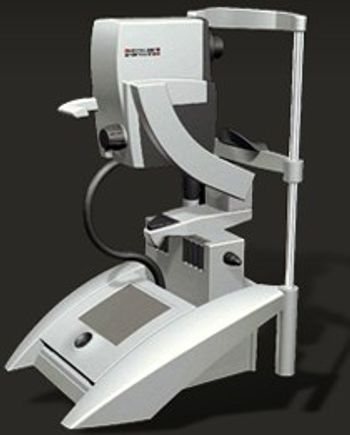
Heidelberg Engineering Spectralis HRA
 Heidelberg Engineering · Model Spectralis HRA
Diagnostic Imaging Platform The SPECTRALIS® HRA ophthalmic imaging platform is especially designed for dye-based angiography such as Fluorescein Angiography (FA) and is equipped with several scanning laser fundus imaging modalities. As an expandable platform, it can be upgraded any time with additional scanning laser fundus imaging modalities, such as ICGA imaging, the Ultra-Widefield Angiography Module or the MultiColor Module. The SPECTRALIS HRA is always delivered with a panning camera head and an external touch panel control for easy adjustment and acquisition that in particular facilitates dye-based angiography with FA or ICGA.
Key tips
- ·Verify laser output with a real power meter, not the unit's own display - the display can drift independently of true output.
- ·Take "the image looks a little off" reports seriously - optical alignment drift is usually gradual, not sudden.
Typical Failure Modes
Compiled for this model from its own documentation and established engineering knowledge for this equipment class - not from a verified service record. Confirm against the manufacturer's service manual.
Optical / illumination fault
MediumSymptoms: Dim, uneven or no illumination; poor or hazy view; slit / filters not working.
Root cause: Bulb / LED at end of life, a power-supply fault, or contaminated optics.
Alignment / positioning-stage fault
MediumSymptoms: Joystick or slide binds, will not hold position, chin-rest / head-rest drive faults.
Root cause: Worn stage bearings / slides or a positioning-drive fault.
Measurement / capture fault
MediumSymptoms: Reading errors (tonometer / autorefractor / lensmeter), no or poor image capture (fundus / OCT), calibration fails.
Root cause: Sensor / camera fault, a calibration issue, or contaminated measurement optics.
Printer / PC / connectivity fault
LowSymptoms: No printout, images / data will not save or transfer.
Root cause: Built-in printer, the PC, or the network / EMR interface.
Motorised table / chin-rest fault (where fitted)
LowSymptoms: Instrument table or chin-rest will not raise / lower.
Root cause: Table / chin-rest actuator or its switch.
Serviceable Parts & Consumables
Serviceable items for this model, compiled from its documentation and engineering knowledge for this equipment class. Service class and relative cost are estimates, not manufacturer figures; no part numbers are given. Confirm intervals and pricing against the manufacturer.
Illumination bulb / LED module
Class Frequent wear itemRel. cost $$R&R Fairly easy
Positioning-stage bearings / slides
Class Major service partRel. cost $$R&R Moderate
Measurement sensor / camera module
Class Major service partRel. cost $$$R&R Moderate
Built-in printer / paper
Class Periodic replacementRel. cost $R&R Fairly easy
Chin-rest / table actuator
Class Major service partRel. cost $$R&R Moderate
| Part | Service class | Relative cost | R&R difficulty |
|---|---|---|---|
| Illumination bulb / LED module | Frequent wear item | $$ | Fairly easy |
| Positioning-stage bearings / slides | Major service part | $$ | Moderate |
| Measurement sensor / camera module | Major service part | $$$ | Moderate |
| Built-in printer / paper | Periodic replacement | $ | Fairly easy |
| Chin-rest / table actuator | Major service part | $$ | Moderate |
Relative cost: $ lowest · $$$$ highest service-part cost for this equipment class. Not a price.
PM Checklist
Preventive-maintenance tasks typical of this equipment class. Perform to the manufacturer's procedure and your facility's policy - this is general reference, not a schedule for this specific unit.
- ·Optical alignment / calibration check
- ·Lamp or laser output verification
- ·Annual full PM
Troubleshooting Approach
A starting sequence for this model, compiled from its documentation and engineering knowledge for this equipment class. Follow the manufacturer's service documentation for the actual procedure.
Symptom: Dim, uneven or no illumination
- Replace the bulb / LED module with the correct type.
- Check the power supply and rheostat / brightness control.
- Clean the illumination and viewing optics per the manual.
- Confirm the slit, filters and apertures operate.
- Replace the power supply if output is still low.
Symptom: Measurement or capture error
- Run the instrument self-test / calibration.
- Clean the measurement window / objective.
- Verify against a model eye / test target where one exists.
- Confirm patient positioning and fixation.
- Refer the sensor / camera module if calibration will not hold.
Typical Location
Where this class of equipment is typically deployed - general reference, not this unit's own placement record.
- Eye clinic / ophthalmology suite
- Operating Room (ophthalmic surgery)
Documents & Manuals
Safety & Recalls
Synced live from the FDA openFDA API.
- RECALL
Error in the default configuration which could lead to the incorrect display of patient master data.
- RECALL
FDA notified Heidelberg Engineering that a 510(k) clearance is needed for the SPECTRALIS Widefield OCT feature, and, on November 27, 2017, Heidelberg Engineering submitted a new 510(k) for this feature. FDA has asked Heidelberg Engineering to instruct customers not to use the Widefield OCT software feature on the SPECTRALIS device until 510(k) clearance has been obtained for this software feature.
Troubleshoot this device with Bio
Describe a symptom or error code. Bio answers from this device's own documented error codes, failure modes, parts, and guides.
Ask Bio