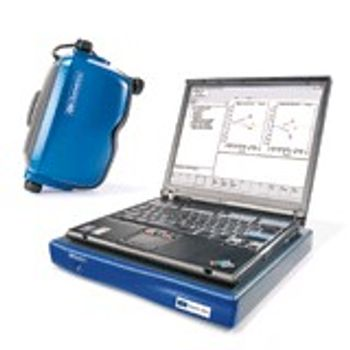
GN Otometrics CHARTR 200 VNG
 GN Otometrics · Model CHARTR 200 VNG
Portable full diagnostic system for USB connection with laptop. Lightweight, comfortable goggles with fixation light. Proven VNG eye-tracking algorithm eliminates errors due to eye blinks. Built-in Video Recorder and Video Playback. Quick review of eye movement tracings. Integrated analysis and normative data displays. Built-in report template with Interpretation Assistant. Complete test battery including saccades, pursuit, optokinetics, gaze, positional, Hallpike, and calorics. Extensive library of test protocols for custom test batteries.
Key tips
- ·Verify laser output with a real power meter, not the unit's own display - the display can drift independently of true output.
- ·Take "the image looks a little off" reports seriously - optical alignment drift is usually gradual, not sudden.
Typical Failure Modes
Compiled for this model from its own documentation and established engineering knowledge for this equipment class - not from a verified service record. Confirm against the manufacturer's service manual.
Optical / illumination fault
MediumSymptoms: Dim, uneven or no illumination; poor or hazy view; slit / filters not working.
Root cause: Bulb / LED at end of life, a power-supply fault, or contaminated optics.
Alignment / positioning-stage fault
MediumSymptoms: Joystick or slide binds, will not hold position, chin-rest / head-rest drive faults.
Root cause: Worn stage bearings / slides or a positioning-drive fault.
Measurement / capture fault
MediumSymptoms: Reading errors (tonometer / autorefractor / lensmeter), no or poor image capture (fundus / OCT), calibration fails.
Root cause: Sensor / camera fault, a calibration issue, or contaminated measurement optics.
Printer / PC / connectivity fault
LowSymptoms: No printout, images / data will not save or transfer.
Root cause: Built-in printer, the PC, or the network / EMR interface.
Motorised table / chin-rest fault (where fitted)
LowSymptoms: Instrument table or chin-rest will not raise / lower.
Root cause: Table / chin-rest actuator or its switch.
Serviceable Parts & Consumables
Serviceable items for this model, compiled from its documentation and engineering knowledge for this equipment class. Service class and relative cost are estimates, not manufacturer figures; no part numbers are given. Confirm intervals and pricing against the manufacturer.
Illumination bulb / LED module
Class Frequent wear itemRel. cost $$R&R Fairly easy
Positioning-stage bearings / slides
Class Major service partRel. cost $$R&R Moderate
Measurement sensor / camera module
Class Major service partRel. cost $$$R&R Moderate
Built-in printer / paper
Class Periodic replacementRel. cost $R&R Fairly easy
Chin-rest / table actuator
Class Major service partRel. cost $$R&R Moderate
| Part | Service class | Relative cost | R&R difficulty |
|---|---|---|---|
| Illumination bulb / LED module | Frequent wear item | $$ | Fairly easy |
| Positioning-stage bearings / slides | Major service part | $$ | Moderate |
| Measurement sensor / camera module | Major service part | $$$ | Moderate |
| Built-in printer / paper | Periodic replacement | $ | Fairly easy |
| Chin-rest / table actuator | Major service part | $$ | Moderate |
Relative cost: $ lowest · $$$$ highest service-part cost for this equipment class. Not a price.
PM Checklist
Preventive-maintenance tasks typical of this equipment class. Perform to the manufacturer's procedure and your facility's policy - this is general reference, not a schedule for this specific unit.
- ·Optical alignment / calibration check
- ·Lamp or laser output verification
- ·Annual full PM
Troubleshooting Approach
A starting sequence for this model, compiled from its documentation and engineering knowledge for this equipment class. Follow the manufacturer's service documentation for the actual procedure.
Symptom: Dim, uneven or no illumination
- Replace the bulb / LED module with the correct type.
- Check the power supply and rheostat / brightness control.
- Clean the illumination and viewing optics per the manual.
- Confirm the slit, filters and apertures operate.
- Replace the power supply if output is still low.
Symptom: Measurement or capture error
- Run the instrument self-test / calibration.
- Clean the measurement window / objective.
- Verify against a model eye / test target where one exists.
- Confirm patient positioning and fixation.
- Refer the sensor / camera module if calibration will not hold.
Typical Location
Where this class of equipment is typically deployed - general reference, not this unit's own placement record.
- Eye clinic / ophthalmology suite
- Operating Room (ophthalmic surgery)
Documents & Manuals
No documents available for this device yet.
Safety & Recalls
Synced live from the FDA openFDA API.
- RECALL
There is a risk to the healthcare professional or patient of exposure to undergrounded electrical surfaces which may result in an electrical shock.
Troubleshoot this device with Bio
Describe a symptom or error code. Bio answers from this device's own documented error codes, failure modes, parts, and guides.
Ask Bio