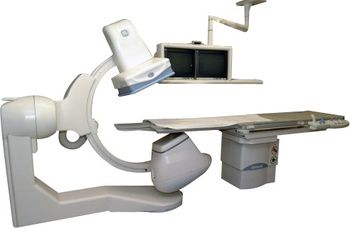
GE HealthCare Innova 2000
 GE HealthCare · Model Innova 2000
The ability to see blood vessels with much greater clarity, even in larger patients whose images are more difficult to see, than on previous technology systems. Revolutionary image quality and the ability to view hard-to-see blood vessels, as well as devices used during procedures, such as stents, guidewires and catheters. Considerable reduction in overall radiation exposure compared to conventional fluoroscopy systems. Clinically, the Revolution detector is unique in its ability to deliver the highest Detective Quantum Efficiency (DQE), a widely recognized measure of image quality, as well as fast frame rate acquisition capability and a wide dynamic range. These features enable physicians to acquire exceptional images and the opportunity for advanced applications due to the inherent capabilities designed into the technology of the detector.
Key tips
- ·Never bypass a radiation interlock to "just get the image" - this is one of the few true zero-tolerance rules in BMET work.
- ·Trend image-quality phantom results over time - drift shows up before an outright failure does.
- ·Portable/mobile units take real physical abuse from transport - check wheel locks and cable strain reliefs more often than fixed units.
Typical Failure Modes
Compiled for this model from its own documentation and established engineering knowledge for this equipment class - not from a verified service record. Confirm against the manufacturer's service manual.
Fluoro image quality / dose fault
HighSymptoms: Noisy or dim fluoro, dose creep, poor DSA, ABC not tracking.
Root cause: Flat-panel detector degradation or the dose / image-processing chain.
No or inconsistent exposure / generator error
HighSymptoms: Fluoro or cine inhibited, generator error code, tube-arc faults.
Root cause: HV generator, the X-ray tube, or the filament supply.
C-arm / L-arm positioner fault
MediumSymptoms: Gantry will not angulate, rotate or reach a stored position; collision trips.
Root cause: Positioner drive, encoder, brake, or collision sensors.
Table motion / tableside-control fault
MediumSymptoms: Table float, tilt, height or cradle will not respond; tableside module dead.
Root cause: Table drive, the tableside control module, or its cable.
Hemodynamic / recording or injector-interface fault
MediumSymptoms: Pressures / ECG missing on the hemo system, injector arm / interface fault.
Root cause: Hemo transducer inputs, the recording PC, or the injector interface.
Tube cooling / duty-cycle lockout
LowSymptoms: Fluoro / cine inhibited after a run, tube-heat alarm.
Root cause: Tube heat limit or a heat-exchanger fault.
Serviceable Parts & Consumables
Serviceable items for this model, compiled from its documentation and engineering knowledge for this equipment class. Service class and relative cost are estimates, not manufacturer figures; no part numbers are given. Confirm intervals and pricing against the manufacturer.
Flat-panel detector (exchange)
Class Major service partRel. cost $$$$R&R Expert-level
X-ray tube assembly
Class Periodic replacementRel. cost $$$$R&R Expert-level
HV generator components
Class Major service partRel. cost $$$$R&R Expert-level
Positioner drive / encoder / brake
Class Major service partRel. cost $$$R&R Difficult
Table drive / tableside control module
Class Major service partRel. cost $$$R&R Difficult
Heat exchanger / cooling components
Class Major service partRel. cost $$$R&R Difficult
| Part | Service class | Relative cost | R&R difficulty |
|---|---|---|---|
| Flat-panel detector (exchange) | Major service part | $$$$ | Expert-level |
| X-ray tube assembly | Periodic replacement | $$$$ | Expert-level |
| HV generator components | Major service part | $$$$ | Expert-level |
| Positioner drive / encoder / brake | Major service part | $$$ | Difficult |
| Table drive / tableside control module | Major service part | $$$ | Difficult |
| Heat exchanger / cooling components | Major service part | $$$ | Difficult |
Relative cost: $ lowest · $$$$ highest service-part cost for this equipment class. Not a price.
PM Checklist
Preventive-maintenance tasks typical of this equipment class. Perform to the manufacturer's procedure and your facility's policy - this is general reference, not a schedule for this specific unit.
- ·Daily QC per modality: image-quality phantom test
- ·Tube and detector inspection
- ·Annual state-required radiation safety survey
- ·Vendor-scheduled preventive maintenance
Troubleshooting Approach
A starting sequence for this model, compiled from its documentation and engineering knowledge for this equipment class. Follow the manufacturer's service documentation for the actual procedure.
Symptom: Poor fluoro image or dose creeping
- Image a phantom at a fixed geometry and compare to the room baseline.
- Check the flat-panel detector performance via service diagnostics.
- Review the dose trend / DAP log.
- Escalate a confirmed detector degradation to the OEM.
- Re-verify dose rate and image quality after correction.
Symptom: Generator error / no exposure
- Record the exact error code and phase.
- Confirm mains and all room interlocks (doors, tube position).
- Confirm the tube is not in a thermal lockout.
- Run tube conditioning / seasoning.
- Escalate a confirmed HV / tube fault; verify output after repair.
Typical Location
Where this class of equipment is typically deployed - general reference, not this unit's own placement record.
- Radiology / Imaging department
- Emergency Department (portable units)
- Operating Room (C-arms)
- Cath lab
- Bedside ICU (portable X-ray)
Documents & Manuals
No documents available for this device yet.
Safety & Recalls
Synced live from the FDA openFDA API.
- RECALL
GE Healthcare has become aware of an Air Kerma Rate issue associated with a large Equivalent Patient Thickness (EPT) on the Innova system that my impact patient safety. During a Maximum Air Kerma Rate (AKR) calibration procedure check, GE Healthcare found the AKR calibration procedure does not exactly reflect the worst-case clinical usage of the product. This may result, when using large Equival
- RECALL
The charger and / or battery of the PDB may fail earlier than expected with no advance warning and thus cause the system to shut down.
- RECALL
GE Healthcare has become aware of 2 potential conditions that could occur with the MAVIG GD Monitor Suspension that is used with Advantx-E, Innova 2000, 21000IQ, 3100/3100IQ, 4100/4100IQ and 2121 IQ/3131IQ cardiovascular systems. The two conditions include 1). Due to insufficient securing of the connecting elements, the LCD vertical monitor support may disengage from its arm and fall on the tab
- RECALL
Frozen Image Problems: During an acquisition (fluoro and/or record), there have been cases reported where an image became "frozen" on the DL (digital leader acquisition system) live monitor screen. In such cases, the system continued to send out X-rays without reporting an error message. The result was that the live imaging screen displayed an older "frozen" image until the operator released the
- RECALL
Incorrect dose data: GE Healthcare has found that after 6 days and 4 hours without performing a system reset or a system reboot (turning it off/on), the displayed dose data on these systems (Innova 3100 / Innova 4100 with Bolus option) may be underestimated by up to 50%. In order to avoid this issue, it is necessary to perform a system reset or reboot every day. GE Healthcare is working on a c
- RECALL
The systems do not contain a certification label on the C2 Cabinet (Beam-limiting control).
- RECALL
Incorrect screws were used for mounting the detector which may lead to a possible part falling onto a patient.
Troubleshoot this device with Bio
Describe a symptom or error code. Bio answers from this device's own documented error codes, failure modes, parts, and guides.
Ask Bio