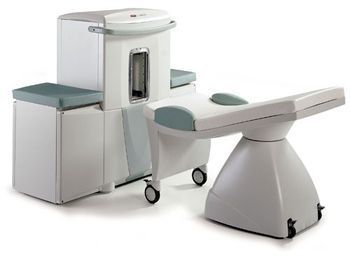
Esaote C-Scan
 Esaote · Model C-Scan
Maintenance-free open permanent magnet 0.2 Tesla field No RF Shielding required Very compact, installation space of 9 m2 required Low Power Consumption: only 1 Kw in normal 220/110V power outlet Ergonomic design for maximum patient comfort (no claustrophobia) Complete set of dedicated optimized coils All imaging sequences used in MSK settings Full set of pre-defined sequences and protocols User defined sequences and customized examination protocols Multi planar score Windows based user interface Extensive image viewing, analysis and elaboration tools Sophisticated storage functionality particularly useful for systems connected to PACS network Full DICOM connectivity.
Key tips
- ·Never bypass a radiation interlock to "just get the image" - this is one of the few true zero-tolerance rules in BMET work.
- ·Trend image-quality phantom results over time - drift shows up before an outright failure does.
- ·Portable/mobile units take real physical abuse from transport - check wheel locks and cable strain reliefs more often than fixed units.
Typical Failure Modes
Compiled for this model from its own documentation and established engineering knowledge for this equipment class - not from a verified service record. Confirm against the manufacturer's service manual.
RF coil fault / poor SNR
HighSymptoms: Low signal-to-noise, shading, or a dead region in images; coil not detected or fails the coil check.
Root cause: Damaged RF coil element, a coil-cable / connector fault, or a preamp fault.
Gradient fault / image distortion
HighSymptoms: Geometric distortion, gradient-amplifier faults, acoustic change, over-temperature trips.
Root cause: Gradient-amplifier fault, gradient-coil cooling problem, or a gradient-coil fault.
Cryogen / cold-head / compressor fault
HighSymptoms: Rising helium boil-off, cold-head noise or stall, He level dropping, compressor alarms.
Root cause: Cold-head at end of life, a helium-compressor fault, or a chilled-water problem.
Chilled water / cooling fault
MediumSymptoms: System-cooling alarms, gradient or RF over-temperature, scans aborting.
Root cause: Facility chilled-water supply, the heat exchanger, or internal pumps.
Patient table / positioning fault
MediumSymptoms: Table will not dock, drive or index; landmarking errors.
Root cause: Table drive, docking sensor, or encoder fault.
Reconstruction / host / network fault
MediumSymptoms: Recon errors, host hangs, images will not reach PACS.
Root cause: Recon or host computer fault, or the network / storage.
Serviceable Parts & Consumables
Serviceable items for this model, compiled from its documentation and engineering knowledge for this equipment class. Service class and relative cost are estimates, not manufacturer figures; no part numbers are given. Confirm intervals and pricing against the manufacturer.
RF receive coil (exchange)
Class Major service partRel. cost $$$$R&R Moderate
Cold head
Planned replacement; He boil-off rises as it wears.
Class Periodic replacementRel. cost $$$$R&R Difficult
Helium compressor / adsorber
Class Major service partRel. cost $$$$R&R Difficult
Gradient amplifier module
Class Major service partRel. cost $$$$R&R Expert-level
Chilled-water pump / heat exchanger
Class Major service partRel. cost $$$R&R Difficult
Patient table drive / encoder
Class Major service partRel. cost $$$R&R Difficult
| Part | Service class | Relative cost | R&R difficulty |
|---|---|---|---|
| RF receive coil (exchange) | Major service part | $$$$ | Moderate |
| Cold head Planned replacement; He boil-off rises as it wears. | Periodic replacement | $$$$ | Difficult |
| Helium compressor / adsorber | Major service part | $$$$ | Difficult |
| Gradient amplifier module | Major service part | $$$$ | Expert-level |
| Chilled-water pump / heat exchanger | Major service part | $$$ | Difficult |
| Patient table drive / encoder | Major service part | $$$ | Difficult |
Relative cost: $ lowest · $$$$ highest service-part cost for this equipment class. Not a price.
PM Checklist
Preventive-maintenance tasks typical of this equipment class. Perform to the manufacturer's procedure and your facility's policy - this is general reference, not a schedule for this specific unit.
- ·Daily QC per modality: image-quality phantom test
- ·Tube and detector inspection
- ·Annual state-required radiation safety survey
- ·Vendor-scheduled preventive maintenance
Error Codes
Extracted directly from this unit's own service manual.
1Einput error from LIF command.
9Egeneral COI fatal error.
10 Efatal timeout error from OPI after abort signal.
101 Einvalid MIF command
102 Esystem call error from MIF interpreter
201 Ebad input to scan execution MIF command.
202 Esystem call error.
203 Echeck error during preliminary phase of scan execution.
204 Ean error code has been returned by DSP during scan execution.
205 Eerror during reconstruction on DSP board.
302 Esystem call error.
303 Edata loaded from DSP have size greater than expected.
401 Ebad input to compile MIF command.
402 Esystem call error.
403 Echeck error during compile time.
406 Esyntax error on sequence source file.
501 Ebad input to scan data load MIF command.
502 Esystem call error.
503 Echeck error verifying scan data coherence.
506 Eformat error on scan data file.
507 Eformat error on predef file.
601 Ebad input to quit MIF command
602 Esystem call error
604 Eerror from DSP performing the quit command
701 Ebad input to load scan MIF command
702 Esystem call error
703 Echeck error during load time
706 Esyntax error on vocabulary file
802 Esystem call error
803 Echeck error verifying execution environment and data structures loaded from DSP
804 Ean error has been returned from DSP initialization code
808 ECOI configuration error
810 Etimeout error waiting for DSP initialization code completion
902 Esystem call error
908 Econfiguration file error
1002 Esystem call error
1008 Econfiguration file error
1102 Esystem call error
1108 Econfiguration file error
1202 Esystem call error
1208 Econfiguration file error
1302 Esystem call error
1308 Econfiguration file error
1402 Esystem call error
1408 Econfiguration file error
1502 Esystem call error
1508 Econfiguration file error
1602 Esystem call error
1608 Econfiguration file error
1702 Esystem call error
1708 Econfiguration file error
1802 Esystem call error
1808 Econfiguration file error
1901 Egradient amplifier not powered
1902 Egradient failure
1903 Egradient failure, gradient amplifier not powered
1904 Ecterm failure
1905 Ecterm failure, gradient amplifier not powered
1906 Ecterm failure, gradient failure
1907 Ecterm failure, gradient amplifier not powered, and gradient failure
Troubleshooting Approach
A starting sequence for this model, compiled from its documentation and engineering knowledge for this equipment class. Follow the manufacturer's service documentation for the actual procedure.
Symptom: Poor SNR / shading / a dead region with one RF coil
- Swap in a known-good coil of the same type and repeat the scan.
- Run the coil-check / coil-QA tool.
- Inspect the coil housing and cable for damage; reseat the connector.
- Scan the ACR / QA phantom and compare SNR to baseline.
- Quarantine and exchange the faulty coil.
Symptom: Rising helium boil-off / cold-head noise / He level dropping
- Log the helium level and boil-off trend daily.
- Check the cold-head sound and the compressor pressures against spec.
- Confirm the chilled-water supply temperature and flow.
- Schedule a cold-head / compressor service before the level reaches the OEM action point.
- Escalate urgently - never let the magnet approach a quench threshold.
Symptom: Gradient fault / image distortion / gradient over-temperature
- Note the gradient-amplifier error.
- Check the gradient-coil cooling and the chilled-water loop.
- Review the amplifier fault log.
- Run gradient diagnostics / calibration.
- Escalate a gradient-amplifier or gradient-coil fault to the OEM.
Symptom: Patient table will not dock, drive or landmark
- Check for an obstruction and the docking sensor.
- Run the table self-test.
- Inspect the drive and encoder.
- Confirm the landmark laser and its alignment.
- Replace the drive / encoder or refer as isolated.
Technical Specs
- Magnet Type
- Permanent
- Power Requirements
- 110/220 VAC
- Weight
- 1150 kg
- Clinical Use
- Extremity
- Magnetic Field Strength
- 0.2 T
- Patient Weight Capacity
- 396 lbs
Typical Location
Where this class of equipment is typically deployed - general reference, not this unit's own placement record.
- Radiology / Imaging department
- Emergency Department (portable units)
- Operating Room (C-arms)
- Cath lab
- Bedside ICU (portable X-ray)
Documents & Manuals
Safety & Recalls
Synced live from the FDA openFDA API.
- RECALL
The device is being recalled because dynamic loading forces from larger patients can fracture the extremity portion of the patient table. Additionally, a weight limit is added to the patient seat for weight-bearing examinations.
Troubleshoot this device with Bio
Describe a symptom or error code. Bio answers from this device's own documented error codes, failure modes, parts, and guides.
Ask Bio