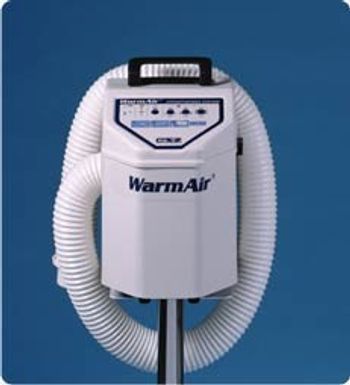
Cincinnati Sub-Zero Warm Air
 Cincinnati Sub-Zero · Model Warm Air
Improve patient safety and patient outcomes The WarmAir® system from CSZ safely provides effective air warming therapy to your patient. Because of the unique patented design of our WarmAir® FilteredFlo® blankets, we can utilize a lower velocity blower which supplies gently moving, clean air that minimizes unwanted air currents that may spread contaminants to your patient or staff. All air is filtered before being distributed to the air blanket to prevent airborne bacterial contamination in critical areas. The warmed air is then filtered again as it leaves the FilteredFlo® warming blanket.
Key tips
- ·Never skip temperature-accuracy verification to save time - it's the one check that directly prevents burns.
- ·Hose/blanket connector wear is the most common real fault and the easiest to miss on a quick visual check.
Typical Failure Modes
Compiled for this model from its own documentation and established engineering knowledge for this equipment class - not from a verified service record. Confirm against the manufacturer's service manual.
Not delivering warm air / temperature fault
HighSymptoms: Air not warm, temperature alarm, over-temp shutdown, blows cold.
Root cause: Heater element, a temperature-sensor / thermal-cutout fault, or a control-board fault.
Low airflow / blower fault
MediumSymptoms: Weak airflow, blanket will not inflate, blower noisy.
Root cause: Worn blower, a blocked intake filter, or a kinked / disconnected hose.
Hose / adapter fault
LowSymptoms: Hose cracked, will not connect to the blanket, air leaks at the coupling.
Root cause: Worn hose or end fitting.
Filter overdue / dirty
LowSymptoms: Reduced airflow, longer warm-up.
Root cause: Clogged intake / HEPA filter.
Over-temperature safety fault
MediumSymptoms: Repeated over-temp alarms even with good airflow.
Root cause: Sensor or thermal-cutout fault.
Serviceable Parts & Consumables
Serviceable items for this model, compiled from its documentation and engineering knowledge for this equipment class. Service class and relative cost are estimates, not manufacturer figures; no part numbers are given. Confirm intervals and pricing against the manufacturer.
Heater element
Class Major service partRel. cost $$R&R Moderate
Blower / motor
Class Major service partRel. cost $$R&R Moderate
Temperature sensor / thermal cutout
Class Major service partRel. cost $$R&R Moderate
Intake / HEPA filter
Class Frequent wear itemRel. cost $R&R Easy
Delivery hose / adapter
Class Periodic replacementRel. cost $$R&R Easy
| Part | Service class | Relative cost | R&R difficulty |
|---|---|---|---|
| Heater element | Major service part | $$ | Moderate |
| Blower / motor | Major service part | $$ | Moderate |
| Temperature sensor / thermal cutout | Major service part | $$ | Moderate |
| Intake / HEPA filter | Frequent wear item | $ | Easy |
| Delivery hose / adapter | Periodic replacement | $$ | Easy |
Relative cost: $ lowest · $$$$ highest service-part cost for this equipment class. Not a price.
PM Checklist
Preventive-maintenance tasks typical of this equipment class. Perform to the manufacturer's procedure and your facility's policy - this is general reference, not a schedule for this specific unit.
- ·Hose / blanket connector inspection
- ·Temperature-accuracy verification
- ·Annual electrical safety test
Troubleshooting Approach
A starting sequence for this model, compiled from its documentation and engineering knowledge for this equipment class. Follow the manufacturer's service documentation for the actual procedure.
Symptom: Fluid / blood / blanket not reaching target temperature
- Confirm the correct programme / set for the fluid type and flow rate.
- Check both heater plates (or the water bath) warm evenly.
- Verify the output temperature against an independent reference at a representative flow.
- Replace the temperature sensor if it disagrees.
- Replace the heater plate / control assembly if output is still low.
Symptom: Over-temperature alarm / shutdown
- Let the unit cool and restart.
- Compare the displayed temperature to an independent reference.
- Check for an extreme flow-rate change during use (fluid warmers).
- Replace the temperature sensor / control board as isolated.
- Confirm stable control across the range before returning to service.
Symptom: Low airflow / blower fault (forced-air) or low water flow (water blanket)
- Replace the intake / HEPA filter (forced-air) or top up and de-air the reservoir (water).
- Check the hose for kinks or splits and confirm the correct blanket type.
- Inspect the blower / circulation pump and impeller.
- Replace the blower / pump if flow is still low.
- Confirm delivered air / water temperature and flow after repair.
Technical Specs
- Height
- 13.5 in
- Length
- 8.75 in
- Weight
- 13.5 lbs
- Width
- 8.75 in
Typical Location
Where this class of equipment is typically deployed - general reference, not this unit's own placement record.
- Operating Room
- PACU
- Emergency Department
- Labor & Delivery
- NICU
Documents & Manuals
Safety & Recalls
Synced live from the FDA openFDA API.
- RECALL
Updated Manual-Warnigs have been added stating that exceeding 40'C for extended periods may cause tissue damage
- RECALL
Design error. The probe jack contacts (terminals on certain of the firm's ECMO Heater devices are located too close to the solid state relay contacts (terminals) which can lead to the terminals coming into contact with one another. If this situation occurs, a Service Technician, Operator/User, and/or Patient could be exposed to electric shock during device servicing or use. This situation was ori
- RECALL
The suspect hyper-hypothermia device systems sold to physicians for research and/or the treatment of AIDS or Cancer patients, were not appropriately cleared by the FDA prior to distribution.
- RECALL
Cincinnati Sub-Zero is conducting a field correction due to changes that have been made to the WarmAir Model 135 devices Operation and Technical Manuals in order to comply with FDA device labeling regulations.
- RECALL
Due to its design the circuit breaker on the device could trip causing it to shut down and not provide heated air to the blanket.
- RECALL
A component defect. The recalling firm determined that one of the connectors attached to the firm's WarmAir 134 device's Printed Circuit Board (PCB) can overheat. Should this event occur, the excess heat build up within the device may result in damage to the device's external case and/or melting of some of the internal components of the unit.
- RECALL
The probe jack contacts (terminals) on certain of the firm's ECMO Heater devices are located too close to the solid state relay contacts (terminals) which can lead to the terminals coming into contact with each other. If this situation occurs, the service technician, user, and/or patient could be exposed to electric shock during servicing and/or use.
- RECALL
Product is labeled as "Sterile". It was observed that incomplete seals were created in the packaging materials during production. When the seal is compromised, the sterility of the product inside the package cannot be assured.
- RECALL
Burning smell, burned microprocessor board. The firm is modifying the connectors and wiring gauge configuration of the device.
Troubleshoot this device with Bio
Describe a symptom or error code. Bio answers from this device's own documented error codes, failure modes, parts, and guides.
Ask Bio