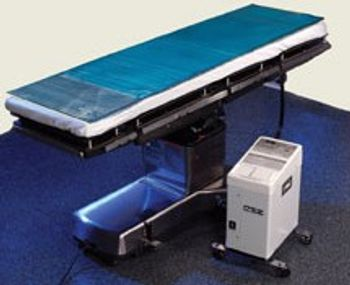
Cincinnati Sub-Zero Gelli-Roll Blanket
 Cincinnati Sub-Zero · Model Gelli-Roll Blanket
Reduces set-up and breakdown time Easy to clean with disinfectants Allows complete access to the patient Supports most patients, infant to bariatric Self-sealing hose connections Can be used for warming or cooling the patient.
Key tips
- ·Never skip temperature-accuracy verification to save time - it's the one check that directly prevents burns.
- ·Hose/blanket connector wear is the most common real fault and the easiest to miss on a quick visual check.
Typical Failure Modes
Compiled for this model from its own documentation and established engineering knowledge for this equipment class - not from a verified service record. Confirm against the manufacturer's service manual.
Will not reach or hold set patient / water temperature
HighSymptoms: Water temperature drifts from setpoint, patient temperature not tracking, over/under-temp alarm.
Root cause: Heater / thermoelectric or refrigeration fault, a temperature-probe fault, or a circulation-pump / flow fault.
Circulation-pump / flow fault
MediumSymptoms: Low-flow alarm, blanket not filling, pump noisy.
Root cause: Worn pump, an air-locked circuit, or a kinked / disconnected hose.
Patient-probe fault
MediumSymptoms: Patient temperature implausible or open-probe alarm, auto-control will not regulate.
Root cause: Damaged patient temperature probe or its connector.
Leak / reservoir fault
MediumSymptoms: Low-water alarm, water on the floor, air in the lines.
Root cause: Reservoir low, a hose / fitting leak, or a blanket leak.
Refrigeration fault (cooling units)
MediumSymptoms: Cannot cool water, compressor not running.
Root cause: Compressor, condenser fan, or a sealed-system fault.
Serviceable Parts & Consumables
Serviceable items for this model, compiled from its documentation and engineering knowledge for this equipment class. Service class and relative cost are estimates, not manufacturer figures; no part numbers are given. Confirm intervals and pricing against the manufacturer.
Circulation pump
Class Periodic replacementRel. cost $$$R&R Difficult
Patient temperature probe
Class Frequent wear itemRel. cost $$R&R Easy
Heater / thermoelectric module
Class Major service partRel. cost $$$R&R Difficult
Hoses / quick-connectors
Class Periodic replacementRel. cost $$R&R Easy
Refrigeration components (cooling units)
Class Major service partRel. cost $$$R&R Difficult
| Part | Service class | Relative cost | R&R difficulty |
|---|---|---|---|
| Circulation pump | Periodic replacement | $$$ | Difficult |
| Patient temperature probe | Frequent wear item | $$ | Easy |
| Heater / thermoelectric module | Major service part | $$$ | Difficult |
| Hoses / quick-connectors | Periodic replacement | $$ | Easy |
| Refrigeration components (cooling units) | Major service part | $$$ | Difficult |
Relative cost: $ lowest · $$$$ highest service-part cost for this equipment class. Not a price.
PM Checklist
Preventive-maintenance tasks typical of this equipment class. Perform to the manufacturer's procedure and your facility's policy - this is general reference, not a schedule for this specific unit.
- ·Hose / blanket connector inspection
- ·Temperature-accuracy verification
- ·Annual electrical safety test
Troubleshooting Approach
A starting sequence for this model, compiled from its documentation and engineering knowledge for this equipment class. Follow the manufacturer's service documentation for the actual procedure.
Symptom: Will not hold set temperature
- Confirm the reservoir is filled and the blanket circuit is primed (no air).
- Verify the water temperature against an independent thermometer.
- Check the patient probe against a reference and swap it.
- Confirm the circulation pump delivers flow.
- Replace the probe, pump or heater / refrigeration components as isolated.
Symptom: Low-flow or leak alarm
- Check the hoses for kinks and confirm the quick-connectors are seated.
- Top up the reservoir and bleed air from the circuit.
- Inspect the blanket and hoses for leaks.
- Replace a leaking hose / blanket.
- Confirm the flow alarm clears and temperature control is stable.
Typical Location
Where this class of equipment is typically deployed - general reference, not this unit's own placement record.
- Operating Room
- PACU
- Emergency Department
- Labor & Delivery
- NICU
Documents & Manuals
No documents available for this device yet.
Safety & Recalls
Synced live from the FDA openFDA API.
- RECALL
Evidence supports that when customers performed a fuse replacement as part of a March 2017 field action, the fuse clips became stretched and were no longer mechanically tight with the fuse, creating a host spot that led to discoloration on the board due to overheating and shut down of the device.
- RECALL
Potential for membrane (control panel) switch errors leading to an inability of the device to change control settings or an unintended change to control settings.
- RECALL
Reports that the Rectal/ Esophageal Temperature Probes are not reading correctly. This situation causes the Blanketrol device, which the probes connect to, to shut down operation and display a 'check probe' error.
- RECALL
Due to its design the circuit breaker on the device could trip causing it to shut down and not provide heated air to the blanket.
- RECALL
A component defect. The recalling firm determined that one of the connectors attached to the firm's WarmAir 134 device's Printed Circuit Board (PCB) can overheat. Should this event occur, the excess heat build up within the device may result in damage to the device's external case and/or melting of some of the internal components of the unit.
- RECALL
Product is labeled as "Sterile". It was observed that incomplete seals were created in the packaging materials during production. When the seal is compromised, the sterility of the product inside the package cannot be assured.
Troubleshoot this device with Bio
Describe a symptom or error code. Bio answers from this device's own documented error codes, failure modes, parts, and guides.
Ask Bio