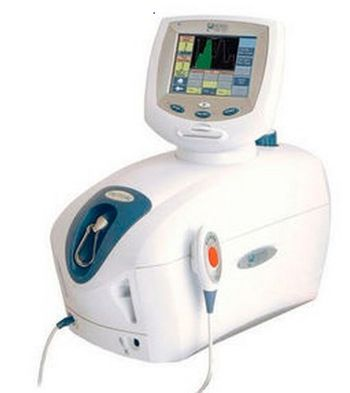
Chattanooga Triton 4739
 Chattanooga · Model Triton 4739
270° Pivoting User Interface. Digital High Resolution Color Touch Screen Interface. Patient Data Cards record up to 14 treatments, including patient pain mapping, pain scales and pain types. Store up to 80 user defined protocols for Cervical, Lumbar, Hip and Wrist traction. Clinical Resources Library with full color anatomical and pathological libraries. Quick-Link Indications to quickly retrieve preset treatment parameters. Detailed color treatment setup photos. Clinical Protocols™, complete with treatment rationale for Cervical, Lumbar, Hip and. Wrist traction. Softer, more comfortable traction pulls. Progressive and Regressive Steps with Independent timer. Traction in Static, Intermittent or Cycling with independent timer. Pre-tension Mode. Variable Speed Motor.
Key tips
- ·Most "no output" stim-unit complaints are cable-side - check electrode/lead continuity before assuming a unit fault.
- ·Frame and strap wear on mechanical rehab equipment is a real fall/injury risk - don't defer it as cosmetic.
Typical Failure Modes
Compiled for this model from its own documentation and established engineering knowledge for this equipment class - not from a verified service record. Confirm against the manufacturer's service manual.
Motor / actuator / drive will not run or is weak
HighSymptoms: Traction force not applied, CPM carriage will not move or stalls, drive assist weak, motion one direction only.
Root cause: Worn drive motor / leadscrew / actuator, a hand-control fault, or a control-board fault.
Force / range / position inaccuracy
MediumSymptoms: Set traction force or CPM angle not reached, load cell drifts, carriage overshoots or stalls short.
Root cause: Load-cell / position-sensor drift, a potentiometer fault, or a limit-switch fault.
Hand control / patient-control fault
MediumSymptoms: Hand control unresponsive, the patient stop / reverse button does not work.
Root cause: Worn hand control or a damaged cable.
Frame / bearing / cable wear
MediumSymptoms: Rough or noisy travel, play in the carriage, frayed traction cord or rope.
Root cause: Worn bearings / slides or a frayed cable / cord.
Power / battery fault
LowSymptoms: Will not power on, short battery run time.
Root cause: Power supply / fuse or an aged battery.
Serviceable Parts & Consumables
Serviceable items for this model, compiled from its documentation and engineering knowledge for this equipment class. Service class and relative cost are estimates, not manufacturer figures; no part numbers are given. Confirm intervals and pricing against the manufacturer.
Drive motor / leadscrew / actuator
Class Major service partRel. cost $$$R&R Difficult
Load cell / position sensor / potentiometer
Class Major service partRel. cost $$R&R Moderate
Hand control
Class Periodic replacementRel. cost $$R&R Fairly easy
Bearings / slides / traction cord
Class Periodic replacementRel. cost $$R&R Moderate
Power supply / fuse / battery
Class Major service partRel. cost $R&R Moderate
| Part | Service class | Relative cost | R&R difficulty |
|---|---|---|---|
| Drive motor / leadscrew / actuator | Major service part | $$$ | Difficult |
| Load cell / position sensor / potentiometer | Major service part | $$ | Moderate |
| Hand control | Periodic replacement | $$ | Fairly easy |
| Bearings / slides / traction cord | Periodic replacement | $$ | Moderate |
| Power supply / fuse / battery | Major service part | $ | Moderate |
Relative cost: $ lowest · $$$$ highest service-part cost for this equipment class. Not a price.
PM Checklist
Preventive-maintenance tasks typical of this equipment class. Perform to the manufacturer's procedure and your facility's policy - this is general reference, not a schedule for this specific unit.
- ·Frame and strap wear inspection
- ·Electrode lead continuity check
- ·Annual electrical safety test
Error Codes
Extracted directly from this unit's own service manual.
100Treatment has been running for 8 seconds, but no tension is detected on the Cord.
Remove Traction Cord Slack.
101Patient pressed Patient Switch.
Touch the Touch Screen to clear message.
102Patient Switch is unplugged. Patient Interrupt Switch not properly connected to unit.
Properly connect Patient Interrupt Switch and touch Touch Screen to clear message.
104User selected Patient Card button on utilities screen, but no traction treatments were found on the card.
Insert correct Patient Data Card.
105User selected save to card, but no card is inserted into the unit.
Properly insert correct Patient Data Card into unit.
106User selected save to card, but the card currently inserted is not a Patient Card.
Insert correct Patient Data Card.
107User selected save to card, but the card currently inserted is full.
Save Data to PDMS and erase Patient Data Card.
108User typed in a blank patient name. No Patient ID assigned.
Enter Patient ID.
109User typed in a blank protocol name. No Protocol name entered.
Enter Protocol name.
110User attempted to access a MMC function, but no MMC is inserted into the unit.
Insert Multimedia Card (MMC) into unit.
111User attempted to upgrade software, but the MMC in the unit is not a software upgrade MMC.
Insert proper Mutimedia Card (MMC) into unit.
112Error upgrading Control Board software.
Contact Dealer or Chattanooga Group for Service.
113Error upgrading motor board software.
Contact Dealer or Chattanooga Group for Service.
114User pressed START, but has not yet set the Max Level value to a value greater than zero.
Complete Treatment Set Up prior to pressing START.
115User pressed HOME button from treatment review screen while a treatment was running.
Press STOP to end treatment prior to pressing HOME.
200The motor PCB has reset.
If the Error repeats routinely, replace Motor Control Board.
201Error communicating with the realtime clock chip.
If the Error repeats routinely, replace Touch Screen Assembly.
202The motor PCB returned an error while performing the zero Load Cell function.
1. Check Cables and Harnesses for proper seating and connection on Motor Control Board. 2. Replace Load Cell Assembly. 3. Replace Motor Control Board. 4. Replace Touch Screen Assembly.
203Timeout waiting for the motor PCB to perform the zero Load Cell calibration.
1. Ensure there is slack in the Cord. 2. Check Cables and Harnesses for proper seating and connection on Motor Control Board. 3. Replace Load Cell. 4. Replace Motor Control Board.
204Timeout waiting for the motor PCB to perform the motor current calibration.
1. Ensure there is no slack in the Cord. 2. Check Cables and Harnesses for proper seating and connection on Motor Control Board. 3. Replace Load Cell. 4. Replace Motor Control Board.
205A Motor fault error has occurred while a treatment was running.
1. Correct any internal mechanical jam. 2. Replace bad Motor Control Board or bad Motor Assembly.
206The Motor PCB cannot get to the desired tension.
1. Correct any internal mechanical jam. 2. Replace bad Motor Control Board or bad Motor Assembly.
207We have detected a motor current error (MC_MON pin on motor PCB).
Perform Unit Calibration and Burn In procedures.
208We have detected a Load Cell limit error (LC_MON pin on motor PCB).
1. Perform Unit Calibration and Burn In procedures. 2. Replace Motor Control Board. 3. Replace Load Cell Assembly.
209Error erasing a patient card.
1. Try known good Patient Data Card. 2. Check Cables and Harnesses for proper seating and connection on Motor Control Board. 3. Replace Touch Screen Assembly.
210CRC not correct on treatment just read from Patient Card.
1. Try known good Patient Data Card. 2. Replace Touch Screen Assembly.
211Error reading default protocol on power up so must rebuild protocols to factory presets.
If the Error repeats routinely, replace Touch Screen Assembly.
212The Motor PCB flagged a comm watchdog error. Touch Screen Assembly did not poll Motor Control Board in a reasonable amount of time.
1. Check Cables and Harnesses for proper seating and connection on Motor Control Board.
214Internal error, unit c
Troubleshooting Approach
A starting sequence for this model, compiled from its documentation and engineering knowledge for this equipment class. Follow the manufacturer's service documentation for the actual procedure.
Symptom: No or low output on a modality / channel
- Fit a fresh applicator / handpiece / electrodes for that modality.
- Substitute a known-good lead / cable.
- Test therapeutic-ultrasound output into a water bath (visible cavitation / warmth) and run the applicator-contact / BNR self-test.
- Try the modality on another unit if available.
- Escalate a confirmed output-stage fault to the OEM.
Symptom: Patient feels nothing / open-circuit on an e-stim channel
- Fit fresh self-adhesive electrodes on well-prepped skin.
- Swap the lead wires.
- Confirm the current ramps and there is no open-electrode alarm.
- Test the channel into a resistive load per the manual.
- Refer the output stage if a good lead set still gives nothing.
Symptom: Unresponsive or erratic touchscreen / parameters will not set
- Power-cycle the unit.
- Recalibrate / re-seat the touchscreen if the touch is offset.
- Check the mains fuse and power supply.
- Confirm the cooling fan runs and the vents are clear.
- Replace the touchscreen or power supply as isolated.
Typical Location
Where this class of equipment is typically deployed - general reference, not this unit's own placement record.
- Physical therapy / rehab gym
- Outpatient rehab clinic
- Sports medicine
Documents & Manuals
Safety & Recalls
Synced live from the FDA openFDA API.
- RECALL
Product contains an improper bracket for the transducer.
- RECALL
Product contains an improper bracket for the transducer.
Troubleshoot this device with Bio
Describe a symptom or error code. Bio answers from this device's own documented error codes, failure modes, parts, and guides.
Ask Bio