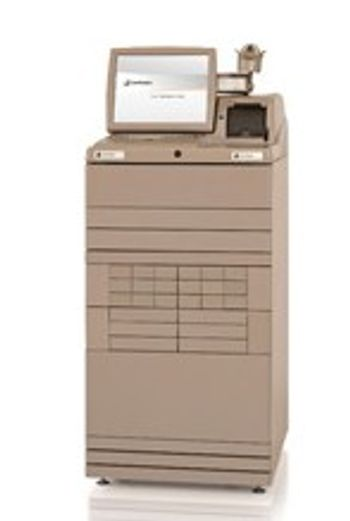
CareFusion Pyxis MedStation
 CareFusion · Model Pyxis MedStation
Maximize the security of high-risk and high-alert medications with the CUBIE system; half-height and full-height pocket sizes accommodate small (i.e. tablet) to large (i.e. PCA syringe) medications. Securely store and help improve availability of bulk items, such as IV solutions and patient-specific medications, with the Pyxis MedStation 4000 integrated mainand all-door configuration of the Pyxis MedStation 4000 system. Integrate the Pyxis MedStation system with Pyxis Connect. Avera McKennan Hospital & University Health Center saw a reduction in order turnaround time from 2.5 hours to 16 minutes. Increase medication availability through decentralized medication management. A study of seven hospitals indicates that as the number of medications managed through ADCs increases, the result is reduced time to first dose and fewer missing doses. Help decrease the risk of diversion and increase medication safety with the Knowledge Portal for the Pyxis MedStation system.
Key tips
- ·Never defeat or bypass a return-electrode monitoring (REM) alarm to finish a case - it's a direct burn risk.
- ·Verify OR table battery backup - a table that loses power mid-procedure is a real, documented incident type.
- ·Track surgical light lamp-hours rather than waiting for failure - a sudden failure mid-case is avoidable.
Typical Failure Modes
Compiled for this model from its own documentation and established engineering knowledge for this equipment class - not from a verified service record. Confirm against the manufacturer's service manual.
Will not power on or unexpected shutdown
HighSymptoms: The surgical & or is dead, reboots, or shuts down mid-use.
Root cause: Mains lead / fuse, an aged battery, or a power-supply board fault.
Battery will not hold charge
MediumSymptoms: Short run time on battery; low-battery alarm soon after a full charge.
Root cause: Aged rechargeable battery pack or a charger fault.
Display / control-panel fault
MediumSymptoms: Blank, dim or distorted display; unresponsive keys or touchscreen.
Root cause: Display, backlight, or control-board fault.
Fails self-test or calibration
MediumSymptoms: Power-on self-test or the scheduled performance check fails or is out of tolerance.
Root cause: Sensor drift or an internal board fault; recalibration or repair needed.
Serviceable Parts & Consumables
Serviceable items for this model, compiled from its documentation and engineering knowledge for this equipment class. Service class and relative cost are estimates, not manufacturer figures; no part numbers are given. Confirm intervals and pricing against the manufacturer.
Rechargeable battery pack
Class Periodic replacementRel. cost $$R&R Fairly easy
Power supply / mains board
Class Major service partRel. cost $$$R&R Difficult
Display / control-panel assembly
Class Major service partRel. cost $$$R&R Moderate
Cooling fan
Class Major service partRel. cost $R&R Moderate
| Part | Service class | Relative cost | R&R difficulty |
|---|---|---|---|
| Rechargeable battery pack | Periodic replacement | $$ | Fairly easy |
| Power supply / mains board | Major service part | $$$ | Difficult |
| Display / control-panel assembly | Major service part | $$$ | Moderate |
| Cooling fan | Major service part | $ | Moderate |
Relative cost: $ lowest · $$$$ highest service-part cost for this equipment class. Not a price.
PM Checklist
Preventive-maintenance tasks typical of this equipment class. Perform to the manufacturer's procedure and your facility's policy - this is general reference, not a schedule for this specific unit.
- ·Pre-case functional check
- ·Electrosurgical return-electrode cable inspection
- ·Table hydraulic / mechanical inspection
- ·Annual electrical safety test and full PM
Troubleshooting Approach
A starting sequence for this model, compiled from its documentation and engineering knowledge for this equipment class. Follow the manufacturer's service documentation for the actual procedure.
Symptom: No or low RF output / high-impedance cut-out
- Confirm good electrode-tissue contact and an adequately wetted field.
- Inspect the handpiece / instrument and its cable for damage; substitute a known-good one.
- Check the split dispersive (return) pad is well applied over well-perfused muscle with a sound cable.
- Verify output into a resistive test load with an electrosurgical analyser.
- Replace the RF output board and recalibrate on a non-conductive surface if output is confirmed absent (anti-static handling).
Symptom: Return-electrode (REM / NESSY / CQM) contact-quality alarm
- Re-apply a fresh split dispersive pad with full skin contact.
- Check the pad cable and its connector.
- Try a known-good pad.
- Run the contact-quality-monitor calibration with a good pad fitted.
- Refer the CQM circuit if it still alarms.
Symptom: Output will not activate from the footswitch or handswitch
- Test the other activation method to isolate the pedal from the handpiece.
- Inspect the footswitch and its cable / connector for damage or moisture.
- Check the handswitch leads on the handpiece.
- Substitute a known-good footswitch.
- Refer the activation input board if both methods fail.
Symptom: Fails calibration / output drifts after a repair
- Verify cut and coag output at several settings into a test load with an analyser.
- Verify the REM / CQM circuit against its spec.
- Recalibrate per the service manual on a non-conductive bench with anti-static precautions.
- Check the cooling fan and thermal path.
- Re-verify all outputs and the REM alarm before returning to service.
Typical Location
Where this class of equipment is typically deployed - general reference, not this unit's own placement record.
- Operating rooms
- Procedure rooms
- Interventional suites
Documents & Manuals
Safety & Recalls
Synced live from the FDA openFDA API.
- RECALL
Fingerprint scanner may overheat to a temperature to cause 1st degree burn.
- RECALL
Due a software issue that may result in equipment not receiving timely updates of patient, medication, or related information from enterprise systems.
- RECALL
Automated Dispensing Cabinets (ADC) received a Half Height CUBIE drawer firmware update, which caused a Cubie Insert event which prompts software to generate a duplicate address, which causes an error and the drawer to fail, which may lead to inability or delay in accessing stored items, delay in the replenishment of ADCs or patient specific medications stored outside of ADCs.
- RECALL
Potential fluid ingress of anesthesia station or med station may result in smoke, system downtime and/or fire.
- RECALL
Reports of delayed access to medication in automated dispensing cabinets because of the override/Add Item workflow.
- RECALL
During automated dispensing cabinet upgrade/installation/reimaging, component manager was left in installed mode, and if a Microsoft patch is then installed this may lead to an error preventing user access to the dispensing software application, which may lead to delay in access to medications/supplies, and delivery/replenishment of patient specific orders; which may lead to delay in patient care.
- RECALL
Antivirus software was not consistently installed on impacted devices during the implementation process.
- RECALL
Due to a software bug, automated dispensing cabinet is unable to calculate countback discrepancies during the issue process, which causes incorrect transaction quantity to be recorded. This bug can also result in the CUBIE opening more times than needed for the transaction to be completed, which may result in a patient receiving more than the intended dose of medication.
- RECALL
Due to a software issue, when attempting to restock the automated dispensing cabinet, user have received the banner message "Stocking window has passed, or item has been removed from purchase order. Please contact Pharmacy for assistance". When this occurs, the medication cannot be restocked and can potentially lead to delays in accessing medication for patients.
- RECALL
Users trying to restock a single bin location of an automated dispensing cabinet, during pocket exchange restocking workflow, may experience a software issue that results in 2 destock transactions and 2 stock transactions, which results in doubling the bin quantity, which may result in a delay in access to desired medications and/or supplies, which may lead to temporary body function impairment.
- RECALL
Sync timeout may occur between the server and automated dispensing device, due to a server software error which may occur if syncing a large amount of data that takes excessive time, which may cause the dispensing devices to become disconnected from the ES server; dispensing devices will not receive updated information, which may lead to incorrect therapy, and delay in accessing medication.
- RECALL
Due to fingerprint scanner failing resulting in the scanner heating up.
- RECALL
Automated dispensing device labeling is being updated to strengthen labeling around manual access to medications to address the risk of potential delays in retrieving contents/ accessing medications that may result from power loss or potential automated dispensing device malfunctions.
- RECALL
Software issues could potentially result in: 1) delays in accessing dispensing software application, 2) wrong therapy (dose, item, timing, etc.), or 3) unauthorized access and/or compliance related issues
- RECALL
Labeling is insufficient regarding delays in access to medication. The firm is strengthening the label as an additional risk mitigation.
- RECALL
Labeling update to include a contraindication statement against the use of medicine cabinets in procedure and operating rooms.
- RECALL
Due to a software issue, automated dispensing cabinet devices may open the wrong cubie pocket or position, which can lead to: 1) Unintended and incorrect medication removal, or 2) Potential for a different medication (medication pulled in error) to be refilled/loaded, which may lead to may lead to low inventory or a stockout.
- RECALL
Due to software issue, there is a potential when a restock label is printed for a medication stored in a non-CUBIE location, that the incorrect bin for the medication is printed on the label.
- RECALL
Due to software issue, there is a potential when a restock label is printed for a medication stored in automated dispensing cabinets, that the incorrect bin for the medication is printed on the label.
- RECALL
Multiple socket-outlet power strips that shipped with automated dispensing cabinet devices have not been certified to International Electrotechnical Commission (IEC) electrical standards when used as a system with automated dispensing cabinet devices, so use may expose user to leakage currents that could cause varying degrees of harm from a minor shock to permanent impairment.
- RECALL
If automated dispensing cabinets have specific software versions, and Component Manager was configured to "installed mode", and software patch KB 5033688 was installed in the production environment, then this will will lead to an error that prevents the user from accessing the dispensing software application, which may delay accessing medication.
- RECALL
Potential fluid ingress of anesthesia station or med station may result in smoke, system downtime and/or fire.
- RECALL
Retroactive-Due to increase in complaints, their is a potential for drawer and/or door failures of the medication cabinet which could result in delay in accessing medications.
- RECALL
Automated dispensing cabinets, running affected software, and Windows 10 operating system may experience the application randomly hang, freeze and/or crash, which may result in delays in medication access, and potential data loss.
- RECALL
When global edit is used to update multiple formulary properties simultaneously, the following properties: 1) Require Lot Number on Recall, 2) Access Destruction Bin (Witness), 3) Add to Destruction Bin (Count/Empty), 4) CII Safe Stock Out Notice are, without user warning, overwritten to the value NO , which could result in diversion of controlled substances from the automated dispensing cabinet.
- RECALL
After dispensing a timed dose medication for a patient, the automated dispensing cabinet software may continue to show the already dispensed medication dose is still available for dispense, which could lead to duplicate medication administration.
- RECALL
Automated dispensing cabinet devices plugged into any multi-socket outlet power strips may present unacceptable levels of current leakage, which could expose users to system downtime and/or potential electric shock.
- RECALL
Due to an automated dispensing cabinet software issue, when a medication single order contains more than one component and at least one is unavailable for a multi-item or combination order, the order may display as grayed out; alternate location tooltip will display "Server connection failed," not listing other area devices where unavailable item(s) may be found, which may lead to delayed therapy.
- RECALL
Automated dispensing cabinet software is experiencing: 1) ES device download failure resulting in partial patient information loss that leads to 2) partial loss of patient transaction data, seen as a server upload processing error. Outdated/incorrect information display may contribute to the removal of medication to which the patient is allergic, incorrect dose amount, or discontinued medication.
- RECALL
Drawer and/or door failures that may lead to a delay in access to medications. The following three situations in which drawer and/or door failures may occur have been identified: Situation 1: Door Latch Failure, Situation 2: Cable Ribbon Damage, Situation 3: Magnet Falling Out,
- RECALL
Due to an increase in complaints of door latch assembly failures that may cause the doors to be left in an open state potentially causing inventory discrepancies, a delay in access to medication and/or diversion of medication.
- RECALL
Automated dispensing cabinet drawer firmware may have inadvertently been downgraded to an earlier version of drawer firmware during new device installations or device replacement upgrades, which may lead to an increased frequency of drawer failures, which could increase the likelihood of patients experiencing delays in receiving medications.
- RECALL
Due to customer complaints related to the MedBank software which may indicate that a different medication is loaded in a cubie (drawer) pocket than what is physically loaded and listed on the pocket label. As a result of this issue, a patient could receive the wrong medication or wrong dose of medication that could lead to patient harm.
- RECALL
The automated dispensing cabinet software update included a .dll file that is not compatible with MedBank Cabinet stations with MedCart Matrix drawers. The cabinet system will stop functioning (Matrix drawers will stop opening in the MedBank Application) leading to delay in access to medications or supplies needed in residential or procedural care facilities.
- RECALL
Customers reported issues when scanning medications with the scanners. When a user scans a medication using the affected barcode scanner, information on a different medication could be communicated to the Pyxis product.
- RECALL
The recall was initiated because Carefusion has confirmed that when the PAS 2000 drawers due to inaccessability of drawers caused by system down time or lock-up.
Troubleshoot this device with Bio
Describe a symptom or error code. Bio answers from this device's own documented error codes, failure modes, parts, and guides.
Ask Bio