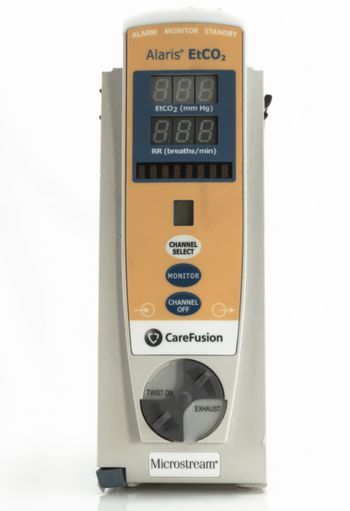
CareFusion Alaris EtCO2 Module 8300
 CareFusion · Model Alaris EtCO2 Module 8300
Supports current ASA and Joint Commission standards mandating CO2 monitoring for all anesthetized patients (intubated and non-intubated Provides an additional safety net at the bedside to continuously monitor patient respiratory response to infusion therapy Provides a unique function for the clinician to automatically pause a PCA infusion if a patient falls below your hospital-defined low respiratory limits when used with the Alaris™ PCA module Dose error reduction (DERs) system Customizable alarm limits by care area Trending data alongside PCA dosing data.
Key tips
- ·Free-flow protection must be verified on every PM - a failed anti-free-flow clamp is a direct overdose risk.
- ·Test occlusion alarms in both directions - failing to alarm when it should is more dangerous than a false alarm.
- ·Battery run-time complaints are the most common real-world nuisance call - a full charge/discharge cycle test catches most of them.
Typical Failure Modes
Compiled for this model from its own documentation and established engineering knowledge for this equipment class - not from a verified service record. Confirm against the manufacturer's service manual.
Failure / error message stops delivery
HighSymptoms: The pump alarms and displays an error message / code and stops.
Root cause: A subsystem fault indexed in the service manual - motor / drive, a sensor, set-detection, or a board.
Occlusion alarm / pressure fault
MediumSymptoms: Repeated occlusion alarms, delivery stops, or an occlusion is missed.
Root cause: Kinked or clamped line, a closed roller clamp, a positional patient tube, pressure-sensor drift, or an improperly loaded set.
Air-in-line alarm
MediumSymptoms: Frequent air-in-line alarms, delivery stops.
Root cause: Air in the set, an improperly loaded set, or an ultrasonic air-detector fault.
Flow-rate accuracy drift
MediumSymptoms: Delivered volume outside tolerance on the annual test, especially at low rates.
Root cause: Worn pumping mechanism / plunger drive.
Battery will not hold charge
MediumSymptoms: Short run time, low-battery early after a full charge.
Root cause: Aged battery pack.
Door / plunger / sensor mechanical wear
LowSymptoms: Set will not load, door will not latch, plunger grip poor.
Root cause: Worn door latch, plunger jaws, or anti-free-flow mechanism.
Serviceable Parts & Consumables
Serviceable items for this model, compiled from its documentation and engineering knowledge for this equipment class. Service class and relative cost are estimates, not manufacturer figures; no part numbers are given. Confirm intervals and pricing against the manufacturer.
Battery pack
Class Periodic replacementRel. cost $$R&R Fairly easy
Pumping mechanism / rotor / plunger drive
Class Major service partRel. cost $$$R&R Difficult
Pressure / air-detector sensor assembly
Class Major service partRel. cost $$R&R Moderate
Door / latch / anti-free-flow assembly
Class Major service partRel. cost $$R&R Moderate
Drive motor / gearbox
Class Major service partRel. cost $$$R&R Difficult
| Part | Service class | Relative cost | R&R difficulty |
|---|---|---|---|
| Battery pack | Periodic replacement | $$ | Fairly easy |
| Pumping mechanism / rotor / plunger drive | Major service part | $$$ | Difficult |
| Pressure / air-detector sensor assembly | Major service part | $$ | Moderate |
| Door / latch / anti-free-flow assembly | Major service part | $$ | Moderate |
| Drive motor / gearbox | Major service part | $$$ | Difficult |
Relative cost: $ lowest · $$$$ highest service-part cost for this equipment class. Not a price.
PM Checklist
Preventive-maintenance tasks typical of this equipment class. Perform to the manufacturer's procedure and your facility's policy - this is general reference, not a schedule for this specific unit.
- ·Occlusion pressure and flow-rate accuracy verification
- ·Battery conditioning cycle
- ·Door latch and air-in-line sensor inspection
- ·Post-drop functional check before return to service
- ·Annual PM per manufacturer schedule
Troubleshooting Approach
A starting sequence for this model, compiled from its documentation and engineering knowledge for this equipment class. Follow the manufacturer's service documentation for the actual procedure.
Symptom: Alarm with an error message / code, delivery stopped
- Note the exact error message or code from the display.
- Look it up in the pump's technical service manual troubleshooting section.
- Run the biomed diagnostics / service utilities to exercise the named subsystem (motor / drive, a sensor, set-detection, a board).
- Follow the manual's parts-replacement procedure for that fault.
- Run the full scheduled-maintenance test set, including a flow-accuracy check, after any repair.
Symptom: Occlusion alarm / pressure fault (or a missed occlusion)
- Check the line for kinks, closed clamps and a closed roller clamp; check the patient site and cannula.
- Reload the administration set correctly, clearing all air.
- Confirm the set is an approved type for this pump.
- Run the pressure-sensor / force-sensor test in the service menu.
- Replace the set; refer the pump if the pressure sensor or pumping mechanism is indicated.
Symptom: Air-in-line alarm / free-flow or feed not delivering
- Prime the set fully and reload it; tap out micro-bubbles at the drip chamber.
- Confirm the set seats correctly against the air-in-line detector / rotor.
- Clean the ultrasonic air-detector window.
- Run the air-detector (or rotor / cassette) test in diagnostics.
- Replace a worn pumping mechanism / anti-free-flow assembly if flow accuracy or detection is out.
Symptom: Battery will not hold charge / short run time
- Fully charge, then run a battery run-down / capacity test in the service menu.
- Check the charging circuit and contacts.
- Replace the battery pack when capacity is below the service limit.
- Recalibrate the battery gauge if the pump supports it.
- Confirm run time meets spec after replacement.
Technical Specs
- Height
- 8.9 in
- Weight
- 2.5 lbs
- Width
- 3.3 in
Typical Location
Where this class of equipment is typically deployed - general reference, not this unit's own placement record.
- Patient care floors
- ICU
- OR
- Oncology / infusion centers
- Home health (portable pumps)
Documents & Manuals
Safety & Recalls
Synced live from the FDA openFDA API.
- RECALL
Due to product labeling not indicating which Transport Layer Security (TLS) version that must be enabled on hospital network to ensure secure Wi-Fi communication with Point-of-Care Units
- RECALL
Due to a number of modules flashed with a date and time associated with the daylight savings time (DST) adjustment that may cause connectivity issue with hospital networks. This issue only affects the Interoperability workflow for devices with a DST invalid timestamp, impacting connectivity of the PCU to the hospital network
- RECALL
If infusion pump is dropped or severely jarred this may damage the pump module bezel assembly, which can cause under-infusion, over-infusion, unregulated flow, or pump module failure to calibrate; so dropped/jarred pumps should be removed from use, tested, and inspected by qualified service personnel prior to reuse; tip sheet, cleaning and disinfecting procedure and reference guide updated.
- RECALL
Infusion pump module used with compatible pump infusion sets may perform outside the established performance ranges for flow rate and bolus accuracy, downstream and upstream occlusion time to alarm, and post-occlusion bolos volume.
- RECALL
Infusion pump module used with compatible pump infusion sets may perform outside the established performance ranges for flow rate and bolus accuracy, downstream and upstream occlusion time to alarm, and post-occlusion bolos volume.
- RECALL
During automated dispensing cabinet upgrade/installation/reimaging, component manager was left in installed mode, and if a Microsoft patch is then installed this may lead to an error preventing user access to the dispensing software application, which may lead to delay in access to medications/supplies, and delivery/replenishment of patient specific orders; which may lead to delay in patient care.
- RECALL
Antivirus software was not consistently installed on impacted devices during the implementation process.
- RECALL
Users trying to restock a single bin location of an automated dispensing cabinet, during pocket exchange restocking workflow, may experience a software issue that results in 2 destock transactions and 2 stock transactions, which results in doubling the bin quantity, which may result in a delay in access to desired medications and/or supplies, which may lead to temporary body function impairment.
- RECALL
Software issue that may result in outdated automated programming request(APR) being sent to the progressive care unit (PCU).
- RECALL
Due to User Manual/Direction for Use incorrectly instructing user to leave the safety clamp in the open position when reloading an infusion set. This issue potentially could result in an accidental over infusion if the roller clamp is left open.
- RECALL
Due to affected devices that may have bent female IUI connector and may not be operable and potentially cause delays in the start of the infusion or monitoring.
- RECALL
Due to a software issue the PC unit may not connect to the server which could impact wireless data transmission to and from the server.
- RECALL
Infusion pump PCs with specific software/network cards/IP addresses can have network/wireless connection failure. Could cause inability to receive new datasets and inability to transfer retrospective analytics data to connected systems. Users with interfaces to electronic medication record or admin discharge transfer, may be unable to receive/send data; infusions may need to be manually programmed
- RECALL
Pump Module keypad lifting, and Fluid ingress could result in 1) Unresponsive keys: module continues infusion, PC unit will not alarm and must be used for programming changes, may necessitate a different Pump Module. May result in infusion start delay/inability to titrate medication. 2) Stuck keys: PC unit alarms, module exhibits Channel Error, may result in infusion interruption/start delay
- RECALL
The Alaris PC unit can display incorrect syringe type and/or syringe sizes. This could result in delays in infusion, under-infusion, or over-infusion.
- RECALL
The pump module keypad may exhibit keys that are unresponsive or stuck as a result of fluid ingress potentially resulting in a delay to the start of infusion, interruption of infusion, or inability to titrate medication. For high-risk patient populations who are receiving life-sustaining infusions, delays in an infusion or interruption can cause serious injury or death.
- RECALL
Infusion pump component defect may result in interruption of patient monitoring
- RECALL
Pump Module keypad may exhibit keys that are unresponsive or stuck as a result of fluid ingress potentially resulting in a delay to the start of infusion or interruption of infusion. Delays in an infusion or interruption can cause serious injury or death in high-risk patient populations.
- RECALL
Cleaning agents may damage Inter-Unit Interface (IUI) Connectors, which may lead to interruption of communication or power between PC Unit and modules, which may result in an infusion that stops with a CHANNEL DISCONNECTED message, and an audio/visual alarm on the PC Unit and an interruption of therapy or monitoring.
- RECALL
Broken elements on pump module platen such as broken upper hinge post, lower hinge, and membrane frame can occur when the door is forcefully closed on an object, the device is dropped, or if improper cleaners are used on the membrane frame assembly. These may prevent devices from delivering accurate amounts of fluid, which may result in an over infusion, free-flow conditions, or under infusion.
- RECALL
If one or more screws or washers are loose or missing causing the battery not to be properly secured to the PC Unit, that is running on battery power, the system may experience a power loss with a prolonged, non-silenceable alarm. Power loss may result in an interruption of patient therapy or monitoring.
- RECALL
LED display, which provides infusion or patient monitoring values, on the module may have segments that appear dim.
- RECALL
Calibration; it has been determined that the capnographs may have been calibrated during manufacturing using a lower than specified concentration of CO2
- RECALL
Complaints where users were unable to prime the administration set.
- RECALL
The bezel manufacturing process for the FR-110 plastic may have resulted in its weakening. A bezel with weakened plastic may, over time, lead to separation of the bezel post (recall issue) as well as other damage to the bezel (i.e. external cracking). The separation of one or more bezel posts may result in free flow, over infusion, under infusion or interruption of infusion.
- RECALL
The syringe plunger grippers may fail to automatically close around the syringe plunger press when the gripper control knob has been closed.
- RECALL
Reports of incorrect priming volume due to manufacturing with incorrect tubing.
- RECALL
The recalling firm has received reports of increased or decreased flows that have occurred in certain pumps.
- RECALL
BD initiated the recall of Alaris PC unit model 8015 after the firm identified five scenarios which can result in the occurrence of Systems Error Code 255-16-275 and can potentially result in interrupted infusions.
- RECALL
There is a potential risk that could cause unintended flow in the older, centered sear door latch design in the Alaris Pump module model 8100.
- RECALL
During an infusion, a false Air-in-Line (AIL) alarm would cause the infusion to be interrupted.
- RECALL
A software anomaly with the Alaris Syringe module software version 9.15 may cause an infusion to unexpectedly stop when the Syringe module is transitioning from one rate to another.
- RECALL
The Oral Airway pouch within the PINK/RED Oxygen Delivery Module, 7700RAW, was incorrectly packaged with the 8 cm Berman Oral Airway. The pouch contained within the module is correctly labeled as 5 cm but actually contains an 8 cm Berman Oral Airway component. Therefore, the component within the pouch is incorrect. The PINK/RED Oxygen Delivery Module, 7700RAW, is intended to be used within the PINK/RED Pouch of the BROSELOW pediatric safety system. Three (3) lots (lot# 914873, lot# 914876 and lot #914878) of the PINK/RED Oxygen Delivery Module, 7700RAW, are affected by this voluntary Field Safety Corrective Action.
- RECALL
A patient weight can be populated incorrectly under certain conditions when using the RESTORE feature to restore infusions running on the Alaris LVP module model 8100 and the Alaris Syringe module model 8110.
- RECALL
The Alaris PC units model 8015 may display a system error code 133.6080 due to failure with the super capacitor (C245) at power up on the Alaris PC unit logic boards.
- RECALL
CareFusion is recalling the Alaris VersaSafe Infusion Set because of separation and/or leakages at the VersaSafe split septum port and tubing may lead to leakage of the administration set.
- RECALL
CareFusion is recalling the Alaris PC unit because a component on the PC unit power supply may cause a "System Error" or "Missing Battery" error code (120.4630).
- RECALL
CareFusion is recalling the Alaris EtCO2 module model 8300 because it may have been tested during service using a higher than specified concentration of CO2. The effect to the EtCO2 module tested with a higher concentration of CO2 could lead to an incorrect measurement of CO2.
- RECALL
CareFusion is recalling the Alaris Pump Module SmartSite Infusion Set because the disconnection and leakage may occur during infusion.
- RECALL
An issue with the cancel functionality used during atypical infusion programming to cancel user inputted values. An infusion may start that is greater than or less than the hospital established limits for the specific medication.
- RECALL
CareFusion is recalling the Alaris PC unit because of an error code. The error code may occur upon power on during the "Power-On Self Test" due to a keypad issue.
- RECALL
CareFusion is recalling the Alaris Pump model 8100 version 9.1.18 because it may have a software issue that results in situation where the pump module will not properly delay an infusion when the "Delay Until" option or "Multidose" feature is used.
- RECALL
CareFusion is recalling the Alaris PC units model 8015 (PC unit), version 9.12, because it is operating at an incorrect voltage and it could potentially experience a loss of communication between the PC Unit main Processor and Keyboard Processor.
- RECALL
The recall was initiated because Carefusion has received reports of a communication error on the Alaris PC unit model 8015 with software version 9.12 when the Alaris EtCO2 module or Alaris SpO2 module is attached.
- RECALL
The recall was initiated because Carefusion has identified potential risk associated with bolus programming with the Alaris PC unit (model 8015) software version 9.12. Automating infusion pump parameter input from either the electronic medical record (EMR) or the Alaris Auto-ID module for a continuous infusion with a bolus dose option may result in a loss of information from the Guardrails Data s
- RECALL
The recall was initiated because Carefusion identified a potential risk associated with the Alaris Pump module model 8100. Carefusion has received reports of customers experiencing motor stalls during infusion with Alaris Pump Module (model 8100) manufactured between August 2010 and July 2011.
- RECALL
The recall was initiated because Carefusion has identified a potential risk associated with the Alaris Pump module model 8100. The pump module door keypad overlay may separate from the keypad assembly
- RECALL
The recall was initiated because the Alaris PC unit model 8015 has a component on the PC unit power supply board that is causing an error code(120.4630) "System Error" or "Missing Battery Error" at start up. The error code is accompanied by both an audible alarm and visual error messages on the PC unit screen.
- RECALL
The recall was initiated because Carefusion has identified a potential risk with a PLD component on the Alaris PC unit model 8015 power supply board. The PLD component used in production between June 21, 2011 and August 15, 2011 has a higher standby current resulting in the battery depleting prematurely.
- RECALL
Than recall was initiated because CareFusion has identified identified a potential risk associated with the Alaris PC unit formerly known as Medley PC unit (PC Unit) model 8000 only when used with Alaris Pump module (Pump module) or Alaris Syringe module' (Syringe module), This recall notification details the potential risk and recommended steps for users to take if they encounter a specific PC
Related calculators
From BioLab, for work done with this kind of equipment.
Troubleshoot this device with Bio
Describe a symptom or error code. Bio answers from this device's own documented error codes, failure modes, parts, and guides.
Ask Bio