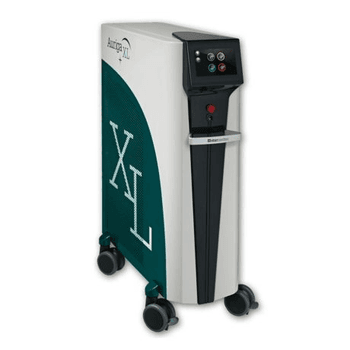
Boston Scientific Auriga XL
 Boston Scientific · Model Auriga XL
The Auriga XL is paired with propriety LightTrail™ Laser Fibers, inclusive of the LightTrail 270µm fiber that can generate 18Hz Console detects what size and type of fiber has been connected Designed for precise optical fit between the fiber and console to increase power at the fiber tip and reduce fiber fracture Only settings that have been tested and verified for the respective fiber size can be selected.
Key tips
- ·Verify true laser output with an external power meter, not the console readout - the display drifts independently of real delivered energy.
- ·Never bypass a door interlock, key switch, or footswitch safety to finish a treatment - laser safety interlocks are not optional.
- ·Most low-output complaints trace to the delivery fiber or handpiece, not the laser source - inspect and swap those first.
- ·Intermittent mid-treatment shutdowns are usually cooling-related - check coolant level and flow before suspecting the diode or lamp.
Typical Failure Modes
Compiled for this model from its own documentation and established engineering knowledge for this equipment class - not from a verified service record. Confirm against the manufacturer's service manual.
No or low laser output
HighSymptoms: Weak or no output at the delivery device, treatment ineffective, power not reaching the set value.
Root cause: Laser module / lamp / diode-bar ageing, a damaged delivery fibre / handpiece / applicator, or a driver / power-supply fault.
Cooling / thermal shutdown
HighSymptoms: Unit shuts down after a period, over-temperature or low-flow alarm.
Root cause: Chiller / TEC fault, low or contaminated coolant, a failed pump, or blocked airflow.
Delivery fibre / handpiece / applicator fault
MediumSymptoms: Burn marks at the tip, high loss, intermittent output, applicator not recognised.
Root cause: Damaged or contaminated fibre / applicator / connector.
Skin-cooling / contact-cooling fault (aesthetic)
MediumSymptoms: Skin cooling not delivered, cooling / cryogen alarm.
Root cause: Contact-cooling / cryogen supply, a valve, or the tip.
Footswitch / interlock / key fault
MediumSymptoms: Laser will not fire, key / interlock / footswitch error.
Root cause: Footswitch, door interlock, or key-switch fault.
Serviceable Parts & Consumables
Serviceable items for this model, compiled from its documentation and engineering knowledge for this equipment class. Service class and relative cost are estimates, not manufacturer figures; no part numbers are given. Confirm intervals and pricing against the manufacturer.
Laser module / lamp / diode bar
Power re-calibration required after replacement.
Class Periodic replacementRel. cost $$$$R&R Expert-level
Delivery fibre / handpiece / applicator
Class Frequent wear itemRel. cost $$$R&R Fairly easy
Chiller / TEC components & coolant filter
Class Periodic replacementRel. cost $$$R&R Difficult
Contact-cooling tip / cryogen valve (aesthetic)
Class Periodic replacementRel. cost $$R&R Moderate
Footswitch
Class Periodic replacementRel. cost $$R&R Fairly easy
| Part | Service class | Relative cost | R&R difficulty |
|---|---|---|---|
| Laser module / lamp / diode bar Power re-calibration required after replacement. | Periodic replacement | $$$$ | Expert-level |
| Delivery fibre / handpiece / applicator | Frequent wear item | $$$ | Fairly easy |
| Chiller / TEC components & coolant filter | Periodic replacement | $$$ | Difficult |
| Contact-cooling tip / cryogen valve (aesthetic) | Periodic replacement | $$ | Moderate |
| Footswitch | Periodic replacement | $$ | Fairly easy |
Relative cost: $ lowest · $$$$ highest service-part cost for this equipment class. Not a price.
PM Checklist
Preventive-maintenance tasks typical of this equipment class. Perform to the manufacturer's procedure and your facility's policy - this is general reference, not a schedule for this specific unit.
- ·Laser output power verification against a calibrated external power meter
- ·Cooling-system check: coolant level, flow rate, and filter / heat-exchanger condition
- ·Delivery-system inspection: handpiece, delivery fiber or articulated arm, and output optics
- ·Interlock, key-switch, emergency-stop, and footswitch function test
- ·Beam-alignment and optical-path check per the service manual
- ·Annual full PM and electrical safety test
Troubleshooting Approach
A starting sequence for this model, compiled from its documentation and engineering knowledge for this equipment class. Follow the manufacturer's service documentation for the actual procedure.
Symptom: No or low output
- Measure output at the delivery device with a laser power meter against the setting.
- Fit a known-good delivery fibre / handpiece / applicator.
- Confirm the cooling system runs and coolant is at level and clean.
- Check the key, interlock and footswitch are satisfied.
- Escalate a confirmed laser-module or driver fault to the OEM; recalibrate power after any module work.
Symptom: Thermal shutdown
- Confirm the cooling fans / pump run and airflow is clear.
- Check the coolant level and replace the coolant filter.
- Let the unit cool and restart.
- Clean the air filters / vents.
- Monitor for recurrence during a treatment.
Typical Location
Where this class of equipment is typically deployed - general reference, not this unit's own placement record.
- Operating rooms and surgical procedure suites
- Dermatology and medical-aesthetic clinics
- ENT, gynecology, and specialty procedure rooms
- Outpatient surgical centers
Documents & Manuals
No documents available for this device yet.
Safety & Recalls
Synced live from the FDA openFDA API.
- RECALL
Flash may be protruding from the lumen of the catheter shaft. If this flash is present in the catheter, there is the potential of an embolization resulting from the flash detaching from the device during the procedure.
- RECALL
Missing holes: Catheters are missing the catheter's side holes.
- RECALL
Excess strands of resin may exist in the lumen near the hub of certain batches/lots of the Mach 1 Guide Catheters. If this excess resin is present in the catheter, there is the potential of an embolization resulting from the excess resin detaching from the device during the procedure.
- RECALL
Boston Scientific is voluntarily recalling one lot/batch of Katzen Infusion Wires because they have identified that the label on the carton may indicate a different length device than what is actually in the carton. The affected batch was manufactured using the Katzen Core Assembly of 146 cm, instead of a 177cm assembly.
- RECALL
One lot of product, Stainless Steel Greenfield Vena Cava Filter, may have the incorrect expiration date of 2008-07 and the correct date is 2008-06.
- RECALL
The PT2 J-tip labeled guide wires may be missing the pre-formed J-tip. As a result, guide wires may have a straight tip instead of a pre-formed J-tip.
- RECALL
Lack of assurance of sterility (pre-sterilization bioburden limits exceeded)
- RECALL
Boston Scientific discovered through an internal inspection process that the PTFE (polytetrafluoroethylene) coating is not consistently adhering to the transition area of the distal end of the guide wires which may cause PTFE to flake off.
- RECALL
Gaps were identified between polymer segments on the 7F Wiseguide Guide Catheter in which the PTFE was not properly laminated to the braid of the catheter. This delamination of the PTFE from the braid could compromise the device delivery.
- RECALL
There have been reports of detachment at the bond between the carrier capsule and the outer sheath of the Greenfield Vena Cava Filters with 12 Fr Femoral introducer Systems manufactured before Marcyh 10, 2004. If the capsule should detach during an implantation procedure, there is a risk of cardiac and pulmonary embolization.
- RECALL
The device has the potential for overheating its transformer and has the potential for fire hazard.
- RECALL
The device has the potential for overheating its transformer and has the potential for fire hazard.
Troubleshoot this device with Bio
Describe a symptom or error code. Bio answers from this device's own documented error codes, failure modes, parts, and guides.
Ask Bio