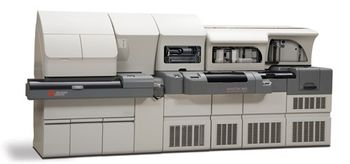
Beckman Coulter UniCel DxC 660i
 Beckman Coulter · Model UniCel DxC 660i
System throughput of up to 990 chemistry, and 200 immunoassay tests per hour Combined onboard capacity of 115 different tests from a menu of more than 150 assays. ClozCap closed-tube sampling and aliquoting technology On-the-fly loading of chemistry and immunoassay reagents and consumables while system is running Hands-free integrated aliquot preparation Streamline parallel sample processing Single point of sample entry.
Key tips
- ·Run QC controls before trusting any repair - an analyzer that passes self-test can still report clinically wrong results.
- ·Rule out a reagent lot change before opening the instrument - it can look exactly like a hardware fault.
- ·Centrifuge rotors have a hard retirement age/cycle limit regardless of visible condition - don't eyeball it.
Typical Failure Modes
Compiled for this model from its own documentation and established engineering knowledge for this equipment class - not from a verified service record. Confirm against the manufacturer's service manual.
QC / calibration failure on an assay
HighSymptoms: Controls out of range, calibration fails, flagged results on one or more assays.
Root cause: Reagent pack issue, a probe / dispense fault, incubation-temperature drift, or a detector / optics fault.
Sample / reagent probe or pipettor fault
MediumSymptoms: Short aspiration, no dispense, clot / level-sense errors, carryover.
Root cause: Clogged or bent probe, a syringe / pump fault, or a level-sense fault.
Wash / aspiration station fault
MediumSymptoms: High background / noise, poor precision, elevated blanks.
Root cause: Blocked wash-station nozzles or a wash-pump / vacuum fault.
Incubator temperature fault
MediumSymptoms: Assay drift or bias, incubation-temperature alarm.
Root cause: Incubator heater or temperature-sensor fault.
Detector / luminometer / photometer fault
MediumSymptoms: Low signal, high CV, detector-error message.
Root cause: PMT / detector ageing or an optics fault.
Serviceable Parts & Consumables
Serviceable items for this model, compiled from its documentation and engineering knowledge for this equipment class. Service class and relative cost are estimates, not manufacturer figures; no part numbers are given. Confirm intervals and pricing against the manufacturer.
Sample / reagent probe
Class Periodic replacementRel. cost $$R&R Moderate
Syringe / dispense pump
Class Periodic replacementRel. cost $$R&R Moderate
Wash-station nozzles / pump tubing
Class Frequent wear itemRel. cost $R&R Moderate
Incubator heater / temperature sensor
Class Major service partRel. cost $$R&R Moderate
Detector / PMT module
Class Major service partRel. cost $$$R&R Difficult
| Part | Service class | Relative cost | R&R difficulty |
|---|---|---|---|
| Sample / reagent probe | Periodic replacement | $$ | Moderate |
| Syringe / dispense pump | Periodic replacement | $$ | Moderate |
| Wash-station nozzles / pump tubing | Frequent wear item | $ | Moderate |
| Incubator heater / temperature sensor | Major service part | $$ | Moderate |
| Detector / PMT module | Major service part | $$$ | Difficult |
Relative cost: $ lowest · $$$$ highest service-part cost for this equipment class. Not a price.
PM Checklist
Preventive-maintenance tasks typical of this equipment class. Perform to the manufacturer's procedure and your facility's policy - this is general reference, not a schedule for this specific unit.
- ·Daily QC controls run and reviewed
- ·Calibration verification per assay
- ·Routine cleaning and decontamination
- ·Scheduled reagent-path and pump-tubing maintenance
Troubleshooting Approach
A starting sequence for this model, compiled from its documentation and engineering knowledge for this equipment class. Follow the manufacturer's service documentation for the actual procedure.
Symptom: QC or calibration failure
- Run fresh controls and recalibrate the affected assay.
- Confirm the reagent pack is in date, mixed and correctly loaded.
- Clean the probes and wash stations.
- Check the incubator temperature against a reference.
- Escalate a detector / optics fault to the OEM.
Symptom: Probe or pipettor fault
- Inspect the probe for a bend or clog and clear it.
- Run the fluidics prime.
- Check the syringe / pump and tubing for leaks or air.
- Verify level sensing and probe position.
- Replace the probe or syringe as found and re-run QC.
Typical Location
Where this class of equipment is typically deployed - general reference, not this unit's own placement record.
- Central / core laboratory
- Point-of-care testing stations
- Blood bank
- Microbiology lab
Documents & Manuals
No documents available for this device yet.
Safety & Recalls
Synced live from the FDA openFDA API.
- RECALL
a software defect in which the Parameter Package (PP) import logic overwrites all predefined calculated test rules, including those previously modified by the user, upon import of a new Parameter Package version. As a result, usercustomized calculated test rules revert silently to their default expressions, potentially generating erroneous patient test results without an explicit error notification. The issue affects instruments running software version 1.5 or lower and only occurs when a new Parameter Package is imported to a system that already has an existing Parameter Package onboard; new installations are not affected.
- RECALL
Beckman Coulter has confirmed a software anomaly on DxI 9000 Access Immunoassay Analyzer and the DxC 500i Clinical Analyzer that may prevent correct application of user-specified manual dilution factors when ordering additional tests for samples already "In Progress" using the same "Sample ID number". This can lead to false low or high patient results and potential delays in reporting, risking erroneous diagnoses if undetected.
- RECALL
On a clinical analyzer, when ordering a Clinical Chemistry (CC) combination test simultaneously with an Immunoassay (IA) test, if the IA test is processed between the CC tests, CC sample status will remain In Progress with no errors, may cause processing delays.
- RECALL
Beckman Coulter is recalling their DxC 500 AU Clinical Chemistry Analyzer because a software error causes the analyzer to not run a requested calibration order in the following scenario: when a reagent blank or calibration is ordered during sample processing and then any of the components (R1 and/or R2) depletes to zero tests, the analyzer will not be able to complete the calibration request, and the calibration order will remain pending. No further calibration orders can be processed for any assays, and the instrument refuses to accept further sample processing order after the existing calibration curves are expired. Although in-process tests will be completed, this error can cause a delay in reporting subsequent test results. No further calibration orders can be processed for any assays which may cause a delay in reporting test results.
- RECALL
The reason for the recall is incorrect sample barcode identification and processing errors that result in the reporting of erroneous and delayed results.
- RECALL
Beckman Coulter has determined that device software versions V1.3, V1.4, V1.4.1, V1.4.2, V1.4.3. have a defect due of which, when all constituent tests of a calculated result are rerun, either manually ordered by the operator at the analyzer or automatically triggered by predefined rules in System Configuration, the calculated result will not be recalculated using the constituent tests rerun results. The system will report only the calculated result using the initial constituent tests results to the operator and LIS/Remisol. The issue was identified by Beckman Coulter internal engineering testing. The defect may cause a delay in reporting patient results.
- RECALL
Beckman Coulter has identified an issue which prevents the DxC 500 AU instrument from providing the correct onboard stability (Open Expiration) dates for assays that were loaded prior to a software upgrade (e.g. 1.3 to 1.4, 1.4 to 1.4.1, etc.). As a result, assays that have expired may still be used for sample processing, leading to inaccurate or erroneous patient test results. The issue only happens on assays loaded before instruments doing upgrades and does not impact new installation. It does not impact the assays loaded after upgrade.
- RECALL
Identified reagent lots are experiencing a high rate of calibration failures with failure code of "Max Iterate" on Access 2 and UniCel Dxl Immunoassay Systems. Reporting of results may be delayed due to the time required to achieve a passing calibration curve.
- RECALL
Due to a software issues, after the instrument processes 250 racks cumulatively, any subsequent racks with samples requiring rerun/reflex will be held in the Sample Handler's Buffer area and and error code "9000" will be reported. This issue may cause a delay of results.
- RECALL
There are two software bug issues with the analyzer. Issue 1: When a dedicated rack is reserved for calibration, after a calibration test has been placed and completed, the same rack may be used to place both a patient order and a calibration order. When a patient sample and a non-barcoded calibrator tube is processed on the rack, the calibration result will be reported as a patient result. Issue 2: calibration with expired calibrator. They both may cause erroneous patient results, but the probability of serious adverse health consequences or death is unlikely.
- RECALL
The firm has identified that the Transferrin reagent does not meet the Instructions for Use (IFU) reagent on-board stability claims, which may cause control failures and/or erroneous patient samples results. The Complaint handling unit has received a total of 2 safety cases (CASE-2023-02027212 and CASE-2023-02045278) and 99 quality cases with the failure mode attributed to Transferrin reagent (OSR6152 / lot 2573) associated with reagent blank shifts for the Reagent 2 (R2), imprecision, calibration failures, erratic Quality Control (QC) recoveries, and/or erroneous high/low (serum, plasma, urine) patient results. The issue was confirmed through internal testing by Beckman Coulter on June 30, 2023. Reagent Blank shifts for R2, imprecision, calibration failures, erratic Quality Control (QC) recoveries, and/or erroneous high/low (serum, plasma, urine) patient results. The issue was confirmed
- RECALL
Lipemic interference for the Magnesium serum application failed to meet the performance claim as defined in the IFU. Use may cause a maximum positive bias up to 30.38% in low magnesium patient samples. The impact is only to the clinical interpretation of magnesium results in the presence of lipemia.
- RECALL
The recalling firm characterized the potential interference effects of biotin (up to 1,200 ng/mL) on all biotin-mediated Access assays. The following six assays: Free T3-REF A13422, Total T3-REF 33830, Free T4-REF 33880, GI Mon-387687, Tg-REF 33860, and TgAbII-REF A32898 displayed significant interference (defined as a result bias greater than +/-10%) at 1,200 ng/mL of biotin.
- RECALL
The shield for the Single-Tube Station on the DxH instrument may interfere with sample aspiration in the open vial position.
- RECALL
The firm identified a negative shift of 5mmol/L for sodium recovery in Synchron Control Level 3 when calibrated with AQUA Cal 1.
- RECALL
Beckman Coulter has confirmed that MA Reagent Lot M609458 may recover outside the lower limit of the published insert range for Beckman Coulter Urine Protein Control Level 1.
- RECALL
Beckman Coulter has identified an incompatibility between No Foam DxC reagent (REF B64130) and the DxC hydropneumatic parts associated with No Foam delivery.
- RECALL
Beckman Coulter is initiating a field action because some Ultrasonic Transducer Kits were potentially assembled with incorrect mounting screws.
- RECALL
Possible leaking of No Foam solution from the No Foam Bottle Assembly on the UniCel DxC Synchron Systems.
- RECALL
Beckman Coulter has confirmed customer reports of LACT Lot M210077 failing calibration with error condition OCR LOW. The calibration failures appear to be related to improper shipping or storage conditions (frozen reagent). Failed calibration of LACT may cause a delay in reporting results.
- RECALL
Beckman Coulter initiated the recall for the Lactate Assay (LACT) Lot M206209 as they received a customer complaint of error message (RXN RATE HI), i.e. no numerical values reported for samples containing Lactate concentration greater than 6.5 mmol/L.
- RECALL
Beckman Coulter has confirmed that the Shuttle to Barcode Reader and Cap Piercer alignment procedure cannot be performed on certain DxC configurations with v5.0.11 software installed. If the Shuttle to Barcode Reader becomes misaligned, the Operator will not be able to perform this alignment procedure on the DxC systems listed above. Software v5.0 .11 does not allow access to the Shuttle to Bar
- RECALL
The recall was initiated because Beckman Coulter has confirmed that the current sample syringe pump drive assemblies installed on DxC Integrated ystem with UniCel Closted Tube Aliquotter (UCTA) serial numbers between 547 and 574 may cause a hardware motion error (ID0x08000501).
- RECALL
The recall was initiated because Beckman Coulter has confirmed that the UniCel Dxl and DxC Access Immunoassay Systems had field modifications to the aspirate and dispense probe assemblies.
- RECALL
The recall was initiated because standardization of the Synchron Systems Calibrator 1, used for both the Synchron LX and UniCel DxC systems, has been established to the new IFCC Reference Preparation for Plasma Proteins, ERM-DA470k (formerly CR470) beginning with lot number M005558. During the standardization to the new IFCC standard, ERM-DA470k, we confirmed that Complement C4 (C4) had been re
- RECALL
The hose clamps in the DxC (with serial numbers less than 3412, labeled behind the lower right side instrument door) hydropneumatic system are sharp and pose a possible risk of injury. An operator could be cut by the hose clamps, which could in turn result in increased exposure to any waste products (biohazards) that might be present on the assembly.
- RECALL
Beckman Coulter is recalling the Synchron Systems LX20/UniCel DxC ISE Reference Reagent because it has a potassium (K) response near the instrument calibration flag limits and may exceed the limits on some instruments.
- RECALL
The recall was initiated because Beckman Coulter has confirmed that the Modular Chemistry (MC) and Cartridge Chemistry (CC) 100 uL sample syringes may experience premature wear as indicated by brown discoloration on the plunger and/or inside the glass syringe barrel. Excessive wear of the 100 uL sample syringe barrel and plunger could lead to leaking and may affect results.
- RECALL
The recall was initiated because Cartridge Glucose (GLU) on UniCel DxC and Synchron LX instruments may give falsely high results for moderately hemolysed samples. The Impact: (1) Neonatal samples drawn by lancets are more likely to be hemolysed to a degree sufficient to cause interference with glucose estimation and are a special at-risk population, (2) Other hemolysed samples may be similar
- RECALL
The recall was initiated after Beckman Coulter confirmed reports that black / brown particulates were observed in some bottles of the Creatinine Alkaline Buffer (Buffer lot M911427 and M911518) in modular Creatinine (CREm) reagent kit lots M911428 and M911519. Beckman Coulter have had reports of erroneous results when using the lots of Creatinine Alkaline Buffer listed above. Single creatinine d
- RECALL
The recall was initiated because Beckman Coulter testing indicated that Rheumatoid Factor (RF) reagent lot M907325 will not remain stable to the labeled expiration date.
- RECALL
UniCel DxC and Synchron LX instruments produced inaccurate (low) GLUCm results. False low results could affect or delay diagnosis or treatment.
- RECALL
The recall was initiated because Beckman Coulter has confirmed customer reports that different results have been obtained using the same patient samples on Access/Access 2 and UniCel Dxl platforms. Values obtained with UniCel Dxl systems have been demonstrated to have a positive bias compared to values obtained with Access or Access 2 systems.
- RECALL
The recall was initiated due to " A loose Aliquot Probe tube fitting in the Closed Tube Aliquotter (CTA), may result in erroneous Access immunoassay results or Synchron chemistry results". This may result in dilution of the sample with Wash Buffer; patient results can potentially be affected for Access immunoassays or Synchron chemistries. Access Quality Control may also be affected if run throug
- RECALL
Excessive Buildup of protein, bacteria and sample tube additives in the ISE flow cell may cause erroneous NA (sodium) results.
- RECALL
This recall was initiated because of software issue was identified in System Software 4.2 and 4.2.1, which may result in the incorrect handling of a wash arm dispense plate motion failure. Instead of generating a red warning event and stopping sample processing, the system will post a yellow caution event and continue to operate with the dispense plate in an elevated position until the instrument
- RECALL
The recall was initiated because the Wash Concentrate Tube Assembly 142 may fail to deliver the appropriate amount of wash concentrate on some SYNCHRON DxC Systems due to an accumulation of crystals. The impact of this issue would include: (1) Quality Control and patient results can potentially be affected. (2) If system has been calibrating properly and Quality Control is recovering within es
- RECALL
The recall was initiated after Beckman Coulter confirmed reports of inaccurate Access Intrinsic Factor Ab test results displayed on, or printed from, the UniCel Dxl portion of an integrated workstation listed above. The problem is limited to numerical Intrinsic Factor Ab results produced on integrated systems running UniCel Dxl system software version 4.0, 4.1, or 4.2. The DxC portion of your inte
- RECALL
The Ammonia Reagent lot M808278 may fail calibration or cause a low shift in Quality Control recovery on some SYNCHRON Systems.
- RECALL
The reagent produces false low test results. Beckman Coulter has confirmed low recovery of values at the low end of the therapeutic range (<1.5 ug/mL, <3.13 umol/L) with SYNCHRON Systems Gentamicin Reagent (GEN) lot M804552. A false low result can cause a patient to receive more medication than necessary.
- RECALL
This recall was initiated after Beckman Coulter verified through testing that Acetaminophen reagents (lots #M702524 & M703276) manufactured with contaminated heparin has shown a negative bias in performance between the assay made with contaminated and uncontaminated heparin.
Troubleshoot this device with Bio
Describe a symptom or error code. Bio answers from this device's own documented error codes, failure modes, parts, and guides.
Ask Bio