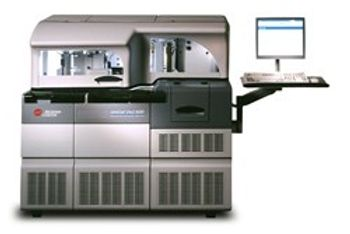
Beckman Coulter UniCel DxC 600 Synchron
 Beckman Coulter · Model UniCel DxC 600 Synchron
For labs with lower volumes (approx. 100 – 500 chemistry samples per day) the UniCel DxC 600 delivers up to 990 tests per hour Delivers the results for 90 basic metabolic panels in an hour (NA, K, CL, CO2, CALC, GLU, BUN, CRE) Samples can be loaded continuously Add the closed-tube sampling (CTS) option to enhance productivity and safety Reduce the potential for worker injury by eliminating the de-capping step for most tubes. Workers have less exposure to repetitive motion injuries and less exposure to biohazards Reduce the potential for errors caused by evaporation or contamination Reduce time spent on tedious manual tasks Choose from a menu that includes more than 100 liquid, ready-to-use reagents The DxC 600 offers 65 different reagents on board at once Liquid reagents eliminate time-consuming reagent preparation Most reagents are packaged with enough volume for hundreds of tests, minimizing operator intervention with the system If reagents are required, operators can load while the system is running No need to interrupt workflow to reconfigure on-board menu Calibration processes minimize time-consuming, labor-intensive steps Calibration data is provided on disk, so technologists don’t have to key in necessary information Almost all calibrators are liquid and ready-to-use, eliminating reconstitution, clean up, and potential result variability The systems automatically accept within-range calibrations The systems require no daily maintenance and minimal weekly maintenance Automated routines for some maintenance procedures eliminate hands-on time by operators Proactive alerts for system maintenance let users know in advance when maintenance is due Onboard maintenance logs with supervisor approval facilitate paperless maintenance records.
Key tips
- ·Run QC controls before trusting any repair - an analyzer that passes self-test can still report clinically wrong results.
- ·Rule out a reagent lot change before opening the instrument - it can look exactly like a hardware fault.
- ·Centrifuge rotors have a hard retirement age/cycle limit regardless of visible condition - don't eyeball it.
Typical Failure Modes
Compiled for this model from its own documentation and established engineering knowledge for this equipment class - not from a verified service record. Confirm against the manufacturer's service manual.
Assay / QC failure across a channel or the whole system
HighSymptoms: Controls out of range, calibration fails, flagged results, drift over a shift.
Root cause: Reagent or cuvette issue, lamp ageing, a probe / mixer / wash-station fault, or ISE-module problems.
Sample / reagent probe clog or crash
MediumSymptoms: Short aspiration, no dispense, clot detection, probe-position error.
Root cause: Clogged or bent probe, or a clot in the sample.
Cuvette / reaction-rotor fault
MediumSymptoms: High cuvette blanks, non-uniform results by position, rotor-drive error.
Root cause: Worn / scratched cuvettes or a wash fault, or a rotor-drive fault.
ISE module fault (Na / K / Cl)
MediumSymptoms: Electrolyte results biased or noisy, ISE calibration fails.
Root cause: Aged ISE electrodes / reference, or a pinch-valve / tubing fault.
Water / vacuum / pressure system fault
MediumSymptoms: Multiple station alarms, priming failures, poor wash.
Root cause: Water / DI supply quality, a pump, or a vacuum / pressure regulator.
Serviceable Parts & Consumables
Serviceable items for this model, compiled from its documentation and engineering knowledge for this equipment class. Service class and relative cost are estimates, not manufacturer figures; no part numbers are given. Confirm intervals and pricing against the manufacturer.
Sample / reagent probes
Class Periodic replacementRel. cost $$R&R Moderate
Photometer lamp
Class Frequent wear itemRel. cost $$R&R Moderate
Reaction cuvettes / segment
Class Frequent wear itemRel. cost $$R&R Easy
ISE electrodes (Na / K / Cl) & reference
Class Frequent wear itemRel. cost $$R&R Fairly easy
Peristaltic / pinch-valve tubing
Class Frequent wear itemRel. cost $R&R Moderate
| Part | Service class | Relative cost | R&R difficulty |
|---|---|---|---|
| Sample / reagent probes | Periodic replacement | $$ | Moderate |
| Photometer lamp | Frequent wear item | $$ | Moderate |
| Reaction cuvettes / segment | Frequent wear item | $$ | Easy |
| ISE electrodes (Na / K / Cl) & reference | Frequent wear item | $$ | Fairly easy |
| Peristaltic / pinch-valve tubing | Frequent wear item | $ | Moderate |
Relative cost: $ lowest · $$$$ highest service-part cost for this equipment class. Not a price.
PM Checklist
Preventive-maintenance tasks typical of this equipment class. Perform to the manufacturer's procedure and your facility's policy - this is general reference, not a schedule for this specific unit.
- ·Daily QC controls run and reviewed
- ·Calibration verification per assay
- ·Routine cleaning and decontamination
- ·Scheduled reagent-path and pump-tubing maintenance
Troubleshooting Approach
A starting sequence for this model, compiled from its documentation and engineering knowledge for this equipment class. Follow the manufacturer's service documentation for the actual procedure.
Symptom: Assay or QC failure
- Run fresh controls at all levels.
- Confirm reagents are in date, correctly loaded and mixed.
- Run the photometer check and replace the lamp if energy is low.
- Clean the probes, mixers and wash stations.
- Recalibrate the affected assay / ISE module and re-run QC.
Symptom: Probe clog or crash
- Inspect the probe for a bend or blockage and clear it.
- Run the fluidics prime / wash cycle.
- Check for a clot in the sample.
- Verify liquid-level sensing and probe positioning.
- Replace the probe if aspiration is still short.
Typical Location
Where this class of equipment is typically deployed - general reference, not this unit's own placement record.
- Central / core laboratory
- Point-of-care testing stations
- Blood bank
- Microbiology lab
Documents & Manuals
No documents available for this device yet.
Safety & Recalls
Synced live from the FDA openFDA API.
- RECALL
Beckman Coulter has determined that, due to a potential communication issue, the analyzers listed above may not successfully restart following a standard shutdown, even after multiple attempts. If this issue occurs, the instrument will be unable to complete initialization and transition to Ready mode and the instrument will not process patient samples, QCs or calibrators. This causes delayed results.
- RECALL
Beckman Coulter has identified that there is an increased probability Synchron Systems Direct LDL Cholesterol (LDLD REF 969706) reagent lot M404166 may generate false high results. The issue was discovered internally and confirmed on August 19, 2025 by Beckman Coulter.
- RECALL
Specific SYNCHRON Systems Modular Chemistry Phosphorus (PHOSm REF 467868) reagent lots may fail calibration before the lot expiration date which causes a delay in obtaining patient results.
- RECALL
Cholesterol Reagent may fail with Out of Calibration Range Low (OCR Low) and/or Back to Back (B/B) errors. Low quality control recovery failures may be observed after passing calibration. Brown particulates in compartment C of the reagent cartridge may be observed. Continued use may lead to, 1) failed QC and/or calibrations, 2) Erroneous low Cholesterol patient results.
- RECALL
Cross-reactivity testing may not meet the claims indicated in the Opiate 2000 ng (OP2) Instructions For Use. The presence of certain compounds in urine may result in false positive or false negative patient test results.
- RECALL
The firm has identified that cross-reactivity testing may not meet the claims indicated in the Barbiturates Reagent Chemistry Information Sheet (CIS). The presence of certain compounds in urine may result in false positive or false negative results.
- RECALL
The firm identified a negative shift of 5mmol/L for sodium recovery in Synchron Control Level 3 when calibrated with AQUA Cal 1.
- RECALL
Beckman Coulter has confirmed that MA Reagent Lot M609458 may recover outside the lower limit of the published insert range for Beckman Coulter Urine Protein Control Level 1.
- RECALL
Beckman Coulter has identified an incompatibility between No Foam DxC reagent (REF B64130) and the DxC hydropneumatic parts associated with No Foam delivery.
- RECALL
Possible leaking of No Foam solution from the No Foam Bottle Assembly on the UniCel DxC Synchron Systems.
- RECALL
Beckman Coulter has confirmed customer reports of LACT Lot M210077 failing calibration with error condition OCR LOW. The calibration failures appear to be related to improper shipping or storage conditions (frozen reagent). Failed calibration of LACT may cause a delay in reporting results.
- RECALL
Beckman Coulter initiated the recall for the Lactate Assay (LACT) Lot M206209 as they received a customer complaint of error message (RXN RATE HI), i.e. no numerical values reported for samples containing Lactate concentration greater than 6.5 mmol/L.
- RECALL
It has been determined that, in some cases, pulley drive components have broken parts or have become loose, mispositioned, or disconnected from their drive shafts. When these defects occur, the pulley may not turn at all, or may turn at an incorrect speed, resulting in inadequate washing or mixing of the contents of the reaction vessel.
- RECALL
Beckman Coulter has confirmed that the Shuttle to Barcode Reader and Cap Piercer alignment procedure cannot be performed on certain DxC configurations with v5.0.11 software installed. If the Shuttle to Barcode Reader becomes misaligned, the Operator will not be able to perform this alignment procedure on the DxC systems listed above. Software v5.0 .11 does not allow access to the Shuttle to Bar
- RECALL
The recall was initiated because Beckman Coulter has confirmed a mislabeling error, some Synchron Systems Multi Calibrator Diskettes (REF 442600, lot M002642G) may actually be Thyroxine (T4) Reagent Calibrator Diskettes.
- RECALL
The recall was initiated because Beckman has confirmed that the all in date lots of Synchron Rheumatoid Factor (RF) Reagent might generate false positive results or calibration failures.
- RECALL
The recall was initiated because standardization of the Synchron Systems Calibrator 1, used for both the Synchron LX and UniCel DxC systems, has been established to the new IFCC Reference Preparation for Plasma Proteins, ERM-DA470k (formerly CR470) beginning with lot number M005558. During the standardization to the new IFCC standard, ERM-DA470k, we confirmed that Complement C4 (C4) had been re
- RECALL
Beckman Coulter is recalling the Synchron Systems LX20/UniCel DxC ISE Reference Reagent because it has a potassium (K) response near the instrument calibration flag limits and may exceed the limits on some instruments.
- RECALL
The recall was initiated because Beckman Coulter has confirmed that the Modular Chemistry (MC) and Cartridge Chemistry (CC) 100 uL sample syringes may experience premature wear as indicated by brown discoloration on the plunger and/or inside the glass syringe barrel. Excessive wear of the 100 uL sample syringe barrel and plunger could lead to leaking and may affect results.
- RECALL
The recall was initiated because Cartridge Glucose (GLU) on UniCel DxC and Synchron LX instruments may give falsely high results for moderately hemolysed samples. The Impact: (1) Neonatal samples drawn by lancets are more likely to be hemolysed to a degree sufficient to cause interference with glucose estimation and are a special at-risk population, (2) Other hemolysed samples may be similar
- RECALL
The recall was initiated after Beckman Coulter confirmed reports that black / brown particulates were observed in some bottles of the Creatinine Alkaline Buffer (Buffer lot M911427 and M911518) in modular Creatinine (CREm) reagent kit lots M911428 and M911519. Beckman Coulter have had reports of erroneous results when using the lots of Creatinine Alkaline Buffer listed above. Single creatinine d
- RECALL
The recall was initiated after Beckman Coulter Inc. confirmed reports of high recovery of immunoglobulin A (IgA) in proficiency surveys or patient samples using Synchron Ig-A reagent lots M812164 or M902345. Using these reagent lots, some samples deficient in IgA have yielded results in the normal range. Other samples with normal levels of IgA have yielded falsely high results.
- RECALL
The recall was initiated because Beckman Coulter testing indicated that Rheumatoid Factor (RF) reagent lot M907325 will not remain stable to the labeled expiration date.
- RECALL
UniCel DxC and Synchron LX instruments produced inaccurate (low) GLUCm results. False low results could affect or delay diagnosis or treatment.
- RECALL
The recall was initiated due to " A loose Aliquot Probe tube fitting in the Closed Tube Aliquotter (CTA), may result in erroneous Access immunoassay results or Synchron chemistry results". This may result in dilution of the sample with Wash Buffer; patient results can potentially be affected for Access immunoassays or Synchron chemistries. Access Quality Control may also be affected if run throug
- RECALL
Excessive Buildup of protein, bacteria and sample tube additives in the ISE flow cell may cause erroneous NA (sodium) results.
- RECALL
This recall was initiated because of software issue was identified in System Software 4.2 and 4.2.1, which may result in the incorrect handling of a wash arm dispense plate motion failure. Instead of generating a red warning event and stopping sample processing, the system will post a yellow caution event and continue to operate with the dispense plate in an elevated position until the instrument
- RECALL
A recall was initiated because Beckman has confirmed that the standardization of the Immuno Protein Calibrator Set has been re-established to IFCC Reference Preparation for Plasma Proteins, BCR-470 beginning with lot number M901330.
- RECALL
The recall was initiated because Beckman Coulter has confirmed reports of variability in results with the lots of Phenobarbital (PHE) reagent and calibrator.
- RECALL
The recall was initiated because the Wash Concentrate Tube Assembly 142 may fail to deliver the appropriate amount of wash concentrate on some SYNCHRON DxC Systems due to an accumulation of crystals. The impact of this issue would include: (1) Quality Control and patient results can potentially be affected. (2) If system has been calibrating properly and Quality Control is recovering within es
- RECALL
The Ammonia Reagent lot M808278 may fail calibration or cause a low shift in Quality Control recovery on some SYNCHRON Systems.
- RECALL
The reagent produces false low test results. Beckman Coulter has confirmed low recovery of values at the low end of the therapeutic range (<1.5 ug/mL, <3.13 umol/L) with SYNCHRON Systems Gentamicin Reagent (GEN) lot M804552. A false low result can cause a patient to receive more medication than necessary.
- RECALL
The recall was initiated after Beckman Coulter confirmed reports of a new premature failure of the upper aspirate peristaltic pump in the systems listed above. Premature failure of the pump may negatively affect precision. The failure is limited to those UniCel DXI 800, DXI 600, and DxC 880i systems which have a pump identified with one of the new pump manufacturing numbers (Mfg. Nos.) listed ab
- RECALL
This recall was initiated after Beckman Coulter verified through testing that Acetaminophen reagents (lots #M702524 & M703276) manufactured with contaminated heparin has shown a negative bias in performance between the assay made with contaminated and uncontaminated heparin.
- RECALL
The Salicylate Reagent lots listed here may fail calibration and/or fail to maintain linearity at the upper end of analytical range.
- RECALL
Incorrect Reagent Status-When a new cartridge of Infinity Lithium Reagent is loaded on to the UniCel DxC System, the Reagent Status screen will incorrectly show 'Days Left' as 21. The correct Reagent Status for a new Lithium reagent cartridge is 14 days. Lithium reagent used past 14 days may produce low quality control and/or patient results.
- RECALL
Beckman Coulter has received reports of patient samples and quality control recovery shifting low when using Vancomycin reagent lots M507219 and M511327. Internal QC recovery was as much as 15% lower than the assigned target value.
- RECALL
It was confirmed that the ORDAC (Over Range Detection And Correction) feature (auto & manual) does not perform correctly for the glucose cup chemistry (GLUCm) when sample type of 'Other' is selected w/operating software version 4.5. Results for these samples could be elevated as much as twice the actual value. The ORDAC feature does function properly w/serum, plasma, urine & CSF.
- RECALL
Synchron LX Systems Operating Software Version 4.5/v4.6 CBD (Chemistry Database) introduced an adjustment to the urine Uric Acid database calculation scheme which for some patients, depending on the volume of 24 hour urine sample, results may be reduced from above the upper limit of the laboratory's reference interval to below the limit.
- RECALL
Beckman Coulter has confirmed that occasionally a cuvette may be skipped during the SYNCHRON Lipase Wash (LIWA) procedure. If this occurs, there is the potential for carryover into the SYNCHRON Lipase (LIPA) assay, resulting ina substantial positive bias affecting Lipase (LIPA) results.
- RECALL
Results of tests are biased low due to a vendor change in formulation not brought to the attention of the recalling firm.
- RECALL
incorrect Calibration Acceptance Limits.
- RECALL
Numeric results are erroneously accepted by the in-house information system without qualifying symbols "<" or ">". In addition, the in-house system may interpret the results incorrectly.
- RECALL
'Initial Rate High' parameter for User Defined Reagents does not perform as indicated in the Synchron LX Clinical Systems Operations Manual.
- RECALL
Incorrect units are printed in labeling but not in software.
- RECALL
Sample values may be decreased by between 9 and 12 percent.
- RECALL
Firm shortened calibration frequency to 7 days from 14 days.
- RECALL
Product was found to produce higher recoveries by about 7-12% compared to other lots.
- RECALL
Instability leading to falsely elevated patient results, out of range controls, or error code.
- RECALL
The quality control samples for Vancomycin would not recover correctly when compared to the S.I. unit values listed in the incorrectly printed product insert. The incorrectly printed values were higher than they should be by a factor of 3 (three).
Related calculators
From BioLab, for work done with this kind of equipment.
Troubleshoot this device with Bio
Describe a symptom or error code. Bio answers from this device's own documented error codes, failure modes, parts, and guides.
Ask Bio