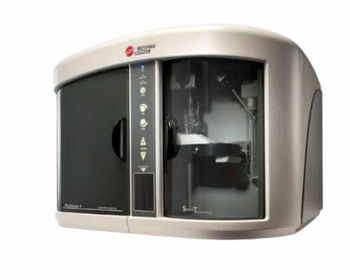
Beckman Coulter Multisizer 4
 Beckman Coulter · Model Multisizer 4
Increased dynamic range over MS3 Increased resolution over MS3 Quality assurance friendly Digital Pulse Processor (DPP) Dynamic size measurements Provides number, volume, mass and surface area size distributions in one measurement V-Check (IQ, OQ, PQ) instrument validation.
Key tips
- ·When no category-specific guidance fits, default to the manufacturer's own service manual and the general troubleshooting method in the Engineer's Guide.
- ·Run an incoming and annual electrical safety test regardless of how niche the device is.
Typical Failure Modes
Compiled for this model from its own documentation and established engineering knowledge for this equipment class - not from a verified service record. Confirm against the manufacturer's service manual.
Out of calibration / accuracy suspect
HighSymptoms: Readings disagree with a reference standard, verification check outside tolerance.
Root cause: Normal drift - the instrument needs its scheduled factory / accredited calibration (at least every 12 months).
Will not power on / battery fault
MediumSymptoms: Dead unit, short battery life, will not charge.
Root cause: Depleted or aged battery, or a power / charger fault.
Test lead / probe / adapter fault
MediumSymptoms: Open or intermittent readings, connection errors, a specific function fails.
Root cause: Worn or broken test leads, mains adapters, patient-lead adapters, or a sensor cable.
A measurement / simulation function fails
MediumSymptoms: One parameter (leakage, insulation, ECG / SpO2 / IBP simulation, defib / pacer energy, ventilator flow / pressure, light / dose) errors or is out of range while others work.
Root cause: An internal source / measurement circuit fault on that channel.
PC / software communication fault
LowSymptoms: The automation / logging software will not connect.
Root cause: USB cable / port or driver.
Serviceable Parts & Consumables
Serviceable items for this model, compiled from its documentation and engineering knowledge for this equipment class. Service class and relative cost are estimates, not manufacturer figures; no part numbers are given. Confirm intervals and pricing against the manufacturer.
Test-lead / adapter set
Class Periodic replacementRel. cost $$R&R Easy
Battery
Class Periodic replacementRel. cost $$R&R Easy
Calibration (factory / accredited)
At least every 12 months per the manufacturer.
Class Frequent wear itemRel. cost $$R&R Easy
Communication cable
Class Periodic replacementRel. cost $R&R Easy
| Part | Service class | Relative cost | R&R difficulty |
|---|---|---|---|
| Test-lead / adapter set | Periodic replacement | $$ | Easy |
| Battery | Periodic replacement | $$ | Easy |
| Calibration (factory / accredited) At least every 12 months per the manufacturer. | Frequent wear item | $$ | Easy |
| Communication cable | Periodic replacement | $ | Easy |
Relative cost: $ lowest · $$$$ highest service-part cost for this equipment class. Not a price.
PM Checklist
Preventive-maintenance tasks typical of this equipment class. Perform to the manufacturer's procedure and your facility's policy - this is general reference, not a schedule for this specific unit.
- ·Follow the manufacturer's PM schedule
- ·Perform incoming and annual electrical safety testing per facility biomedical program
Troubleshooting Approach
A starting sequence for this model, compiled from its documentation and engineering knowledge for this equipment class. Follow the manufacturer's service documentation for the actual procedure.
Symptom: Accuracy suspect / verification fails
- Confirm the calibration is within date.
- Verify against a known reference (a decade box, a reference meter, a second analyzer).
- Check the test leads / adapters for damage and reseat them.
- If a single function is out, note it for the calibration lab.
- Send the unit for its scheduled calibration if it is due or fails verification.
Symptom: A function fails or will not power on
- Fit fresh batteries / confirm the charger.
- Swap in a known-good lead / adapter set.
- Test the failing function into a known load / source.
- Update the firmware if available.
- Return the unit for a persistent internal fault.
Typical Location
Where this class of equipment is typically deployed - general reference, not this unit's own placement record.
- Varies by device - check the unit's own manual for facility placement guidance
Documents & Manuals
No documents available for this device yet.
Safety & Recalls
Synced live from the FDA openFDA API.
- RECALL
Bicarbonate reagent may generate falsely high Bicarbonate results due to interference with Lactate Dehydrogenase (LDH) in the test sample.
- RECALL
LIH Influence check settings for Lipemia are incorrect which may result patient samples being reported as false low results or cause a high result to report as normal
- RECALL
Beckman Coulter has become aware that the cannula, which is found in the Flowcell and the iQClear Rinse Waste Well Assembly, may rust. Rust from the cannula has the potential to generate erroneous results.
- RECALL
Lipemic interference failed to meet the performance specification listed within the IFU.
- RECALL
A software defect in the DxA Automation System may cause tests to be run on patient samples in tube types not compatible with the requested test, leading to erroneous patient results
- RECALL
There is a potential for a decrease in calibration ODs for Bicarbonate reagent which could result in calibration failures and/or quality control failures.
- RECALL
Beckman Coulter has become aware of an increase in customer complaints generated for intermittent IRISpec CB glucose control false positive results when used in conjunction with iChemVelocity Urine Chemistry Strips PN 800-7212
- RECALL
Potential exposure to biohazard. Software design problem causes excess speed and vibrations in the unload arm movement which causes caused sample splashing.
- RECALL
Compatibility issue between the software and Microsoft updates to Windows 7, 8, and 10. The compatibility issue causes the software to be unusable which could result in a delay of reporting results.
- RECALL
NAPQI, a metabolite of Acetaminophen, causes negative interference with the recalled product assays at levels present in the serum/plasma of overdose patients.
- RECALL
Sorting-Drive software version 4.2 (released in October 2015) introduced a new option for iPAW and the Sorting-Drive Client that is used for manual printing of barcodes. Sorting Drive software version 4.2 was replaced by 4.2.1 (both versions contain the same option for manual barcode printing). When printing consecutively numbered tube labels using this optional Barcode Counter function, the system incorrectly converts numbers with consecutive multiple zeroes in the middle, potentially leading to wrong barcode IDs. The firm reports this does not affect automated label creation or reprinting of individual labels and that no other system functions are affected.
- RECALL
Beckman Coulter has identified that Dipyrone (Metamizole) may cause erroneous, false low results in the following assays: Cholesterol OSR6X16, Triglyceride OSR6X118, Uric Acid OSR6X98, Lactate OSR6X93, and Lipase OSR6X30.
- RECALL
N-Acetyl Cysteine (NAC), when administered in therapeutic concentrations for the treatment of acetaminophen overdose, interferes with the assays for these analytes: Cholesterol OSR6X16, Uric Acid OSR6X98, Lactate OSR6X93, and Lipase OSR6X30. NAC interference may lead to falsely low results.
- RECALL
Beckman Coulter is including additional information and instructions in the Creatinine (OSR6x78) IFU and Setting Sheet, relating to calibration stability and quality control frequency to assure product performance.
- RECALL
The recall was initiated because patient results are falsely elevated by approximately 30% because the reference standard of the Manual Inhibin A ELISA assay has shifted from the assays original calibration. Erroneously elevated results may lead to unnecessary ultrasound testing to confirm gestational age, patient psychological stress until diagnostic testing is completed, and/or medical decis
- RECALL
The recall was initiated because Beckman Coulter has identified a problem with two lots of HbA1c APT reagent OSR61177. When HbA1c APT reagent lots 9390 and 9472 are calibrated with HbA1c calibrator ODR3032, elevated recovery may be observed for patient samples. Falsely elevated HbA1c values may be interpreted as increased risk for diabetes or poorly controlled diabetes. Consequent medical acti
- RECALL
Sporadic absolute count recovery failures with assayed control cell products when using Lot Number 754801F of the Flow-Count Fluorospheres. Additionally, this lot has experienced secondary fluorescent populations containing more than 20% of the total population, as stated in the Evidence of Deterioration section of the Package Insert.
Related calculators
From BioLab, for work done with this kind of equipment.
Troubleshoot this device with Bio
Describe a symptom or error code. Bio answers from this device's own documented error codes, failure modes, parts, and guides.
Ask Bio