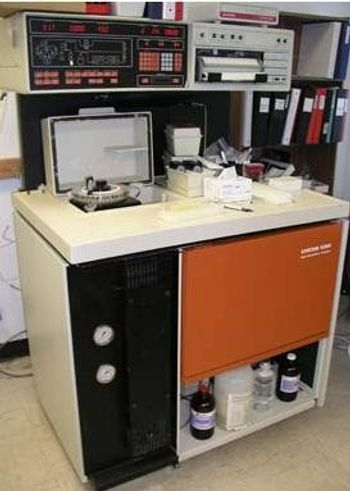
Beckman Coulter 6300 Amino Acid Analyzer
 Beckman Coulter · Model 6300 Amino Acid Analyzer
Repeatable analysis of complex mixtures even in the presence of salts, sugars, and fats. Dual channel colorimeter detects primary and secondary amino acids (440 nm and 570 nm). Sandwich loading method allows 100% of sample applied to column. Minimal reagent consumption due to microbore column design-only 20ml/hr buffer consumption, 10ml/h reagent consumption.
Key tips
- ·Run QC controls before trusting any repair - an analyzer that passes self-test can still report clinically wrong results.
- ·Rule out a reagent lot change before opening the instrument - it can look exactly like a hardware fault.
- ·Centrifuge rotors have a hard retirement age/cycle limit regardless of visible condition - don't eyeball it.
Typical Failure Modes
Compiled for this model from its own documentation and established engineering knowledge for this equipment class - not from a verified service record. Confirm against the manufacturer's service manual.
Will not power on or unexpected shutdown
HighSymptoms: The laboratory & diagnostics is dead, reboots, or shuts down mid-use.
Root cause: Mains lead / fuse, an aged battery, or a power-supply board fault.
Battery will not hold charge
MediumSymptoms: Short run time on battery; low-battery alarm soon after a full charge.
Root cause: Aged rechargeable battery pack or a charger fault.
Display / control-panel fault
MediumSymptoms: Blank, dim or distorted display; unresponsive keys or touchscreen.
Root cause: Display, backlight, or control-board fault.
Fails self-test or calibration
MediumSymptoms: Power-on self-test or the scheduled performance check fails or is out of tolerance.
Root cause: Sensor drift or an internal board fault; recalibration or repair needed.
Serviceable Parts & Consumables
Serviceable items for this model, compiled from its documentation and engineering knowledge for this equipment class. Service class and relative cost are estimates, not manufacturer figures; no part numbers are given. Confirm intervals and pricing against the manufacturer.
Rechargeable battery pack
Class Periodic replacementRel. cost $$R&R Fairly easy
Power supply / mains board
Class Major service partRel. cost $$$R&R Difficult
Display / control-panel assembly
Class Major service partRel. cost $$$R&R Moderate
Cooling fan
Class Major service partRel. cost $R&R Moderate
| Part | Service class | Relative cost | R&R difficulty |
|---|---|---|---|
| Rechargeable battery pack | Periodic replacement | $$ | Fairly easy |
| Power supply / mains board | Major service part | $$$ | Difficult |
| Display / control-panel assembly | Major service part | $$$ | Moderate |
| Cooling fan | Major service part | $ | Moderate |
Relative cost: $ lowest · $$$$ highest service-part cost for this equipment class. Not a price.
PM Checklist
Preventive-maintenance tasks typical of this equipment class. Perform to the manufacturer's procedure and your facility's policy - this is general reference, not a schedule for this specific unit.
- ·Daily QC controls run and reviewed
- ·Calibration verification per assay
- ·Routine cleaning and decontamination
- ·Scheduled reagent-path and pump-tubing maintenance
Troubleshooting Approach
A starting sequence for this model, compiled from its documentation and engineering knowledge for this equipment class. Follow the manufacturer's service documentation for the actual procedure.
Symptom: Will not power on
- Confirm the outlet, mains lead and fuse.
- Try on battery, then on mains only, to isolate the supply.
- Look for a power indicator or POST code.
- Replace the fuse / battery / power supply as isolated.
- Run the self-test after any repair.
Symptom: Fails self-test or calibration
- Note the exact failure message / code.
- Power-cycle and repeat the self-test.
- Verify against a reference / simulator where one applies.
- Recalibrate per the service manual.
- Refer the affected board for service if it will not hold calibration.
Typical Location
Where this class of equipment is typically deployed - general reference, not this unit's own placement record.
- Central / core laboratory
- Point-of-care testing stations
- Blood bank
- Microbiology lab
Documents & Manuals
No documents available for this device yet.
Safety & Recalls
Synced live from the FDA openFDA API.
- RECALL
Beckman Coulter identified that an issue for Access 2 Sample Motors (B48016) due to improper alignment, causing the motors to rub against the sample wheelbase plate and index sensor. The issue was traced to a worn tool used in production (at the supplier), affecting Access 2 sample motors. This could lead to a potential delay in reporting patient test results.
- RECALL
Beckman Coulter, Inc. has identified a rise in reagent carousel motion errors in Access 2 Immunoassay System Analyzers that appear to be caused by misaligned index wheels housed within the reagent carousel module. Customers affected by this issue may observe an increase in reagent carousel motion errors or QSMC errors that occur while unloading or loading reagent packs during system initialization and sample processing, which causes a non-operational system status and cancels tests; and patient results may be delayed if these errors cancel test processing.
- RECALL
An increased incidence of damage to the nut band from a new vendor (Boamax) has led to an increased volume of complaints from consignees regarding wash arm motion failures, system check failures, and/or assay performance leading to a remote probability of delayed results or reporting erroneous patient results. The subject nut bands were found to not meet the firm's specifications for hardness and had the incorrect material grain direction. Affected instruments were manufactured from December 28, 2017 to October 19, 2022 or had their nut bands replaced during the same period.
- RECALL
Beckman Coulter has become aware of an issue affecting Specific Gravity chemistry settings for the iChemVELOCITY Urine Chemistry System that prevents the trigger of a chemistry system flag S3 and may result in erroneous Specific Gravity (SG) results.
- RECALL
It has been determined that N-acetyl p benzoquinone imine (NAPQI), a metabolite of acetaminophen (paracetamol), may cause negative interference for assays if present in high quantities in serum due to acetaminophen overdoese. This could result in a delay in diagnosis and treatment.
- RECALL
The device may process the same sample with two different sample IDs and sample information while using the single tube loader, which has the potential for erroneous results due to the mis-identification.
- RECALL
Beckman Coulter has identified the following drugs as potential sources of interference: Metamizole (Dipyrone), Sulfasalazine, and Sulfapyridine and may result in false low results.
- RECALL
Beckman Coulter is recalling the Rack ID Labels because the Rack ID number displayed and the Rack ID barcode label do not match.
- RECALL
The probe misalignment or bending has the potential to lead to delay in reporting results or incorrect patient results.
- RECALL
The Access 2 Immunoassay System Analyzer and the UniCel DxI 600 Access may have been manufactured with non-conforming bushings. Non-conforming bushings have a remote probability of generating incorrect results.
- RECALL
Beckman Coulter is recalling the LH 750 and LH 780 Hematology Systems because the optical degradation may potentially cause a delay in reporting results for nucleated red blood cells (nRBC), white blood cell differential and/or reticulocytes.
- RECALL
The check valves may fail on the Coulter LH 750 Hematology Analyzer (PN 6605632 and A85570) and Coulter LH 780 Hematology Analyzer (PN 723585 and A90728). A failure may result in an air or liquid leak at the connection to the Vacuum Overflow Tank waste line or at the Backwash Tank drain line.
- RECALL
The recall was initiated because Beckman Coulter has confirmed that some AU Clinical Chemistry Analyzer ISE units can experience premature ISE REF (Reference) valve failure. Premature valve failure can be detected by the presence of air bubbles in the ISE REF solution tubing on the ISE unit. If air bubbles are present, accuracy of the ISE test results may be affected.
- RECALL
The recall was initiated because Beckman Coulter has identified a software error on AU5800 analyzers with the Automation Ready (AR) Sampler Kit. This software error results in the failure of the concentrated wash solution pump to stop, creating an overflow or leak on each analyzer unit.
- RECALL
Beckman Coulter is recalling AU2700/AU2700 Plus & AU5400 Clinical Chemistry Analyzers becuase it was determined that the tubing/joint connections associated with these MODs may leak concentrated detergent. Beckman Coulter has received complaints that the joint connecting the tubing appears to disintegrate over time, causing a leak.
- RECALL
Beckman Coulter, Inc. initiated this recall because there is a software error that has the potential to cause the reporting of erroneous patient results because of misidentification by the AU5800 system.
- RECALL
Due to a software data storage limitation which only occurs under certain conditions, measurements of the Reagent Blank (RB) or Calibration (CAL) sample results are not saved and the software reverts to a previously stored, acceptable RB/CAL result.
- RECALL
Beckman Coulter is recalling the AU8500 Clinical Chemistry Analyzer because there is no labeling on the diluted detergent tank to show the proper disposition of the on/off valve.
- RECALL
Beckman Coulter is recalling the Access Folate Calibrators because it may produce falsely elevated results that could mask a folate deficiency.
- RECALL
The recall was initiated because Beckman Coulter has confirmed that the Auto Stop and Auto Transmit features for Quality Control become disabled after scanning assay values from Coulter 5C and Retic-C Cell Controls assay sheets using the 2D Barcode scanner.
- RECALL
This recall was initiated because Beckman Coulter identified a problem with some date fields that are transmitted to the Laboratory Information System (LIS). Starting Jan 1, 2011, the date fields will transmit as a blank field to the LIS if the year is greater than 2010. The following dates are affected: Run date, Control expiration date, Date of birth (For individuals born in 2011 or later), a
- RECALL
The recall was initiated because Beckman Coulter has confirmed the Coulter MAXM, MAXM AL, HmX and HmX AL Analyzers omit the tilde (~) character when the tilde is used as part of the Sample 10 within a barcode label scanned by the primary mode barcode reader. There is a potential for Specimen or Patient misidentification to occur.
- RECALL
The recall was initiated because Beckman Coulter has confirmed an Immage Systems Wash Solution Lot 71744 was manufactured by a Beckman European facility and not intended to be used in the U.S. However, this lot was inadvertently shipped to the U.S. and delivered to five customers.
- RECALL
The recall was initiated because Beckman has confirmed that the AU Clinical Chemistry Analyzers may experience cuvette overflow.
- RECALL
Patient Mis-identification can occur: 1)- When a positive identifier (Sample ID or Cassette/Position) is manually edited to a positive identifier that is already in the To Do list. The workstation will accept the entry and no error message will be generated, creating 2 samples with the identical positive identifier. 2)- When manually entering a Patient ID, if a blank space is entered between th
- RECALL
Beckman has confirmed that erroneous results could be reported when the workstation database crashes.
- RECALL
A rare risk of sample misidentification exists with Coulter LH 750 Hematology Analyzers. The printout results from the instrument are affected; however, the results stored in the workstation's database are not affected.
- RECALL
Erroneous results issue when MONOJECT blood collection tubes are used during analysis after tubes are uncapped and recapped then analysed in the closed vial mode. Results are lower than if cap had not been removed.
- RECALL
A rare condition of the Access 2 Immunoassay Systems software versions 2.0, 2.1 and 2.2 could present a risk of an erroneous confirmatory result under a specific set of circumstances. The Chlamydia Blocking results may be affected. The instrument will erroneously perform the blocking calculation on the affected test by using the mean of the diluted and neat results.
- RECALL
Beckman Coulter has confirmed an issue associated with the predilute mode of the COULTER LH 500 Hematology Analyzer. The workstation may display, transmit, and / or print an erroneous result or an incorrect dilution factor with a predilute sample result.
- RECALL
If a customer enters a dilution factor for Sample B prior to the results from Sample A being transfered to the workstation, the predilute multiplication factor will be applied erroneously to the Sample A's results once they are received at the workstation.
- RECALL
Spring failure, design defect in component.
- RECALL
Failure to cycle properly ammong samples.
Troubleshoot this device with Bio
Describe a symptom or error code. Bio answers from this device's own documented error codes, failure modes, parts, and guides.
Ask Bio