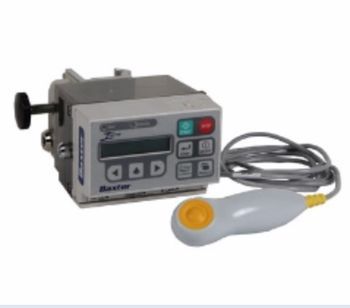
Baxter I pump
 Baxter International · Model I pump
Program for epidural, IV, or subcutaneous delivery Delivers continuous, Basal + PCA, or PCA infusions Set dosing limits based on clinical preferences, e.g., one or four-hour volume limits and maximum PCA (patient-controlled analgesia) doses per hour Specify PCA dose delay time options in one-minute intervals up to 240 minutes Control flow rates in 0.1 mL/hour increments for maximum flexibility – with continuous flow rates up to 90 mL/hour.
Key tips
- ·Free-flow protection must be verified on every PM - a failed anti-free-flow clamp is a direct overdose risk.
- ·Test occlusion alarms in both directions - failing to alarm when it should is more dangerous than a false alarm.
- ·Battery run-time complaints are the most common real-world nuisance call - a full charge/discharge cycle test catches most of them.
Typical Failure Modes
Compiled for this model from its own documentation and established engineering knowledge for this equipment class - not from a verified service record. Confirm against the manufacturer's service manual.
Failure / error message stops delivery
HighSymptoms: The pump alarms and displays an error message / code and stops.
Root cause: A subsystem fault indexed in the service manual - motor / drive, a sensor, set-detection, or a board.
Occlusion alarm / pressure fault
MediumSymptoms: Repeated occlusion alarms, delivery stops, or an occlusion is missed.
Root cause: Kinked or clamped line, a closed roller clamp, a positional patient tube, pressure-sensor drift, or an improperly loaded set.
Air-in-line alarm
MediumSymptoms: Frequent air-in-line alarms, delivery stops.
Root cause: Air in the set, an improperly loaded set, or an ultrasonic air-detector fault.
Flow-rate accuracy drift
MediumSymptoms: Delivered volume outside tolerance on the annual test, especially at low rates.
Root cause: Worn pumping mechanism / plunger drive.
Battery will not hold charge
MediumSymptoms: Short run time, low-battery early after a full charge.
Root cause: Aged battery pack.
Door / plunger / sensor mechanical wear
LowSymptoms: Set will not load, door will not latch, plunger grip poor.
Root cause: Worn door latch, plunger jaws, or anti-free-flow mechanism.
Serviceable Parts & Consumables
Serviceable items for this model, compiled from its documentation and engineering knowledge for this equipment class. Service class and relative cost are estimates, not manufacturer figures; no part numbers are given. Confirm intervals and pricing against the manufacturer.
Battery pack
Class Periodic replacementRel. cost $$R&R Fairly easy
Pumping mechanism / rotor / plunger drive
Class Major service partRel. cost $$$R&R Difficult
Pressure / air-detector sensor assembly
Class Major service partRel. cost $$R&R Moderate
Door / latch / anti-free-flow assembly
Class Major service partRel. cost $$R&R Moderate
Drive motor / gearbox
Class Major service partRel. cost $$$R&R Difficult
| Part | Service class | Relative cost | R&R difficulty |
|---|---|---|---|
| Battery pack | Periodic replacement | $$ | Fairly easy |
| Pumping mechanism / rotor / plunger drive | Major service part | $$$ | Difficult |
| Pressure / air-detector sensor assembly | Major service part | $$ | Moderate |
| Door / latch / anti-free-flow assembly | Major service part | $$ | Moderate |
| Drive motor / gearbox | Major service part | $$$ | Difficult |
Relative cost: $ lowest · $$$$ highest service-part cost for this equipment class. Not a price.
PM Checklist
Preventive-maintenance tasks typical of this equipment class. Perform to the manufacturer's procedure and your facility's policy - this is general reference, not a schedule for this specific unit.
- ·Occlusion pressure and flow-rate accuracy verification
- ·Battery conditioning cycle
- ·Door latch and air-in-line sensor inspection
- ·Post-drop functional check before return to service
- ·Annual PM per manufacturer schedule
Troubleshooting Approach
A starting sequence for this model, compiled from its documentation and engineering knowledge for this equipment class. Follow the manufacturer's service documentation for the actual procedure.
Symptom: Error message or code
- Note the exact error message / code.
- Look it up in the pump's technical service manual troubleshooting section.
- Use the biomed diagnostics / utilities to test the affected subsystem.
- Follow the manual's parts-replacement procedure.
- Run the scheduled-maintenance test set (including flow accuracy) after any repair.
Symptom: Occlusion or delivery problem
- Check the line for kinks, clamps and a closed roller clamp; check the patient site.
- Reload the set correctly, clearing all air.
- Confirm an approved set for this pump.
- Run the pressure / air-detector (or rotor) test in diagnostics.
- Replace the set; refer the pump if a sensor / mechanism fault is indicated.
Typical Location
Where this class of equipment is typically deployed - general reference, not this unit's own placement record.
- Patient care floors
- ICU
- OR
- Oncology / infusion centers
- Home health (portable pumps)
Documents & Manuals
No documents available for this device yet.
Safety & Recalls
Synced live from the FDA openFDA API.
- RECALL
A software issue that may occur during a Volume/Time (VOT) multi-syringe infusion when a syringe reaches empty and is replaced while a Volume To Be Infused (VTBI) remains.
- RECALL
Pumps were released without full testing being performed, including occlusion alarm testing.
- RECALL
Certain pumps have potentially been released from service with defective grease applied to the cam and motor gears. Due to its low viscosity, the defective grease may lead to the device having insufficient lubrication on the cam, which could lead to premature wear of the mechanism assembly, resulting in over-infusion or a free-flow situation.
- RECALL
Baxter Healthcare Corporation is issuing an Urgent Medical Device Correction for the Novum IQ Large Volume Pump (LVP) and Novum IQ Syringe Pump (SP) due to software anomalies that may result in a blank Run screen (LVP and SP) and/or false motor movement system error (SP only).
- RECALL
Baxter is issuing an Urgent Medical Device Correction for the Novum IQ large volume pump (LVP) due to the potential for underinfusion when transitioning from a flow rate to a higher flow rate that is more than double. (e.g., rate change or bolus). The level of underinfusion is variable based on the current infusion rate, the duration the pump has been running at this flow rate, and the magnitude of the rate change. The longer the duration the pump has been running at the current infusion rate and the larger the magnitude of the rate change, the larger the underinfusion that would be experienced. Additionally, Baxter has identified an increase in customer reports of over and underinfusion potentially due to set misloading. Failure to properly load the tubing into the pump channel may result in the pump infusing at a rate higher or lower than programmed. Consistent with the instructions
- RECALL
Baxter has identified that certain pumps have potentially been released with the grease applied to the cam and motor gears that will break down quickly. The breakdown of the grease will lead to the device having insufficient or ineffective grease applied to the cam, which could lead to premature wear of the mechanism assembly, resulting in excessive therapy.
- RECALL
Certain Spectrum infusion pumps may have an incorrect version of software.
- RECALL
Baxter has identified a design issue which may cause the pump to detect the presence of a syringe flange when no syringe is loaded. When this issue occurs, the pumps 'user interface becomes stuck on the "Remove Syringe" screen when an infusion is complete, and the syringe is unloaded. A System Error 21502 (Flange Sensor Failure) may occur. Please note this issue only affects a subset of Novum IQ syringe pumps manufactured or repaired after July 4, 2023.
- RECALL
Devices were identified as released after repair without full testing being performed, which includes flow testing.
- RECALL
The Spectrum WBM may fail to auto-document infusion status information back to the hospital's Electronic Medical Record (EMR) system. This software issue only impacts customers where the Spectrum V8 or Spectrum IQ infusion system is integrated with the hospital s EMR system.
- RECALL
Improperly performed testing prior to release
- RECALL
There is a potential for cracks on the mount of the front panel of the device.
- RECALL
One device was improperly performed testing prior to release from a Service Center.
- RECALL
A medical device correction is being issued for SIGMA Spectrum Infusion System (V8 Platform) and Spectrum IQ Infusion System with Dose IQ Safety Software infusion pumps due to an increase in reported false upstream occlusion alarms following upgrades to software versions v8.01.01 and v9.02.01.
- RECALL
Software issue: The defect creates a mismatch between linked drug identifiers (IDs) in the Dose IQ user interface (UI) and the binary drug library (BDL) loaded onto the Spectrum IQ pump.
- RECALL
Potentially defective component in the AC power adapter which may fail over time.
- RECALL
Variability in the performance of the tubing in the ARPS (Automatic Repositioning System) Pump Assembly which may lead to alarm situations during system self-test and therapy. This tubing is normally replaced during annual preventative maintenance. Alarm Situations: During System Self-Test: Alarm code B1215 (ARPS Self-Test failure); During Therapy: B1273 (ARPS Leak), B1215 (ARPS Pressure self-test), B1116 (Return Pressure self-test Failure), B1539 (Access Pod Reposition Failure), B1541 (Effluent Pod Reposition Failure), B1540 (Effluent Filter Pod Reposition Failure). If an alarm occurs, it may lead to delay or interruption of therapy. In the event that therapy is terminated without returning blood to the patient, blood loss may occur.
- RECALL
Battery performance issues related to prolonged storage.
- RECALL
There is a potential software error during programming.
- RECALL
Baxter is updating the device IFU for safety communication regarding cleaning practices.
- RECALL
The flow rate test verification was not properly executed for certain Sigma Spectrum infusion pumps prior to release. The testing was performed for less than the required minimum run time. Improperly performed flow rate testing may not identify issues with pumps that could cause inaccuracies in flow rates which, in turn, could lead to over- or under- infusion. Potential risk to the patient depends on a number of factors including treatment and patient comorbidities. Depending on these factors, the patient could experience serious adverse health consequences.
- RECALL
The firm will be updating the Instructions for Use for the product. Current IFUs instruct users to lower the primary bag 20 inches below the secondary bag using a hanger when performing a secondary infusion. However, the firm supplies 12.5-inch hangers with the Baxter disposable secondary sets.
- RECALL
Service technician improperly documented final release testing on product, indicating that the full battery of release tests were performed when, in fact, several tests were omitted. he omitted tests include air-in-line detection at 400ml/hr and 800ml/hr and verification of upstream occlusion detection at 800ml/hr. Improper detection of air-in-line or upstream occlusion may result in serious adverse health consequences.
- RECALL
Certain infusion pumps may exhibit excessive wear of the pumping mechanism caused by a lack of lubrication, this could affect the occlusion of the tubing and result in over- or under-infusion.
- RECALL
SIGMA Spectrum Infusion Pumps with Master Drug Library, Software V8.00.02 contains an anomaly that may cause a Sharp Watchdog Timeout error message. Specifically, the software anomaly causes the error message only under conditions in which a message is being written to the Spectrum Infusion Pumps Event History Log (EHL), and the length of that message exactly matches the size of the available memory at the end of a memory sector. For this reason, the issue is significantly more likely to manifest when poor network maintenance results in high volumes of messages being written to the EHL.
- RECALL
A correction was issued for the SIGMA Spectrum Infusion Pump with Master Drug Library in order to replace speakers installed in pumps or included in spare part rear case assemblies that have an increased potential to fail prematurely.
- RECALL
Baxter Healthcare Corporation is issuing a voluntary product recall for all unexpired lots of the 50mm 0.2 Micron Filter (Product Code: H93835) due to the potential for the filter membrane layer to be missing and for particulate matter to be present.
- RECALL
Loading/Bolus default dose settings in the Master Drug Library and the values shown on the pump during programming may differ. MDL drug dose time in seconds will round to the nearest integer in minutes on the pump dose setup screen (20 sec may show as 1 min on the pump display). The pump will administer drugs as configured. The discrepancy may cause therapy delay or unintended rate of delivery.
- RECALL
One Service Technician may not have correctly serviced specific Sigma Spectrum Infusion Pumps according to established procedures during the time period of 5/5/2014 through 6/3/2014.
- RECALL
Baxter Healthcare Corporation has issued an Urgent Device Correction for the SIGMA SPECTRUM Volumetric Infusion Pump with Master Drug Library due to repeated System Error 322 occurrences.
- RECALL
Baxter Healthcare Corporation is recalling the LCD display screen on the SIGMA SPECTRUM Infusion Pump with Master Drug Library for not meeting standards for withstanding an electrostatic discharge.
- RECALL
Baxter Healthcare Corporation issued an Urgent Device Correction for the SIGMA SPECTRUM Infusion Pump with Master Drug Drug Library due to reports of upstream occlusion alarms and air-in-line alarms occurring during infusions.
- RECALL
Due to an increase in complaints for leaks at the distal male Luer and Luer cap. Baxter implemented enhancements to the blue winged cap to improve the seal between the cap and the Luer.
- RECALL
Recall expansion; the infusion pumps have the potential to fail causing inaccurate flow conditions during use. These conditions range from back flow to free flow, which could result in over-infusion. Sigma's evaluation of subsequent complaints involving failed bearings indicated that the loss or degradation of bearing lubricant to be a more significant contributor to bearing failure than initially believed. Based upon the results of the analysis of these additional failures, Sigma determined that any bearings prior to the latest, improved design may be at risk for failure. Sigma decided to expand the recall of the Spectrum Infusion Pumps to include units manufactured from 1/18/2005 through 11/01/2010.
- RECALL
Should a battery with the minimum contact diameter (.51 inches) be placed on the battery spring (.53 inches), an electrical circuit will not be completed and the InfusOR will not operate. The reason being that the InfusOR (2L3100) Battery Spring has a flat contact that measures .53 inches .01 inches on the inner diameter of the spring coil. The IEC 60086-2 and ANSI 08 standards specify a minimum
- RECALL
The FloGard Infusion Pump was released from service without having the Current Leakage test performed. This could lead to the patient/user to receive an electrical shock.
- RECALL
Non-conforming Electrostatic Discharge (ESD) grounding squares may cause the pump to be susceptible to shorting-out of circuitry, resulting in a loss of audio, and/or interruption of therapy.
- RECALL
The occlusion detection and alarm may be delayed when the pumps are used with larger volume syringes at low flow rates.
- RECALL
A non-conforming gasket was used in manufacturing of the specific pumps, causing the pumps to be more susceptible to electro-static discharge, which could increase the potential for the pump to fail during use and alarm.
- RECALL
Delivery of unrequested PCA doses of medication due to damaged PCA cords, partial sticking of PCA button, and fluid ingress into the pump or PCA button.
- RECALL
Advisory to alert users to assure that the hemofilter of the blood line is in the horizontal position to avoid kinking of the bloodline tubing to avoid hemolysis, and to show the compatible blood tubing sets to be used with the BM11/BM11A Blood Monitor Pump and BM25 System ultrafiltration hemodialysis system.
- RECALL
Failures within the PCA profile as well as incidents resulting in interruptions of therapy in various profiles.
- RECALL
Possible shorting of some printed circuit boards could result in a possible interruption of therapy or cause the pump to fail the Power-On Self Test.
- RECALL
When infusing at flow rates below 0.5 mL/hr, the upstream occlusion alarm of the pumps may not detect the occlusion.
- RECALL
During an infusion in the 'Basal + PCA' or 'PCA only' modes, the SYNDEO pump may generate false Service Code 919 or Service Code 920, which will cause the pump to stop the infusion. Also, while attempting to turn on the device by pressing the On/Off key, the pump may not power up properly.
- RECALL
There is an overinfusion condition in the Intermittent mode where the pump may continue to deliver at the higher dose rate instead of switching to the lower keep open rate once the first dose is completed.
- RECALL
A 'Check Flange' alarm may occur even though the syringe has been properly loaded into the AS50 Infusion Pump. The false alarm may occur during the syringe loading process or while an infusion is running. Also, the occlusion detection and alarm may be delayed when the pumps are used with larger volume syringes at low flow rates.
- RECALL
Potential failures of the pump due to upstream occlusion alarms, electro-static discharge, system error 32 or 33, history printout errors and fluid volume in 'Use Previous Rx' when priming through the pump.
- RECALL
The pump may free-flow if the door to the 6060 pump is not closed prior to loading the pump in to the lock box. The pump will alarm 'Door Open', but if the pump is turned off to silence the alarm while remaining in the lock box, the fluid will free-flow.
- RECALL
Premature motor failure.
- RECALL
Leakage may occur at the inlet port
- RECALL
The I.V. filter sets contain a 1.2 micron filter instead of the labeled 0.22 micron filter.
Related calculators
From BioLab, for work done with this kind of equipment.
Troubleshoot this device with Bio
Describe a symptom or error code. Bio answers from this device's own documented error codes, failure modes, parts, and guides.
Ask Bio