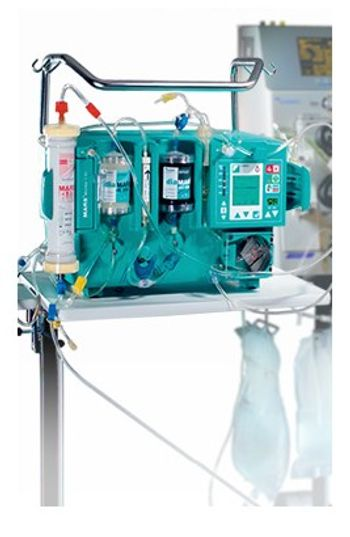
Baxter Gambro MARS System
 Baxter International · Model Gambro MARS System
Enhanced blood purification for the treatment of Hepatic Encephalopathy due to a decompensation of chronic liver disease, as well as drug overdose and poisonings. The Molecular Adsorbent Recirculating System (MARS) uses adsorber cartridges to remove drugs and toxins with an affinity for albumin. When combined with a Continuous Renal Replacement Therapy (CRRT) system, the MARS circuit expands the ability of the CRRT treatment to simultaneously remove not only water-soluble substances, but albumin-bound (lipophilic) substances as well. The blood in the extracorporeal circuit is pumped through the specialized MARS FLUX filter on the MARS system. Then, protein-bound and water-soluble substances pass through the membrane by diffusion and convection into the albumin-enriched dialysate. Next, the albumin dialysate passes through the Prisma® system diaFLUX filter to remove water-soluble substances, and continues through the MARS adsorbers to remove the lipophilic substances (i.e. drugs and poisons) bound to the albumin molecules in the MARS circuit. The regenerated albumin dialysate returns through the MARSFLUX filter to repeat this process for the duration of the treatment. The MARS therapy is today the most widely used extracorporeal liver support therapy. This therapy has been in clinical use outside the United States since 1993 and commercially available since 1999. The MARS system is used in 45 countries around the world and its safety and efficacy have been demonstrated by clinical experience with more than 15,000 patients (about 45,000 treatments) who have benefited from its use. The MARS® device is cleared for use in the U.S. in the treatment of drug overdose and poisonings as well as hepatic encephalopathy (HE) due to a decompensation of a chronic liver disease. It is not indicated in the U.S. as a bridge to liver transplant.
Key tips
- ·Conductivity and water-quality checks are non-negotiable before every shift - dialysate chemistry errors are a direct patient-harm mechanism.
- ·Confirm disinfection cycle completion, never assume it, after every use.
- ·Treat a blood-leak detector fault as real until proven otherwise - never silence and continue.
Typical Failure Modes
Compiled for this model from its own documentation and established engineering knowledge for this equipment class - not from a verified service record. Confirm against the manufacturer's service manual.
Conductivity / temperature / dialysate-prep alarm
HighSymptoms: Conductivity or temperature out of range, dialysate-preparation alarm, treatment will not start.
Root cause: Concentrate connection / supply, a heater fault, a conductivity-cell fault, or a proportioning-pump / valve fault.
Blood or dialysate pump fault
MediumSymptoms: Pump will not run at set speed, occlusion or flow alarms, tubing walking in the raceway.
Root cause: Worn pump rotor / rollers or a motor / control fault.
Pressure-monitoring / air-detector fault
MediumSymptoms: Venous / arterial / TMP pressure implausible, air-detector false alarms or fails to detect.
Root cause: Transducer-protector wetting, a pressure-sensor fault, or an air-detector fault.
UF / balancing-chamber fault
MediumSymptoms: Fluid-balance / UF alarms, weight loss inaccurate, balancing-chamber leak.
Root cause: Balancing-chamber diaphragm / valve wear or a flow-sensor fault.
Disinfection / rinse fault
MediumSymptoms: Heat or chemical disinfection will not complete, residual disinfectant test fails.
Root cause: Heater, a dosing / rinse valve, or a conductivity-verification fault.
Serviceable Parts & Consumables
Serviceable items for this model, compiled from its documentation and engineering knowledge for this equipment class. Service class and relative cost are estimates, not manufacturer figures; no part numbers are given. Confirm intervals and pricing against the manufacturer.
Blood / dialysate pump rotor & rollers
Class Periodic replacementRel. cost $$R&R Moderate
Conductivity cell / temperature sensor
Class Periodic replacementRel. cost $$R&R Moderate
Pressure sensors / transducer protectors
Class Periodic replacementRel. cost $$R&R Fairly easy
Balancing-chamber diaphragm / valve kit
Class Periodic replacementRel. cost $$$R&R Difficult
Proportioning pump / valves
Class Major service partRel. cost $$$R&R Difficult
| Part | Service class | Relative cost | R&R difficulty |
|---|---|---|---|
| Blood / dialysate pump rotor & rollers | Periodic replacement | $$ | Moderate |
| Conductivity cell / temperature sensor | Periodic replacement | $$ | Moderate |
| Pressure sensors / transducer protectors | Periodic replacement | $$ | Fairly easy |
| Balancing-chamber diaphragm / valve kit | Periodic replacement | $$$ | Difficult |
| Proportioning pump / valves | Major service part | $$$ | Difficult |
Relative cost: $ lowest · $$$$ highest service-part cost for this equipment class. Not a price.
PM Checklist
Preventive-maintenance tasks typical of this equipment class. Perform to the manufacturer's procedure and your facility's policy - this is general reference, not a schedule for this specific unit.
- ·Disinfection cycle verification
- ·Conductivity and water-quality check
- ·Blood-leak detector test
- ·Scheduled tubing / filter replacement
- ·Annual full PM
Troubleshooting Approach
A starting sequence for this model, compiled from its documentation and engineering knowledge for this equipment class. Follow the manufacturer's service documentation for the actual procedure.
Symptom: Conductivity or temperature alarm
- Confirm the concentrate is connected, correct and not empty.
- Verify dialysate conductivity and temperature with independent calibrated meters.
- Check / calibrate the conductivity cell and temperature sensor.
- Inspect the proportioning pumps / valves and de-air the hydraulics.
- Do not treat until conductivity and temperature are verified in range.
Symptom: Pump or pressure fault
- Inspect the pump rotor and rollers for wear and correct occlusion.
- Reseat the tubing segment in the raceway.
- Check the pressure transducers and protectors for wetting.
- Calibrate the pressure channels.
- Replace the rotor / rollers or a faulty sensor as isolated.
Typical Location
Where this class of equipment is typically deployed - general reference, not this unit's own placement record.
- Dialysis unit / clinic
- ICU (acute dialysis)
- Home hemodialysis
Documents & Manuals
No documents available for this device yet.
Safety & Recalls
Synced live from the FDA openFDA API.
- RECALL
Baxter Healthcare will be installing new firmware on all Prismaflex control units to address the potential for a small number of these units to exhibit a failure mode with the pump module electronics. The failure mode may result in a Voltage Out of Range malfunction alarm, which causes the device to enter a safe state and become inoperable until it is serviced. Baxter will be releasing new firmware that will prevent the malfunction from occurring.
- RECALL
Baxter has received customer complaints regarding leakage in the albumin circuit. The leakage was caused by an inadequate adhesive connection of the tubing to the Hansen connector of the MARS Tube Set which is part of the MARS Treatment Kit.
Troubleshoot this device with Bio
Describe a symptom or error code. Bio answers from this device's own documented error codes, failure modes, parts, and guides.
Ask Bio