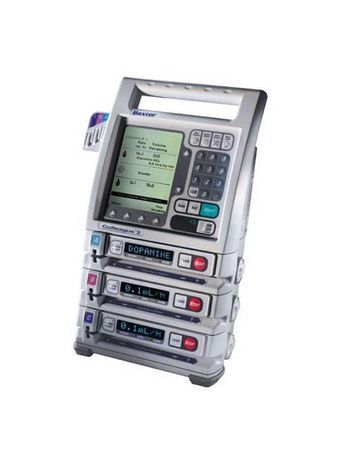
Baxter Colleague Triple Monochrome
 Baxter International · Model Colleague Triple Monochrome
The pump can be customized with selectable performance parameters for a diverse range of care sites and therapies.
Key tips
- ·Free-flow protection must be verified on every PM - a failed anti-free-flow clamp is a direct overdose risk.
- ·Test occlusion alarms in both directions - failing to alarm when it should is more dangerous than a false alarm.
- ·Battery run-time complaints are the most common real-world nuisance call - a full charge/discharge cycle test catches most of them.
Typical Failure Modes
Compiled for this model from its own documentation and established engineering knowledge for this equipment class - not from a verified service record. Confirm against the manufacturer's service manual.
Failure / error message stops delivery
HighSymptoms: The pump alarms and displays an error message / code and stops.
Root cause: A subsystem fault indexed in the service manual - motor / drive, a sensor, set-detection, or a board.
Occlusion alarm / pressure fault
MediumSymptoms: Repeated occlusion alarms, delivery stops, or an occlusion is missed.
Root cause: Kinked or clamped line, a closed roller clamp, a positional patient tube, pressure-sensor drift, or an improperly loaded set.
Air-in-line alarm
MediumSymptoms: Frequent air-in-line alarms, delivery stops.
Root cause: Air in the set, an improperly loaded set, or an ultrasonic air-detector fault.
Flow-rate accuracy drift
MediumSymptoms: Delivered volume outside tolerance on the annual test, especially at low rates.
Root cause: Worn pumping mechanism / plunger drive.
Battery will not hold charge
MediumSymptoms: Short run time, low-battery early after a full charge.
Root cause: Aged battery pack.
Door / plunger / sensor mechanical wear
LowSymptoms: Set will not load, door will not latch, plunger grip poor.
Root cause: Worn door latch, plunger jaws, or anti-free-flow mechanism.
Serviceable Parts & Consumables
Serviceable items for this model, compiled from its documentation and engineering knowledge for this equipment class. Service class and relative cost are estimates, not manufacturer figures; no part numbers are given. Confirm intervals and pricing against the manufacturer.
Battery pack
Class Periodic replacementRel. cost $$R&R Fairly easy
Pumping mechanism / rotor / plunger drive
Class Major service partRel. cost $$$R&R Difficult
Pressure / air-detector sensor assembly
Class Major service partRel. cost $$R&R Moderate
Door / latch / anti-free-flow assembly
Class Major service partRel. cost $$R&R Moderate
Drive motor / gearbox
Class Major service partRel. cost $$$R&R Difficult
| Part | Service class | Relative cost | R&R difficulty |
|---|---|---|---|
| Battery pack | Periodic replacement | $$ | Fairly easy |
| Pumping mechanism / rotor / plunger drive | Major service part | $$$ | Difficult |
| Pressure / air-detector sensor assembly | Major service part | $$ | Moderate |
| Door / latch / anti-free-flow assembly | Major service part | $$ | Moderate |
| Drive motor / gearbox | Major service part | $$$ | Difficult |
Relative cost: $ lowest · $$$$ highest service-part cost for this equipment class. Not a price.
PM Checklist
Preventive-maintenance tasks typical of this equipment class. Perform to the manufacturer's procedure and your facility's policy - this is general reference, not a schedule for this specific unit.
- ·Occlusion pressure and flow-rate accuracy verification
- ·Battery conditioning cycle
- ·Door latch and air-in-line sensor inspection
- ·Post-drop functional check before return to service
- ·Annual PM per manufacturer schedule
Troubleshooting Approach
A starting sequence for this model, compiled from its documentation and engineering knowledge for this equipment class. Follow the manufacturer's service documentation for the actual procedure.
Symptom: Error message or code
- Note the exact error message / code.
- Look it up in the pump's technical service manual troubleshooting section.
- Use the biomed diagnostics / utilities to test the affected subsystem.
- Follow the manual's parts-replacement procedure.
- Run the scheduled-maintenance test set (including flow accuracy) after any repair.
Symptom: Occlusion or delivery problem
- Check the line for kinks, clamps and a closed roller clamp; check the patient site.
- Reload the set correctly, clearing all air.
- Confirm an approved set for this pump.
- Run the pressure / air-detector (or rotor) test in diagnostics.
- Replace the set; refer the pump if a sensor / mechanism fault is indicated.
Typical Location
Where this class of equipment is typically deployed - general reference, not this unit's own placement record.
- Patient care floors
- ICU
- OR
- Oncology / infusion centers
- Home health (portable pumps)
Documents & Manuals
No documents available for this device yet.
Safety & Recalls
Synced live from the FDA openFDA API.
- RECALL
The Air In Line (AIL) test was not properly performed by the service technician at the Service Center.
- RECALL
The FDA sent a letter to Baxter on April 30, 2010, ordering the company to recall and destroy all models of its Colleague Volumetric Infusion Pumps currently in use in the United States. FDA determined that this action is necessary, as Baxter has failed to adequately correct, within a reasonable timeframe, the deficiencies in the Colleague pumps still in use. This recall is a consolidation of al
- RECALL
Baxter has identified failure codes that lead to an interruption of therapy, hazards associated with improper cleaning, and damaged battery messages for the Colleague Infusion Pumps.
- RECALL
Some of the pumps were upgraded by one service technician who failed to replace prisms and batteries as required in the upgrade.
- RECALL
A software anomaly is causing newly upgraded Colleague Triple Channel Infusion Pumps to alarm, display an error code (16:310:867:0002) and stop the infusion. This occurs during user programming with all three channels simultaneously infusing fluids. In reported cases, the pump stopped infusing and both an audible and a visual alarm notification were activated.
- RECALL
Baxter has identified the potential for a corruption of the memory chip in the pump to occur due to linear accelerator radiation exposure. If corruption occurs, it could result in an interruption of therapy with an audible and visual alarm notification to the user.
- RECALL
Interruption of therapy due to battery undercharging, the generation of air-in-line alarms due to IV administration set tugging, and gearbox wear; and underinfusion due to misalignment of the pump head components.
- RECALL
A hardware problem can cause internal communications errors which halt therapies, generate alarms and communication failure codes.
- RECALL
The pumps may experience inadvertent power off, external communications port failures and electronic pump failure codes 402, 403, 533, 535, 599, 810:04 and 810:11.
- RECALL
Swelling of the sealed lead-acid batteries in the infusion pump can cause internal pump damage, and excessive battery discharge can damage the batteries if the pump is left on battery power for an extended period of time after teh Battery Depleted alarm occurs.
- RECALL
A software anomaly causes a failure alarm code 12:303 which audibly alarms and stops the function of all channels in use. This causes an interruption in therapy, which may result in a risk to the patient.
- RECALL
Ink deterioration of the letters, numbers and symbols of the programming and pump channel keypads, which may impact the legibility of the keys over time.
Related calculators
From BioLab, for work done with this kind of equipment.
Troubleshoot this device with Bio
Describe a symptom or error code. Bio answers from this device's own documented error codes, failure modes, parts, and guides.
Ask Bio